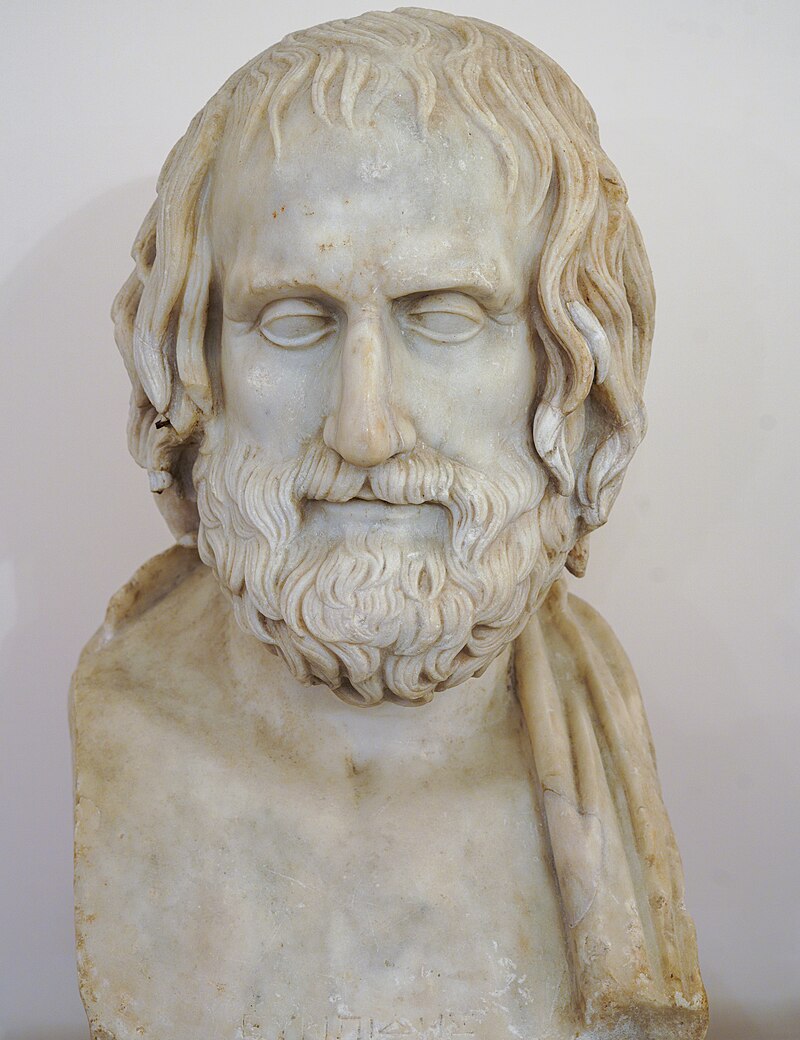
File:Euripide_(cropped).jpg · Wikimedia Commons · See Wikimedia Commons
Euripides
Sign in to saveEuripides (; , ; ) was a Greek tragedian of classical Athens. Along with Aeschylus and Sophocles, he is one of the three authors of Greek tragedy for whom any plays have survived in full. Some ancient scholars attributed ninety-five plays to him, but the Suda says it was ninety-two at most. Nineteen plays attributed to Euripides have survived more or less complete, although one of these (Rhesus) is often considered not to be genuinely his work. Many fragments (some of them substantial) survive from most of his other plays. More of his plays have survived intact than those of Aeschylus and Soph
OverviewAI-generated
Euripides (Εὐριπίδης) was a male playwright, writer, poet, and philosopher from Classical Athens. A member of the deme Phlya, he worked in the fields of drama, poetry, and philosophy, primarily writing in Ancient Greek. His notable works include Alcestis, Andromache, The Bacchae, and Hecuba, with his genre defined as Greek tragedy.
He was born on Salamis Island, Greece, and died in Pella, Macedonia. His writings are described by sources such as the Encyclopædia Britannica 11th edition, the Brockhaus and Efron Encyclopedic Dictionary, Pauly–Wissowa, and The Nuttall Encyclopædia. Additional works associated with him include Euripides' Iphigenia among the Taurians and Medea.
Synthesized by Vinony from 19 facts across 4 sources: Wikidata, Open Library, Europeana Sparql, TMDb. Generated from structured data (not the Wikipedia text) and checked against those facts — may still contain errors.
Person · Open Library
- Works
- 212
Top works
- Euripides' Iphigenia among the Taurians
- Bacchae (SparkNotes Literature Guide)
- Medea (SparkNotes Literature Guide)
- Roman Roads Reader : Selections from Greek Drama and Lyric
- Forensic Mental Health Assessment : A Casebook
via Open Library + Wikidata
Film & TV
Salamis Island, Greece
Euripides (c. 480 – c. 406 BC) was a Greek tragedian of classical Athens. Along with Aeschylus and Sophocles, he is one of the three ancient Greek tragedians for whom any plays have survived in full. Some ancient scholars attributed ninety-five plays to him, but the Suda says it was ninety-two at most. Of these, eighteen or nineteen have survived more or less complete (Rhesus is suspect). There…
via TMDB
Key facts
- Person.name
- Euripides
- Person.image
- File:Euripide (cropped).jpg
- Person.caption
- Bust of Euripides
- Person.birth_place
- Salamis
- Person.death_date
- (aged approximately 74)
- Person.death_place
- Macedon
- Person.occupation
- Playwright
- Person.parents
- Mnesarchus Cleito
via Wikipedia infobox
Wikidata facts
- Instance of
- human
- Gender
- male
- Citizenship
- Classical Athens
- Place of birth
- Salamis Island
- Place of death
- Pella
- Occupation
- philosopher
- Languages spoken
- Ancient Greek
- Notable work
- The Phoenician Women
- Field of work
- philosophy
- Genre
- Greek tragedy
- Image
- Euripides Pio-Clementino Inv302.jpg
Show 13 more facts
- topic's main category
- Category:Euripides
- Commons category
- Euripides
- Commons Creator page
- Euripides
- described by source
- New International Encyclopedia
- member of the deme
- Phlya
- name in native language
- Εὐριπίδης
- writing language
- Ancient Greek
- date of birth
- 0480-09-20
- date of death
- 0405-00-00
- on focus list of Wikimedia project
- Wikipedia:Vital articles/Level/4
- P12674
- Oscar Schneider
- P12749
- Puidoux
- P13311
- Marc Márquez
Sources (3)
via Wikidata · CC0
Works in European collections
35 objects attributed to Euripides, held across European museums, libraries & archives · via Europeana
![Euripidu Tragōdiōn hosa sōzontai. [1]](https://api.europeana.eu/thumbnail/v2/url.json?uri=http%3A%2F%2Fwww.bsb-muenchen-digital.de%2Fweb1021%2Fbsb10214997%2Fimages%2Fbsb10214997_00031.jpg&type=IMAGE)
Euripidu Tragōdiōn hosa sōzontai. [1]

Ausgewählte Tragödien des Euripides. 1, Medea

Choirs and melodramas on the tragedy of Hippolytus

Euripidis Tragoediae Quatuor Hecuba Phoenix

Euripides :with an English commentary ; in three volumes. 1

Euripidis Tragoediae. 2,3, Continens Herculem furentem
Euripidou sozomena apanta Euripidis quae extant omnia
Euripidou Rhesos

"The dramas of the Euripides. 11, Andromache

Electra

Hecuba. Orestes. Phoenissae. Medea. Hippolytus. Alcestis. Andromache. Supplices. Iphigenia in Aulide

Iphigenia in Tauris. Rhesus. Troades. Bacchae. Cyclops. Heraclidae. Helena. Ion. Hercules Furens. Electra. Danae

Euripides' Werke :griechisch mit metrischer Uebersetzung und prüfenden und erklärenden Anmerkungen. 2, Trojerinnnen

Hecuba :ad fidem manuscriptorum emendata et brevibus notis ... instructa
![Euripidu Hippolytos Stephanēphoros. [1]](https://api.europeana.eu/thumbnail/v2/url.json?uri=http%3A%2F%2Fwww.bsb-muenchen-digital.de%2Fweb1021%2Fbsb10215025%2Fimages%2Fbsb10215025_00005.jpg&type=IMAGE)
Euripidu Hippolytos Stephanēphoros. [1]

Euripides' Werke :griechisch mit metrischer Uebersetzung und prüfenden und erklärenden Anmerkungen. 10, Alkestis

Euripidis Tragoediae. Vol. 2. Sect. 1, Helena

Euripidis Tragoediae. 1
Parma, Palatine Library, Parmense, Ms. Parm. 154

Euripidis Supplices et Iphigenia in Aulide et in Tauris. 2, Euripidis Iphigenia in Aulide et in Tauris : cum indicibus necessariis ; Accedunt: P. Emsleii annotationes in Euripidis Hecubam Herculem furentem et Sophoclis Aiacem

Opera omnia. 1. Hecuba, Orestes
![Aristologia Evripidea Graecolatina. Hoc est, quicquid in Euripide, Tragicorum principe, memorabile est: Sententiae grauissimae, & doctrinae de totius uitae honesta & utili gubernatione, de omnibus quae in hominum uita accidere possunt :cum occasione singulorum dictorum, & accomodatione eorundem, ad marginem Graecum fideliter adscripta. Argumenta quoque singulis Tragoedijs, secundum historiae & fabularum ordinem, praemissa sunt. Acceßit quoq[ue] rerum & uerborum Index copiosus = Aristologia Eripideiē ellēnikolatinē](https://api.europeana.eu/thumbnail/v2/url.json?uri=http%3A%2F%2Fwww.bsb-muenchen-digital.de%2Fweb1121%2Fbsb11217247%2Fimages%2Fbsb11217247_00005.jpg&type=IMAGE)
Aristologia Evripidea Graecolatina. Hoc est, quicquid in Euripide, Tragicorum principe, memorabile est: Sententiae grauissimae, & doctrinae de totius uitae honesta & utili gubernatione, de omnibus quae in hominum uita accidere possunt :cum occasione singulorum dictorum, & accomodatione eorundem, ad marginem Graecum fideliter adscripta. Argumenta quoque singulis Tragoedijs, secundum historiae & fabularum ordinem, praemissa sunt. Acceßit quoq[ue] rerum & uerborum Index copiosus = Aristologia Eripideiē ellēnikolatinē

Euripidis Tragoediae quae exstant. 2
Hippolytos uwieńczony
Bachantki

Opera omnia. 2. Phoenissae, Medea

Euripides' Werke :griechisch mit metrischer Uebersetzung und prüfenden und erklärenden Anmerkungen. 16, Andromache

Portrait of Euripides.
Medea
Ifigenia w Aulidzie

Euripides

Euripides

Euripides

Euripides

Euripides
~43 min read
Encyclopedic overview
19 sectionsContents
- Life
- A fabled life
- A comic life
- A tragedian's life
- Work
- Language
- Reception
- Texts
- Transmission
- Chronology
- Extant plays
- Lost and fragmentary plays
- The "New Euripides"
- Notes
- References
- Citations
- Bibliography
- Further reading
- External links
Euripides (; , ; ) was a Greek tragedian of classical Athens. Along with Aeschylus and Sophocles, he is one of the three authors of Greek tragedy for whom any plays have survived in full. Some ancient scholars attributed ninety-five plays to him, but the Suda says it was ninety-two at most. Nineteen plays attributed to Euripides have survived more or less complete, although one of these (Rhesus) is often considered not to be genuinely his work. Many fragments (some of them substantial) survive from most of his other plays. More of his plays have survived intact than those of Aeschylus and Sophocles together, partly because his popularity grew as theirs declined: he became, in the Hellenistic Age, a cornerstone of ancient literary education, along with Homer, Demosthenes, and Menander.
Euripides is identified with theatrical innovations that have profoundly influenced drama down to modern times, especially in the representation of traditional, mythical heroes as ordinary people in extraordinary circumstances. This new approach led him to pioneer developments that later writers adapted to comedy, some of which are characteristic of romance. He was referred to by Aristotle as "the most tragic of poets", probably in reference to a perceived preference for unhappy endings, but Aristotle's remark is seen by Bernard Knox as having wider relevance, since "in his representation of human suffering Euripides pushes to the limits of what an audience can stand; some of his scenes are almost unbearable." Focusing on the inner lives and motives of his characters in a way previously unknown, Euripides was "the creator of ... that cage which is the theatre of Shakespeare's Othello, Racine's Phèdre, of Ibsen and Strindberg," in which "imprisoned men and women destroy each other by the intensity of their loves and hates". But he was also the literary ancestor of comic dramatists as diverse as Menander and George Bernard Shaw.
Excerpted from Wikipedia’s “Euripides” article, available under the CC BY-SA 4.0 licence.
Gallery (20)
Available in 102 languages
- Español
- Français
- Deutsch
- 中文
- 日本語
- Русский
- Português
- Italiano
- العربية
- Afrikaans
- Albanian
- Albanian
- Aragonese
- Armenian
- Asturian
- Azerbaijani
- Bahasa Indonesia
- Bangla
Show 83 more
- Bashkir
- Basque
- be_x_old
- Belarusian
- Bosnian
- Breton
- Bulgarian
- Burmese
- Catalan
- Central Kurdish
- Chuvash
- Croatian
- Czech
- Danish
- Egyptian Arabic
- Esperanto
- Estonian
- Fiji Hindi
- Filipino
- Finnish
- Galician
- Georgian
- Goan Konkani
- Greek
- Haitian Creole
- Hausa
- Hebrew
- Hungarian
- hyw
- Icelandic
- Ido
- Interlingua
- Irish
- Kazakh
- Kurdish
- Kyrgyz
- Latin
- Latvian
- Lingua Franca Nova
- Lithuanian
- Macedonian
- Malagasy
- Malay
- Malayalam
- Marathi
- Mazanderani
- Mingrelian
- Mongolian
- Neapolitan
- Nederlands
- Newari
- Norwegian
- Norwegian Nynorsk
- Occitan
- Polski
- Punjabi
- Romanian
- Saterland Frisian
- Serbian
- Serbian (Latin)
- Sicilian
- simple
- Sindhi
- Slovak
- Slovenian
- Svenska
- Swahili
- Tamil
- Tiếng Việt
- Türkçe
- Ukrainian
- Urdu
- Uzbek
- Waray
- Welsh
- West Flemish
- Western Frisian
- Western Panjabi
- Wu Chinese
- zh_yue
- فارسی
- ไทย
- 한국어
via Wikidata sitelinks · CC0