Described at
We’ve Been Wrong Before: The Expanding Earth Theory
Did the continents spread apart because the planet itself is expanding? No, but a lot of good scientists used to think so.
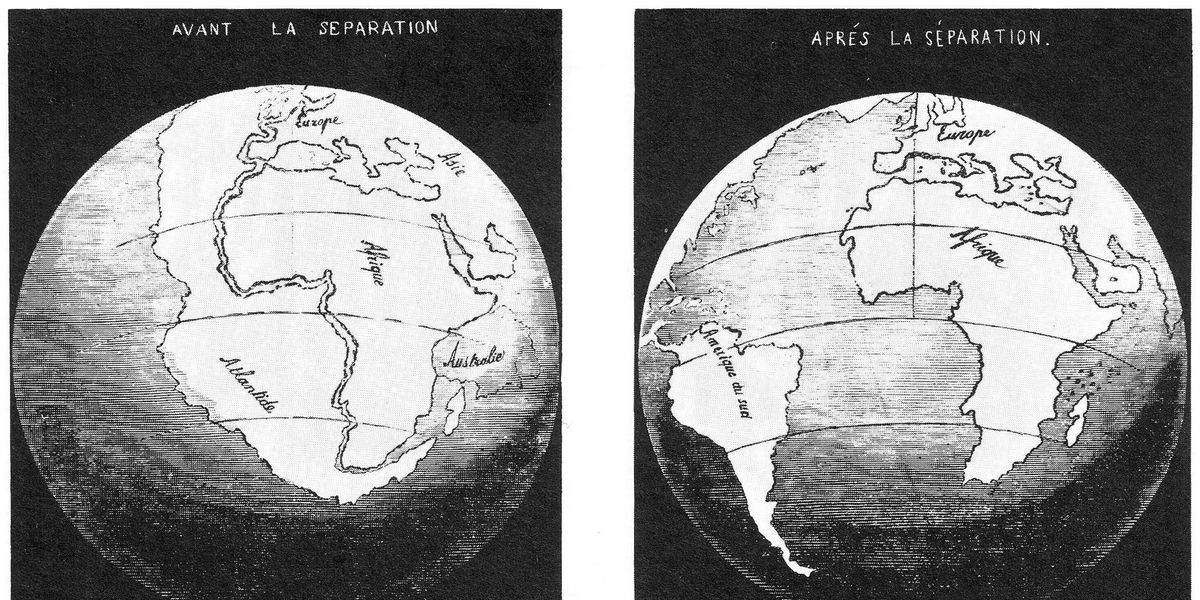
popularmechanics.com →“We’ve Been Wrong Before” is Popular Mechanics' encyclopedia of scientific ideas that sounded good at the time but didn't quite pan out. Today: The Expanding Earth Theory, which argues that the reason the continents have spread apart is that the Earth itself has been getting bigger over the years. Five centuries ago, when Europeans saw their first world maps that included the Americas, they noticed something odd: The coastlines of Africa and South America would fit together like a Jigsaw puzzle if they weren’t separated by the expanse of the Atlantic Ocean. Thinkers of the era couldn’t get over this resemblance. In 1620, the English natural philosopher Francis Bacon wrote that the matching coasts were “more than a curiosity," but couldn’t figure any explanation. The interest in this curiosity would lead to one of geology’s most dubious ideas: the Expanding Earth theory. The theory claimed that millions of years ago, our planet was only about 60 percent of its current size and that the entire surface of this pint-sized globe was blanketed by land. There were no oceans. Then, as the dwarf Earth expanded, the continental shell broke apart. The seas formed in the gaps between the continents. Today, following a 20th century golden age of marine science, scientists understand how shifting plates have shifted the continents over the course of Earth’s history. But up until the point plate tectonics became widely accepted, the Expanding Earth theory was a popular explanation for the processes that shaped the Earth. Even respected scientists like Charles Darwin and Nikola Tesla flirted with the idea. The first scholarly attempts to explain the puzzle-piece configuration of the continents invoked the hand of God. In 1668, a French monk by the name of François Placet suggested that America and Africa separated when the lost island of Atlantis was destroyed by the biblical flood and sank into the depths, creating the Atlantic Ocean. In the 17th and 18th centuries, many Europeans thought the planet was shaped by a series of biblical catastrophes, and the wrath of God remained a trendy explanation for the position of the continents. Before the 20th century, only two prominent scientists in the West even entertained the idea of mobile continents, and both credited a catastrophic event. The first was Abraham Ortelius, the Flemish cartographer credited with inventing the modern Atlas. In 1596, Ortelius suggested the continents may have traveled to their current positions when the Americas were "torn away from Europe and Africa.” The in 1858, the French geographer Antonio Snider-Pellegrini also suggested the continents moved apart laterally, again pointing to the biblical flood as the main instigator. In 1858, Snider-Pellegrini made these two maps. They depict his interpretation of how the American and African continents may once have fit together before becoming separated. The first scientific theory suggesting that continents could drift on their own finally came in 1912, from the German geophysicist Alfred Wegener. He proposed the Earth’s disparate lands once fit together as a single ancient supercontinent he called Pangea, a Greek word meaning “all lands.” He believed Pangea was surrounded by a single body of water—the Panthalassa—and the continents maneuvered to their current positions by floating through the sea like icebergs. As evidence, he found fossils of identical plants and animals on continents now separated by oceans. Wegener’s theory of continental drift represented a new way of thinking about our world, and today we know he was basically on the right track. But like many novel scientific ideas, his theory was met with ridicule. (It didn’t help that Wegener was a meteorologist and not a geologist, allowing others to dismiss him through snobbery.) At the time, scientists were more inclined to believe the Earth’s crust was moving up and down than side to side. In fact, through much of the 1800s, the prevailing idea was that
Excerpt from a page describing this subject · 25,807 chars · not written by Vinony
Wikidata facts
- Instance of
- superseded scientific theory
- Image
- Vom wachsenden Erdball.jpg
Show 2 more facts
- Commons category
- Expanding Earth
- described at URL
- www.hist-geo-space-sci.net/5/135/2014
Sources (1)
via Wikidata · CC0