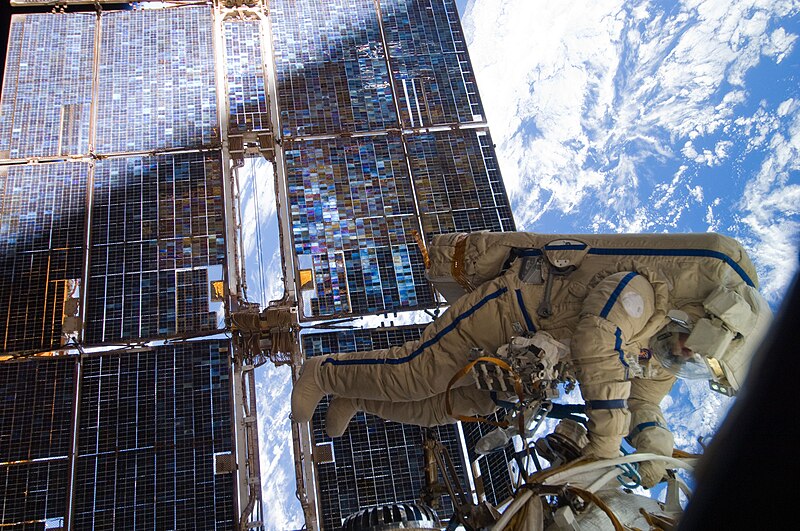
File:Volkov_during_Russian_EVA28.jpg · Wikimedia Commons · See Wikimedia Commons
extra-vehicular activity
Sign in to saveAlso known as extravehicluar activity, spacewalk, space walk, EVA
activity done by an astronaut outside a spacecraft
Research
41 papers- Metabolic assessments during extra-vehicular activity.Acta astronautica · 1998
- Managing space motion sickness.Journal of vestibular research : equilibrium & orientation · 1998
- Adult Female Sleep During Hypoxic Bed Rest.Frontiers in neuroscience · 2022
- Patent foramen ovale: a review of associated conditions and the impact of physiological size.Journal of the American College of Cardiology · 2001
- [Hook-up in space of two vehicles, and extra--vehicular activity: premise for the making of an earth-orbiting laboratory].Minerva medica · 1969
via PubMed
Wikidata facts
- Subclass of
- intentional human activity
- Location
- outer space
- Image
- Nicole Stott participates in the STS-128 mission's first spacewalk.jpg
Show 4 more facts
- Commons category
- Extra-vehicular activity
- topic's main category
- Category:Extravehicular activity
- hashtag
- spacewalk
- different from
- ethylene-vinyl acetate
Sources (2)
via Wikidata · CC0
~20 min read
Encyclopedic overview
Cosmonaut Sergey Volkov works outside the International Space Station on August 3, 2011. Stephen Robinson riding the Canadarm2 while conducting the first in-flight repair of the Space Shuttle during STS-114 on August 3, 2005. The landmass in the backdrop is the Bari region of Somalia. Extravehicular activity (EVA) is any activity performed by an astronaut in outer space outside of a spacecraft. This includes spacewalks, lunar or planetary surface exploration (commonly known as moonwalks), and stand-up EVAs (SEVAs) where astronauts stand through an open hatch without fully leaving the spacecraft. EVAs have been conducted by the Soviet Union/Russia, the United States, and China, with astronauts from Canada, Japan, the United Arab Emirates, and the European Space Agency also participating in EVAs conducted by those nations. Since there is no atmosphere in space, the astronaut is completely dependent on the space suit for environmental support.
On March 18, 1965, Alexei Leonov conducted the first spacewalk, lasting 12 minutes and 9 seconds during the Voskhod 2 mission. Neil Armstrong performed the first moonwalk on July 20, 1969, during the Apollo 11 mission, lasting 2 hours and 31 minutes. Svetlana Savitskaya became the first woman to conduct a spacewalk in 1984, spending 3 hours and 35 minutes outside the Salyut 7 space station. Astronauts on the last three crewed lunar landing missions, Apollo 15, 16, and 17, also performed deep space EVAs to retrieve film canisters. In 1973, American astronauts Pete Conrad, Joseph Kerwin, and Paul Weitz conducted an EVA to repair launch damage to Skylab, the United States' first space station.
Excerpted from Wikipedia’s “extra-vehicular activity” article, available under the CC BY-SA 4.0 licence.