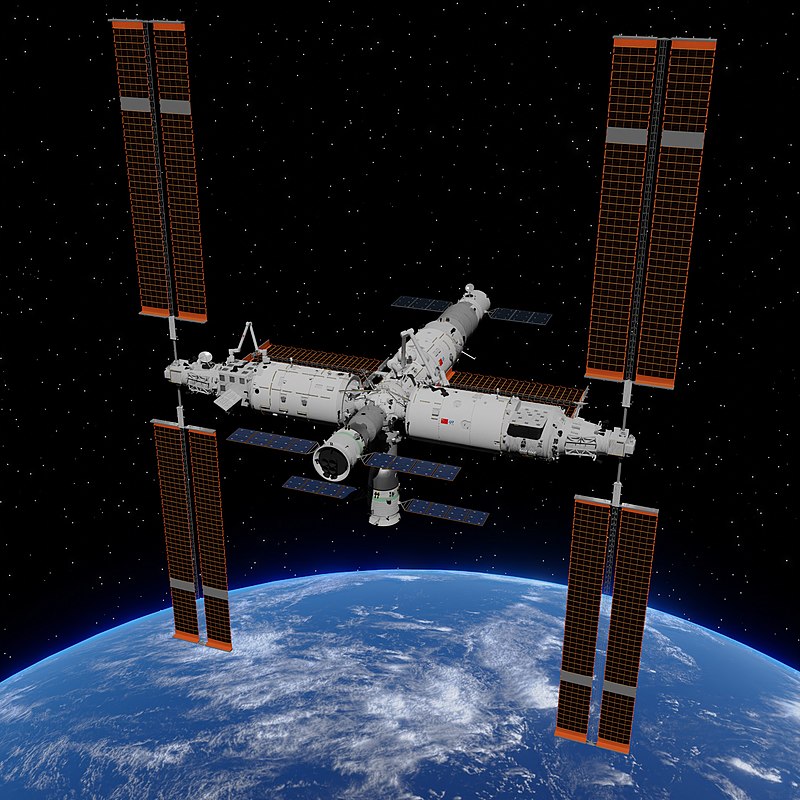
Tiangong space station
Also known as CSS, TG, China Space Station, Tiangong
Chinese space station in low Earth orbit
Key facts
- Crew
- Size: 3 Current expedition : 11 ( Shenzhou 23 ) Current commander: Zhu Yangzhu
- Launch
- 29 April 2021 ( Tianhe ) 24 July 2022 ( Wentian ) 31 October 2022 ( Mengtian )
- Launch pad
- Wenchang , LC-101
- Mass
- ~100,000 kg (220,000 lb)
- Length
- ~55.6 m (182 ft)
- Diameter
- ~39 m (128 ft)
- Pressurised volume
- 340 m (12,000 ft ) Habitable: 122 m (4,310 ft )
- Periapsis altitude
- 386.4 km (240.1 mi)
- Apoapsis altitude
- 391.8 km (243.5 mi)
- Orbital inclination
- 41.47°
- Orbital speed
- 7.67 km/s (27,600 km/h; 17,200 mph)
- Orbital period
- 92.3 minutes
Article
The Tiangong space station (Chinese: 天宫; pinyin: Tiāngōng; lit. 'Heavenly Palace'), officially the China Space Station (CSS; Chinese: 中国空间站; pinyin: Zhōngguó kōngjiānzhàn), is China's first permanently crewed space station, in low Earth orbit since 2021. Operated by the China Manned Space Agency (CMSA), it is China's third space station, under the Tiangong subprogram of the China Manned Space Program. A space laboratory, it hosts experiments on bioastronautics, microgravity, materials science and space technology. Crews of three travel aboard the Shenzhou spacecraft for missions of about six months, with temporary crew sizes of six during handovers. Cargo missions use the Tianzhou spacecraft. It is one of two operational space stations, alongside the International Space Station (ISS).
When China formally requested to join the ISS program in 2007, Roscosmos and the European Space Agency (ESA) supported cooperation with China, but the Wolf Amendment, enacted by the United States since 2011, prohibited Chinese participation. That same year, China launched Tiangong-1, gaining rendezvous and docking experience. In 2016, Tiangong-2 developed longer-term life support systems, and autonomous docking and refueling via Tianzhou. The current station has supported experiments involving researchers from 17 countries. It hosted the first astronaut from Hong Kong, and China is training astronauts from Macau and Pakistan.