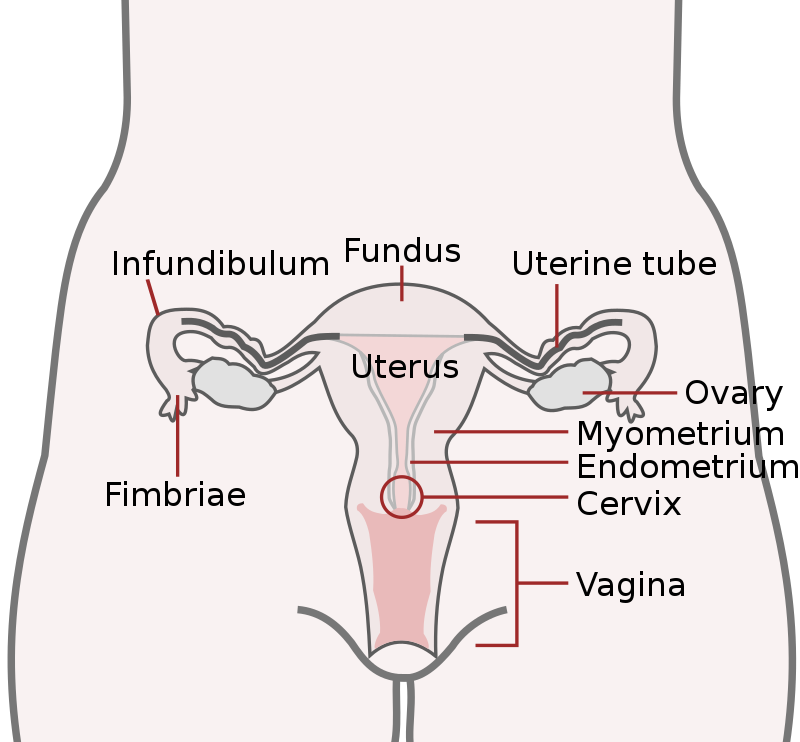
File:Basic_Female_Reproductive_System_(English).svg · Wikimedia Commons · See Wikimedia Commons
fallopian tube
Sign in to saveAlso known as salpinx, salpinges, vejcovody, uterine tube
part of the female reproductive organs
The fallopian tube is a narrow tube in the female reproductive system that connects the ovary to the uterus. It plays a crucial role in reproduction by providing the pathway where an egg travels after being released from the ovary, and where it can meet sperm for fertilization.
AI-generated from the Wikipedia summary — may contain errors.
Research
24,425 papers- Fallopian tube endometriosis: clinical implications.Fertility and sterility · 2020Garcia-Velasco JADOI: 10.1016/j.fertnstert.2020.07.045
- Interventional Radiologist's Approach to Fallopian Tube Recanalization.ReviewTechniques in vascular and interventional radiology · 2021Kohi MPDOI: 10.1016/j.tvir.2021.100736
- Fallopian Tube Dermoid Tumor.Journal of minimally invasive gynecology · 2024Horton T, Dinh TDOI: 10.1016/j.jmig.2023.09.008
- Fallopian tube torsion: laparoscopic evaluation and treatment of a rare gynecological entity.ReviewThe Journal of the American Board of Family Practice · 2001Krissi H, Shalev J, Bar-Hava I et al.
- Noninflammatory fallopian tube pathology in children.ReviewPediatric radiology · 2008Merlini L, Anooshiravani M, Vunda A et al.DOI: 10.1007/s00247-008-1034-3
- Fallopian tube microbiota: evidence beyond DNA.Future microbiology · 2018Pelzer ES, Willner D, Huygens F et al.DOI: 10.2217/fmb-2018-0118
- Adenomatoid tumor of the fallopian tube.Asian journal of surgery · 2022Zhang W, Luo T, Yang L et al.DOI: 10.1016/j.asjsur.2021.11.045
- [Pseudocarcinomatous hyperplasia of the fallopian tube: a clinicopathological analysis of sixteen cases].Zhonghua bing li xue za zhi = Chinese journal of pathology · 2024Sun YH, Chen XC, Xiao YP et al.DOI: 10.3760/cma.j.cn112151-20240204-00084
via PubMed
Wikidata facts
- Named after
- Gabriele Falloppio
- Image
- Normal Fallopian Tube, Human.jpg
Show 4 more facts
- Commons category
- Fallopian tube
- anatomical location
- pelvic cavity
- sexually homologous with
- appendix of testis
- NCI Thesaurus ID
- C12403
Sources (8)
via Wikidata · CC0
~17 min read
Encyclopedic overview
The fallopian tubes, also known as uterine tubes, oviducts or salpinges (sg.: salpinx), are paired tubular sex organs in the human female body that stretch from the ovaries to the uterus. The fallopian tubes are part of the female reproductive system. In other vertebrates, they are only called oviducts.
Each tube is a muscular hollow organ that is on average between 10 and 14 cm (3.9 and 5.5 in) in length, with an external diameter of 1 cm (0.39 in). It has four described parts: the intramural part, isthmus, ampulla, and infundibulum with associated fimbriae. Each tube has two openings: a proximal opening nearest to the uterus, and a distal opening nearest to the ovary. The fallopian tubes are held in place by the mesosalpinx, a part of the broad ligament mesentery that wraps around the tubes. Another part of the broad ligament, the mesovarium suspends the ovaries in place.
Excerpted from Wikipedia’s “fallopian tube” article, available under the CC BY-SA 4.0 licence.
Gallery (10)
Available in 76 languages
- Español
- Français
- Deutsch
- 中文
- 日本語
- Русский
- Português
- Italiano
- العربية
- हिन्दी
- Afrikaans
- Aragonese
- Armenian
- Azerbaijani
- Bahasa Indonesia
- Bangla
- Basque
- be_x_old
Show 57 more
- Belarusian
- Bosnian
- Breton
- Bulgarian
- Catalan
- Central Kurdish
- Croatian
- Czech
- Danish
- Divehi
- Esperanto
- Estonian
- Filipino
- Finnish
- Galician
- Greek
- Hebrew
- Hungarian
- Igbo
- Irish
- Kashmiri
- Kazakh
- Kurdish
- Latin
- Latvian
- Lithuanian
- Macedonian
- Malay
- Malayalam
- Marathi
- Nederlands
- Nepali
- Norwegian
- Norwegian Nynorsk
- Polski
- Romanian
- Scots
- Serbian
- Serbian (Latin)
- simple
- Slovak
- Slovenian
- Sundanese
- Svenska
- Tamil
- Tatar
- Telugu
- Tigrinya
- Türkçe
- Ukrainian
- Uyghur
- Uzbek
- Welsh
- Wu Chinese
- zh_yue
- فارسی
- 한국어
via Wikidata sitelinks · CC0