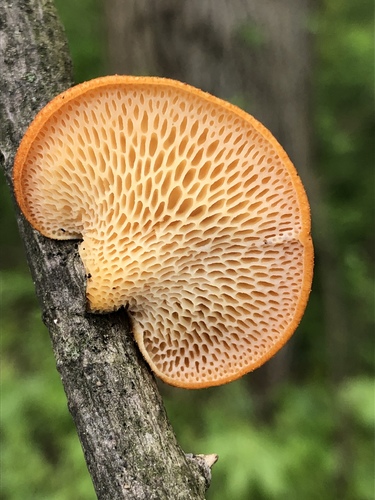
(c) Julie Travaglini, niektoré práva vyhradené (CC BY), uploaded by Julie Travaglini · cc-by
Favolus
Sign in to saveFavolus, or honeycomb fungus, is a genus of fungi in the family Polyporaceae. The fruit bodies of Favolus species are fleshy with radially arranged pores on the underside of the cap that are angular and deeply pitted, somewhat resembling a honeycomb.
Species
hexagonal-pored polypore
GENUS
- KingdomFungi
- PhylumBasidiomycota
- ClassAgaricomycetes
- OrderPolyporales
- FamilyPolyporaceae
via GBIF
Museum specimens
- Specimen records
- 556
- With media
- 272
- Family
- Polyporaceae
- Collections
- UJAT, INSTITUTO NACIONAL DE PESQUISAS DA AMAZÔNIA (INPA), LSUM, FH
- Recorded in
- Mexico, Brasil, United States
Wikidata facts
- Instance of
- taxon
- Parent taxon
- Polyporaceae
- Image
- Neotriplax lewisii01.jpg
Show 4 more facts
- Commons category
- Favolus
- taxon name
- Favolus
- taxon rank
- genus
- taxon author citation
- Fr.
Sources (2)
via Wikidata · CC0
~5 min read
Encyclopedic overview
4 sectionsContents
- Taxonomy
- Description
- Species
- References
Favolus, or honeycomb fungus, is a genus of fungi in the family Polyporaceae. The fruit bodies of Favolus species are fleshy with radially arranged pores on the underside of the cap that are angular and deeply pitted, somewhat resembling a honeycomb.
==Taxonomy== The naturalist Palisot de Beauvois was the first to use the name Favolus in his 1805 work ''Flore d'Oware et de Benin, en Afrique. His type species was Favolus hirtus, a fungus first collected in Africa. Elias Fries used the name as a subgenus of Polyporus in 1821. Seven years later, Fries used the name Favolus for a different genus, with the tropical species F. brasiliensis'' as the type. Fries's concept of the genus was later accepted as it was published in one of the sanctioning works of mycology. Favolus hirtus is now called Trametes hirta, and Beauvois' concept of Favolus is placed in synonymy with Trametes. The generic name Favolus is derived from the Latin favus meaning honeycomb.
Excerpted from Wikipedia’s “Favolus” article, available under the CC BY-SA 4.0 licence.