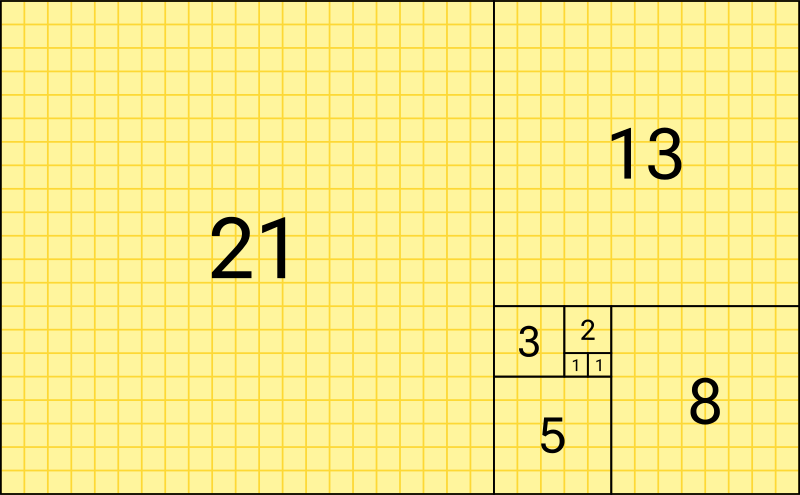
File:Fibonacci_Squares.svg · Wikimedia Commons · See Wikimedia Commons
The Fibonacci sequence is an infinite list of numbers where each number is the sum of the two numbers before it, starting with 0 and 1 (so it goes 0, 1, 1, 2, 3, 5, 8, 13, and so on). These numbers show up surprisingly often in nature and mathematics, making them interesting to mathematicians and scientists who study patterns in the world around us.
AI-generated from the Wikipedia summary — may contain errors.
Wikidata facts
- Subclass of
- element
- Part of
- Fibonacci sequence
- Named after
- Fibonacci
- Image
- Fibonacci orchid.jpg
Show 5 more facts
- Commons category
- Fibonacci numbers
- topic's main category
- Category:Fibonacci numbers
- Stack Exchange tag
- math.stackexchange.com/tags/fibonacci-numbers
- on focus list of Wikimedia project
- Wikipedia:Vital articles/Level/4
- maintained by WikiProject
- WikiProject Mathematics
Sources (2)
via Wikidata · CC0
~40 min read
Encyclopedic overview
In mathematics, the Fibonacci sequence is a sequence in which each element is the sum of the two elements that precede it. Numbers that are part of the Fibonacci sequence are known as Fibonacci numbers, commonly denoted Fn . The initial elements of the sequence are F1 = 1 and F2 = 1, though many authors also include a zeroth element F0 = 0. Starting from F0, the sequence begins
0, 1, 1, 2, 3, 5, 8, 13, 21, 34, 55, 89, 144, ... (sequence A000045 in the OEIS)
Excerpted from Wikipedia’s “Fibonacci number” article, available under the CC BY-SA 4.0 licence.
Gallery (12)
Available in 68 languages
- Español
- Français
- Deutsch
- 中文
- 日本語
- Русский
- Italiano
- العربية
- हिन्दी
- Albanian
- Armenian
- Azerbaijani
- Bahasa Indonesia
- Bashkir
- Basque
- Belarusian
- Bosnian
- Bulgarian
Show 49 more
- Catalan
- Central Kurdish
- Church Slavic
- Chuvash
- Croatian
- Danish
- Esperanto
- Estonian
- Filipino
- Finnish
- fiu_vro
- Gujarati
- Hebrew
- Hungarian
- hyw
- Icelandic
- Kara-Kalpak
- Kazakh
- Latin
- Latvian
- Malay
- Malayalam
- Marathi
- Mongolian
- Nederlands
- Norwegian
- Pashto
- Punjabi
- Romanian
- Serbian
- Serbian (Latin)
- simple
- Sinhala
- Slovenian
- Svenska
- Tamil
- Telugu
- Tiếng Việt
- Türkçe
- Ukrainian
- Uzbek
- Waray
- Welsh
- wikifunctions
- Wu Chinese
- zh_yue
- فارسی
- ไทย
- 한국어
via Wikidata sitelinks · CC0