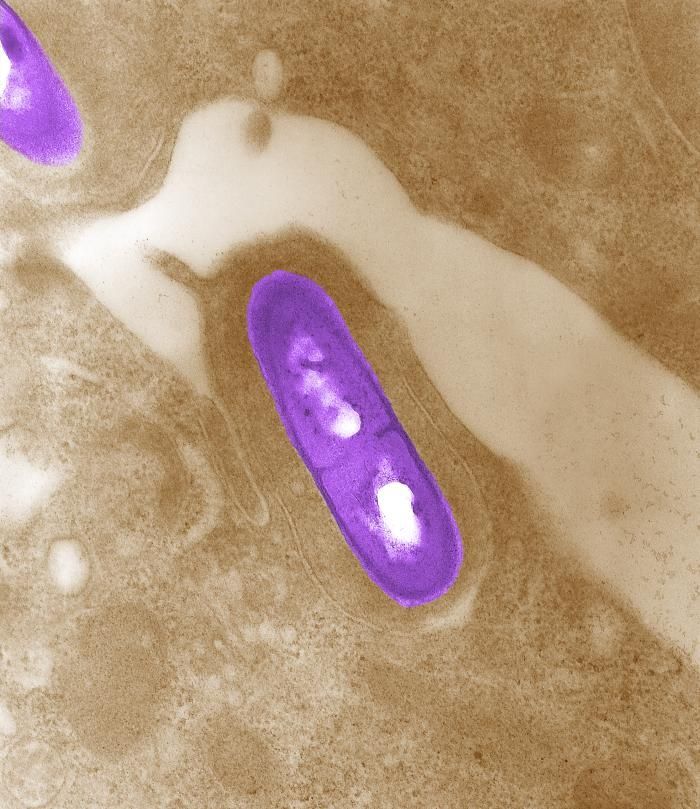
Encyclopedia of Life · EOL (see source)
Species
ファーミキューテス門
PHYLUM
- KingdomBacteria
- PhylumFirmicutes
Die Firmicutes (lat. firmus „stark“, cutis „Haut“) bilden einen artenreichen Stamm innerhalb der Domäne der Bakterien. Die Firmicutes bilden zusammen mit den Actinobacteria die große Gruppe der meist Gram-positiven Bakterien. Sie unterscheiden sich von den Actinobakterien jedoch unter anderem durch ihren niedrigeren GC-Gehalt. Die Gram-Färbung dient dazu, Bakterien nach dem Aufbau ihrer Zellwand zu unterscheiden. Der Test fällt positiv aus, wenn die auf der Membran aufgelagerte Mureinhülle dickschichtig ist. Wenn er negativ ausfällt, handelt es sich um eine dünnschichtige Mureinhülle der noch eine zweite Membran aufgelagert ist. Bei der Mehrheit der Firmicutes handelt es sich also um gram-positive Bakterien, Ausnahmen bilden z. B. die Klassen Negativicutes, Erysipelotrichia sowie die Ordnung Halanaerobiales (zählt zu der Klasse Clostridia). Viele können widerstandsfähige Endosporen bilden, einige leben phototroph, manche Arten syntroph, andere spielen als Krankheitserreger eine wichtige Rolle. Heute zählt man zu den Firmicutes folgende Klassen Bacilli (überwiegend aerob) Clostridia (anaerob bis aerotolerant) Erysipelotrichia Negativicutes (Gram-negative Vertreter) Thermolithobacter
via GBIF
Research
434,868 papers- The Firmicutes/Bacteroidetes Ratio: A Relevant Marker of Gut Dysbiosis in Obese Patients?Nutrients · 2020
- Gut firmicutes: Relationship with dietary fiber and role in host homeostasis.Critical reviews in food science and nutrition · 2023
- Role of the normal gut microbiota.World journal of gastroenterology · 2015
- One or two membranes? Diderm Firmicutes challenge the Gram-positive/Gram-negative divide.Molecular microbiology · 2020
- The Role of Bacillithiol in Gram-Positive Firmicutes.Antioxidants & redox signaling · 2018
via PubMed
Described at

Snug with your bugs? How microbes control your sleep - BBC Future
Emerging evidence suggests the bacteria living in your gut and mouth influence how you sleep at night. Scientists want to use them to help you rest better.
bbc.co.uk →Scientists want to use the bacteria living in your gut and mouth to help you sleep better at night. As you lie in bed tonight, your body will be a teeming mass of activity. Across almost every inch of you – and inside you too – billions of tiny organisms are writhing and jostling for space. But if that horrifying thought is likely to keep you up at night, consider this: they might also help you get a better night's sleep. And tantalisingly, it could offer new ways of tackling sleep-related conditions caused by a disrupted body clock, described by sleep scientists as circadian rhythms. While many people currently rely on sleeping pills to quell persistent insomnia, the future might see friendly bacteria deployed to help us nod off, and even address obstructive sleep apnoea, a condition in which people struggle to breathe normally while asleep. It would bring new meaning to the term "sleep hygiene ". "The predominant theory for a long time has been that having sleep disorders is disruptive to our microbiomes ," says Jennifer Martin, a University of California Los Angeles professor of medicine and board member of the American Academy of Sleep Medicine. "But some of the evidence we're seeing now indicates that it's probably a relationship that goes in both directions." Plus, people with social jetlag – where their sleep patterns during the working week and weekend vary enormously – had significantly different gut microbiomes to those whose sleep patterns did not vary much, according to data analysed by UK health-tech company Zoe . "Circadian rhythm disruption occurs in people who stay up later and sleep in on the weekends, those who work long hours, like first responders, police and security, paramedics and the military, and in people who eat too close to bedtime," says Kenneth Wright, a professor of integrative physiology at the University of Colorado Boulder in the US. "This can cause gastrointestinal disturbances and metabolic diseases, which are common for example in shift workers, and a disturbed microbiome may play a role." "Part of the theory behind this is that when you've had a bad night's sleep, the reward centres in your brain are heightened the next day, and so you seek out that quick fix," she says. "Your brain is kind of tricking you into feeling, 'Ok, I need refined carbohydrates', to get that quick burst of energy." But changing dietary patterns in response to sleep deprivation is not the whole story. Berry and her colleagues found nine species that were greater in abundance and eight that were less abundant in people with social jet lag compared to those without this variation in sleep patterns. But they found that diet appeared to only account for changes in abundance for four of these microbe species. Jaime Tartar, a professor of psychology and neuroscience at Nova Southeastern University in Florida who was not involved in the Zoe study, says she has become increasingly convinced that certain microbes play a direct role in sleep. She cites Firmicutes , one of the most dominant taxonomic groups of bacteria found in the gut. In tests where Tartar and her colleagues monitored the sleep and tested the gut microbes of 40 men, they found 15 different groups of Firmicutes bacteria that correlated with a number of sleep metrics in varying ways. "We don't have all the answers right now, but it certainly seems that some can improve sleep and others can impair sleep," she says. In some cases, sleep disruptions might actively drive shifts in these microbial populations through impairing the immune system and its ability to regulate microbes, which could in turn increase the likelihood of longer-term sleep problems. Some evidence for this comes from a series of studies involving so-called faecal transplants. In one 2024 study , scientists transplanted faeces – along with the gut microbes it contained – from humans and implanted it into the intestines of mice. Rodents who received faeces from people suffering from j
Excerpt from a page describing this subject · 20,958 chars · not written by Vinony
Wikidata facts
Show 8 more facts
- taxon rank
- phylum
- taxon name
- Firmicutes
- Commons category
- Bacillota
- topic's main category
- Category:Firmicutes
- taxon common name
- gram-positive bacteria
- LPSN URL
- lpsn.dsmz.de/phylum/firmicutes
- taxon synonym of
- Bacillota
via Wikidata · CC0
~1 min read
Encyclopedic overview
REDIRECT Bacillota
Excerpted from Wikipedia’s “Firmicutes” article, available under the CC BY-SA 4.0 licence.
Available in 33 languages
- 日本語
- Русский
- Italiano
- العربية
- हिन्दी
- Bahasa Indonesia
- Basque
- Catalan
- Croatian
- Czech
- Egyptian Arabic
- Estonian
- Finnish
- Galician
- Hebrew
- Icelandic
- Lithuanian
- Macedonian
Show 14 more
via Wikidata sitelinks · CC0