File:Flora.png · Wikimedia Commons · See Wikimedia Commons
flora
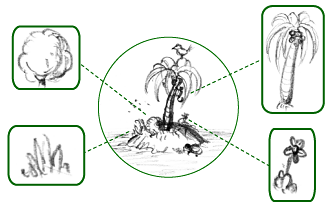
Sign in to saveframe|right|Simplified schematic of an island's flora all its plant species, highlighted in boxes Flora (: floras or florae) is all the plant life present in a particular region or time, generally the naturally occurring (indigenous) native plants. The corresponding term for animals is fauna, and for fungi, it is funga. Sometimes bacteria and fungi are also referred to as flora as in the terms gut flora or skin flora for purposes of specificity.
Flora refers to all the plant life that naturally occurs in a particular region or time period. It matters because it helps us understand and describe the plant communities that make up ecosystems and landscapes around the world.
AI-generated from the Wikipedia summary — may contain errors.
Wikidata facts
Show 6 more facts
- topic's main category
- Category:Flora
- opposite of
- fauna
- different from
- flora
- studied by
- phytogeography
- Commons category
- Flora
- facet of
- botany
via Wikidata · CC0
~4 min read
Encyclopedic overview
6 sectionsContents
- Etymology
- Classifications
- Documentation
- See also
- References
- External links
frame|right|Simplified schematic of an island's flora all its plant species, highlighted in boxes Flora (: floras or florae) is all the plant life present in a particular region or time, generally the naturally occurring (indigenous) native plants. The corresponding term for animals is fauna, and for fungi, it is funga. Sometimes bacteria and fungi are also referred to as flora as in the terms gut flora or skin flora for purposes of specificity.
==Etymology== The word "flora" comes from the Latin name of Flora, the goddess of plants, flowers, and fertility in Roman mythology. The technical term "flora" is then derived from a metonymy of this goddess at the end of the sixteenth century. It was first used in poetry to denote the natural vegetation of an area, but soon also assumed the meaning of a work cataloguing such vegetation. Moreover, "Flora" was used to refer to the flowers of an artificial garden in the seventeenth century.
Excerpted from Wikipedia’s “flora” article, available under the CC BY-SA 4.0 licence.
Gallery (9)
Available in 85 languages
- Español
- Français
- Deutsch
- 中文
- 日本語
- Русский
- Português
- Italiano
- العربية
- हिन्दी
- Albanian
- Albanian
- Armenian
- Asturian
- Azerbaijani
- Bahasa Indonesia
- Bangla
- Basque
Show 66 more
- be_x_old
- Belarusian
- Bikol
- Bosnian
- Breton
- Bulgarian
- Catalan
- Central Kurdish
- Chuvash
- Croatian
- Czech
- Danish
- Esperanto
- Estonian
- Filipino
- Finnish
- fiu_vro
- Galician
- Georgian
- Greek
- Hebrew
- Hungarian
- Icelandic
- Iloko
- Interlingue
- Kazakh
- Kurdish
- Kyrgyz
- Latin
- Latvian
- Limburgish
- Lithuanian
- Macedonian
- Malay
- Malayalam
- Mingrelian
- nah
- Nederlands
- Northern Sami
- Norwegian
- Norwegian Nynorsk
- Occitan
- Picard
- Polski
- Romanian
- Rusyn
- Serbian
- Serbian (Latin)
- simple
- Slovak
- Slovenian
- Svenska
- Tajik
- Tamil
- Tiếng Việt
- Türkçe
- Ukrainian
- Uzbek
- Waray
- Western Panjabi
- Wu Chinese
- Zaza
- zh_min_nan
- فارسی
- ไทย
- 한국어
via Wikidata sitelinks · CC0