
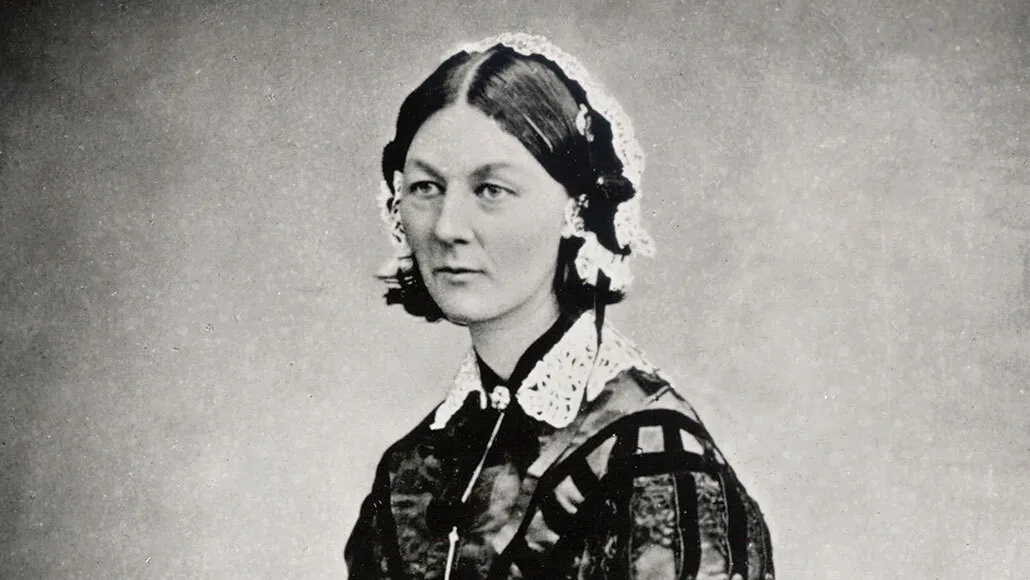
File:Florence_Nightingale_(H_Hering_NPG_x82368).jpg · Wikimedia Commons · See Wikimedia Commons
Florence Nightingale
Sign in to saveAlso known as Miss Smith, Nightingale Florence, Lady with the Lamp, Angel of Crimea
English social reformer, statistician, and founder of modern nursing (1820–1910)
OverviewAI-generated
Florence Nightingale Smith was a British nurse, statistician, writer, and politician born in Florence in 1820. She worked in the field of health care and was a member of the Royal Statistical Society. Her pseudonym was The Lady with the Lamp. She wrote in English and was an Anglican.
She died in London in 1910. Her citizenship was in the United Kingdom of Great Britain and Ireland, where she also resided. She received the Order of Merit and the Decoration of the Royal Red Cross. She had a sibling named Frances Parthenope Verney.
Her work is described by sources including The Nuttall Encyclopædia and the Encyclopædia Britannica 11th edition. Archives of her materials are held at the British Library and the Thomas Fisher Rare Book Library.
Synthesized by Vinony from 26 facts across 2 sources: Wikidata, Firecrawl. Generated from structured data (not the Wikipedia text) and checked against those facts — may still contain errors.
Described at
Florence Nightingale understood the power of visualizing science
Florence Nightingale showed simple sanitation measures could stop infectious diseases’ spread, a timely message given the ongoing coronavirus pandemic.
sciencenews.org →Victorian icon Florence Nightingale is best known as the founder of modern nursing. But Nightingale, who would have celebrated her 200th birthday on May 12, was also a statistics and data visualization pioneer who sought to illustrate that simple sanitation techniques, such as handwashing, could stop the spread of infectious diseases ( SN: 1/5/20 ). While that’s a particularly timely message given the ongoing coronavirus pandemic, it wasn’t one widely known, or even believed, in the mid-1800s. Nightingale’s best-known diagram is a variation of a pie chart known as a rose, or polar area, chart. In that diagram, she showed that poor sanitation, not battle wounds, lay behind most English soldiers’ deaths during the Crimean War in the 1850s and that such deaths were avoidable, says statistics historian Eileen Magnello of University College London. It “provided unequivocal evidential data that preventable contagious diseases could be eliminated.” To make the graph, Nightingale used data she and medical staff collected while caring for English soldiers in army hospitals and camps. She observed the soldiers’ horrific living conditions — dirty linens, clothes infested with lice and fleas, and rats hiding under the beds. Far more soldiers, she realized, were dying of diseases, such as cholera, typhus and dysentery, than battle wounds. Nightingale’s most famous data visualization shows how many more English soldiers were dying of cholera and other preventable diseases (blue) than battle wounds (red) during the Crimean War. (Black is all other causes of death.) Each wedge represents a month. The rose chart on the right is from before sanitation measures were implemented in English army hospitals and camps during the war, and the chart on the left is after. The left chart shows how simple public health measures save lives.WELLCOME COLLECTION (CC BY 4.0 ) That graph wasn’t Nightingale’s only attempt at data visualization: She made a series of other charts to help convince the general public, medical staff and lawmakers that sanitation saves lives. In one example, Nightingale showed that soldiers were much more likely to die of preventable diseases than male civilians, even during peacetime. She used a bar chart to show that soldiers, even during peacetime, were dying at roughly double the rate of civilians, due to especially bad sanitation in English barracks. Here, Nightingale uses a bar chart to compare the mortality rate during peacetime of male English civilians (black bars) with English soldiers (red) in four age groups.ELMER BELT FLORENCE NIGHTINGALE COLLECTION/UNIV. OF CALIFORNIA LIBRARIES/ARCHIVE.ORG Other “bat’s wing” diagrams were precursors to the rose charts. In one example, Nightingale compares causes of English soldiers’ deaths during the Crimean War from April 1854 to March 1855 by month with deaths from April 1855 to March 1856. These diagrams were meant to show that sanitation efforts implemented in army camps and hospitals during the war dramatically cut soldiers’ deaths. The length of each radial line is proportional to the death rate for that month, with a large spike in deaths in January 1855. But the text accompanying the diagrams suggested the shaded areas, not the radial lines, correspond to the death rate. Nightingale put an erratum on the figure and stopped using it, showing she arrived at her iconic rose chart through trial and, even, error. These “bat’s wing” diagrams, precursors to the rose charts, compare causes of English soldiers’ deaths during the Crimean War from April 1854 to March 1855 by month (right) with deaths from April 1855 to March 1856 (left). Green represents preventable deaths due to disease, red is wounds and gray is all other causes. The length of each radial line is proportional to the death rate for that month, with a big spike in deaths in January 1855.ELMER BELT FLORENCE NIGHTINGALE COLLECTION/UNIV. OF CALIFORNIA LIBRARIES/ARCHIVE.ORG Ultimately, Nightingale’s ideas around sanit
Excerpt from a page describing this subject · 14,025 chars · not written by Vinony
Wikidata facts
- Instance of
- human
- Given name
- Florence
- Named after
- Florence
- Gender
- female
- Citizenship
- United Kingdom of Great Britain and Ireland
- Place of birth
- Florence
- Place of death
- London
- Sibling
- Frances Parthenope Verney
- Occupation
- sociologist
- Languages spoken
- English language
- Religion
- Anglicanism
- Field of work
- health care
- Image
- Florence Nightingale (H Hering NPG x82368).jpg
Show 17 more facts
- Commons category
- Florence Nightingale
- date of birth
- 1820-05-12
- date of death
- 1910-08-13
- topic's main category
- Category:Florence Nightingale
- Commons Creator page
- Florence Nightingale
- Commons gallery
- Florence Nightingale
- archives at
- Thomas Fisher Rare Book Library
- name in native language
- Florence Nightingale Smith
- writing language
- English language
- different from
- Florence Nightingale
- described at URL
- baike.sogou.com/v222239.htm
- IPA transcription
- ˌflɒrəns ˈnaɪtɪŋɡeɪl
- member of
- Royal Statistical Society
- pseudonym
- The Lady with the Lamp
- medical condition
- myalgic encephalomyelitis/chronic fatigue syndrome
- maintained by WikiProject
- WikiProject Mathematics
- P12749
- croquette
Sources (9)
via Wikidata · CC0
~40 min read
Encyclopedic overview
Florence Nightingale (/ˈnaɪtɪŋɡeɪl/; 12 May 1820 – 13 August 1910) was an English social reformer, statistician and the founder of modern nursing. Nightingale came to prominence while serving as a manager and trainer of nurses during the Crimean War, in which she organised care for wounded soldiers at Constantinople. She significantly reduced death rates by improving hygiene and living standards. Nightingale gave nursing a favourable reputation and became an icon of Victorian culture, especially in the persona of "The Lady with the Lamp" making ward rounds for wounded soldiers at night.
Recent commentators have asserted that Nightingale's Crimean War achievements were exaggerated by the media at the time, but critics agree on the importance of her later work in professionalising nursing roles for women. In 1860, she laid the foundation of professional nursing with the establishment of her nursing school at St Thomas' Hospital in London. It was the first secular nursing school in the world and is now part of King's College London. In recognition of her pioneering work in nursing, the Nightingale Pledge taken by new nurses, and the Florence Nightingale Medal, the highest international distinction a nurse can achieve, were named in her honour, and the annual International Nurses Day is celebrated on her birthday. Her social reforms included improving healthcare for all sections of British society, advocating better hunger relief in India, helping to abolish prostitution laws that were harsh for women, and expanding the acceptable forms of female participation in the workforce.
Excerpted from Wikipedia’s “Florence Nightingale” article, available under the CC BY-SA 4.0 licence.
Gallery (12)
On the map
Available in 122 languages
- Español
- Français
- Deutsch
- 中文
- 日本語
- Русский
- Português
- Italiano
- العربية
- हिन्दी
- Afrikaans
- Amharic
- ami
- Aragonese
- Armenian
- Arpitan
- Assamese
- Asturian
Show 103 more
- azb
- Azerbaijani
- Bahasa Indonesia
- Balinese
- Bangla
- Basque
- bat_smg
- Belarusian
- Bikol
- Bosnian
- Breton
- Bulgarian
- Burmese
- Catalan
- Central Dusun
- Central Kurdish
- Cornish
- Croatian
- Czech
- Danish
- Egyptian Arabic
- eml
- Esperanto
- Estonian
- Extremaduran
- Fiji Hindi
- Filipino
- Finnish
- Galician
- Gan Chinese
- Georgian
- Greek
- Guarani
- Hausa
- Hebrew
- Hungarian
- hyw
- Icelandic
- Interlingua
- Irish
- Javanese
- Kannada
- Kazakh
- Kurdish
- Latin
- Latvian
- Lithuanian
- Low German
- Luxembourgish
- Macedonian
- Maithili
- Malagasy
- Malay
- Malayalam
- Marathi
- Minangkabau
- Mingrelian
- Mongolian
- Nederlands
- Nepali
- Newari
- Northern Sami
- Norwegian
- Norwegian Nynorsk
- Novial
- Pashto
- Piedmontese
- Polski
- Punjabi
- rki
- Romanian
- Sanskrit
- Santali
- Sardinian
- Serbian
- Serbian (Latin)
- simple
- Sindhi
- Sinhala
- skr
- Slovak
- Slovenian
- Svenska
- Swahili
- Tamil
- Telugu
- Tiếng Việt
- Tulu
- Türkçe
- Ukrainian
- Urdu
- Uzbek
- Venetian
- Waray
- Welsh
- Western Panjabi
- Wu Chinese
- zh_classical
- zh_min_nan
- zh_yue
- فارسی
- ไทย
- 한국어
via Wikidata sitelinks · CC0