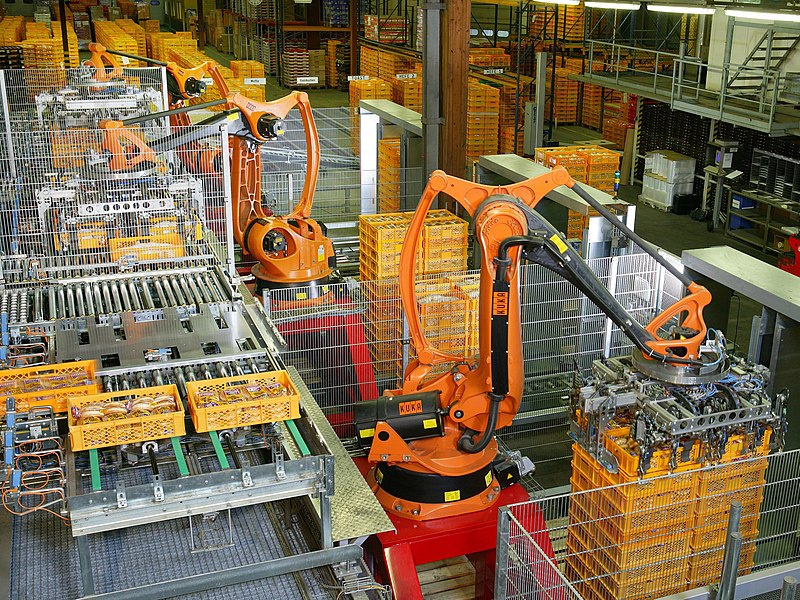
File:Factory_Automation_Robotics_Palettizing_Bread.jpg · Wikimedia Commons · See Wikimedia Commons
food engineering
Sign in to saveAlso known as nutrition engineering
field of applied physical sciences which combines science, microbiology, and engineering education for food and related industries
Wikidata facts
- Instance of
- field of study
- Subclass of
- technology
- Main subject
- physical education
- Image
- Refrigeration Warehouse.jpg
Show 1 more fact
- on focus list of Wikimedia project
- Wikipedia:Vital articles/Level/4
via Wikidata · CC0
~14 min read
Encyclopedic overview
Bread factory in Germany Food engineering is a scientific, academic, and professional field that interprets and applies principles of engineering, science, and mathematics to food manufacturing and operations, including the processing, production, handling, storage, conservation, control, packaging and distribution of food products. Given its reliance on food science and broader engineering disciplines, such as electrical, mechanical, civil, chemical, industrial and agricultural engineering, food engineering is considered a multidisciplinary and narrow field.
Due to the complex nature of food materials, food engineering also combines the study of more specific chemical and physical concepts, such as biochemistry, microbiology, food chemistry, thermodynamics, transport phenomena, rheology, and heat transfer. Food engineers apply this knowledge to the cost-effective design, production, and commercialization of sustainable, safe, nutritious, healthy, appealing, affordable and high-quality ingredients and foods, as well as to the development of food systems, machinery, and instrumentation.
Excerpted from Wikipedia’s “food engineering” article, available under the CC BY-SA 4.0 licence.