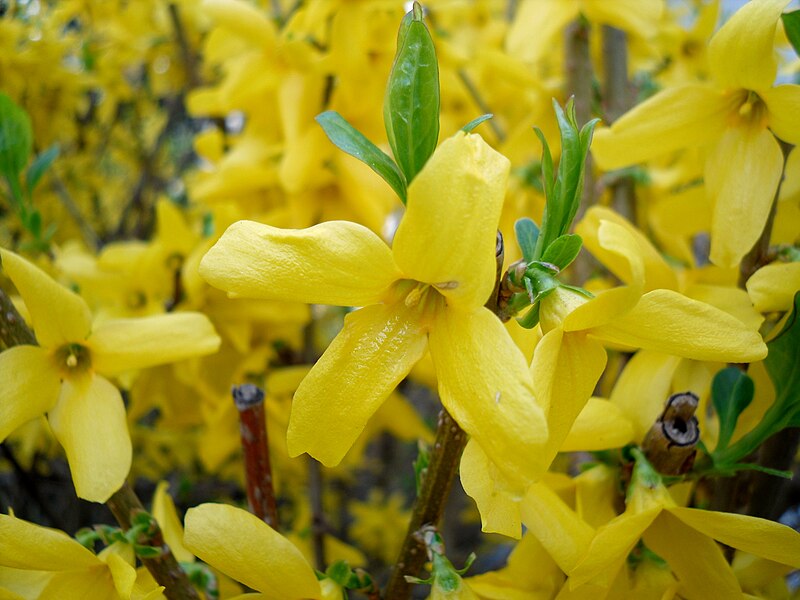
File:Forsythia_flower.JPG · Wikimedia Commons · See Wikimedia Commons
Forsythia
Sign in to saveAlso known as golden bells
Forsythia , is a genus of flowering plants in the olive family Oleaceae. There are about 11 species, mostly native to Eastern Asia, but one native to Southeastern Europe. Forsythia – also one of the plant's common names – is named after the botanist William Forsyth.
OverviewAI-generated
Forsythia is a genus of plants in the family Oleaceae, belonging to the order Lamiales and class Magnoliopsida. The scientific name is Forsythia Vahl, and the genus is named after William Forsyth. Its parent taxon is Forsythieae, and the type species is Forsythia suspensa. Common names include forsythia, レンギョウ, and 개나리속. The genus produces capsules and features yellow coloration.
Forsythia suspensa, also known as weeping forsythia, is a species native to North-Central, South-Central, and Southeast China, as well as Inner Mongolia. It is described as an elegant, hardy shrub. Records from iDigBio indicate collections from the United States, France, and the United Kingdom, held by institutions such as the University of Alberta Museums, NY, CM, CHSC, and NHMUK.
Synthesized by Vinony from 41 facts across 8 sources: Wikidata, GBIF, iNaturalist, PubMed, Gbif Occ, Plants of the World, iDigBio, Vinony graph. Generated from structured data (not the Wikipedia text) and checked against those facts — may still contain errors.
Species
Golden-bell
Forsythia
GENUS
- KingdomPlantae
- PhylumTracheophyta
- ClassMagnoliopsida
- OrderLamiales
- FamilyOleaceae
General: Weeping forsythia is an elegant, hardy shrub, which Common Name: Weeping forsythia
via GBIF · Kew POWO
Museum specimens
- Specimen records
- 414
- With media
- 328
- Family
- Oleaceae
- Collections
- UNIVERSITY OF ALBERTA MUSEUMS, NY, CM, CHSC, NHMUK, MO
- Recorded in
- United States, France, United Kingdom
Key facts
- Chinese.j
- lin4-kiu4
- Chinese.t
- 連翹
- Chinese.s
- 连翘
- Chinese.p
- liánqiáo
- Chinese.y
- lìhn-kìuh
via Wikipedia infobox
Research
2,281 papers- Forsythia velutina Nakai extract: A promising therapeutic option for atopic dermatitis through multiple cell type modulation.Allergy · 2024
- The integration of metabolites from Forsythia suspensa and gut microbiota ameliorates drug-induced liver injury: network pharmacology and molecular docking studies.Artificial cells, nanomedicine, and biotechnology · 2025
- Forsythia suspensa polyphenols regulate macrophage M1 polarization to alleviate intestinal inflammation in mice.Phytomedicine : international journal of phytotherapy and phytopharmacology · 2024
- Peptidoglycan synthesis in Tannerella forsythia: Scavenging is the modus operandi.Molecular oral microbiology · 2018
- The Biological Effects of Forsythia Leaves Containing the Cyclic AMP Phosphodiesterase 4 Inhibitor Phillyrin.Molecules (Basel, Switzerland) · 2021
via PubMed
Wikidata facts
- Instance of
- taxon
- Parent taxon
- Forsythieae
- Named after
- William Forsyth
- Image
- Forsythia flower.JPG
Show 10 more facts
- taxon rank
- genus
- taxon name
- Forsythia
- Commons category
- Forsythia
- topic's main category
- Category:Forsythia
- Commons gallery
- Forsythia
- taxon common name
- 连翘属
- has fruit type
- capsule
- taxonomic type
- Forsythia suspensa
- color
- yellow
via Wikidata · CC0
~8 min read
Encyclopedic overview
11 sectionsContents
- Description
- Species
- Garden history
- Cultivation
- Uses
- Medicinal use
- Musical instrument
- Common names
- Gallery
- References
- External links
Forsythia , is a genus of flowering plants in the olive family Oleaceae. There are about 11 species, mostly native to Eastern Asia, but one native to Southeastern Europe. Forsythia – also one of the plant's common names – is named after the botanist William Forsyth.
==Description== Forsythia are deciduous shrubs typically growing to a height of and, rarely, up to with rough grey-brown bark. The leaves are borne oppositely and are usually simple, though sometimes trifoliate with a basal pair of small leaflets; they range between in length and, rarely, up to , with a margin that is serrated or entire (smooth). Twigs may be hollow or chambered, depending on the species.
Excerpted from Wikipedia’s “Forsythia” article, available under the CC BY-SA 4.0 licence.