File:Quinta_Essentia_(Thurneisse)_illustration_Alchemic_approach_to_four_humors_in_relation_to_the_four_elements_and_zodiacal_signs.jpg · Wikimedia Commons · See Wikimedia Commons
four temperaments
Sign in to saveAlso known as humoralism, humoral theory, humorism, humours
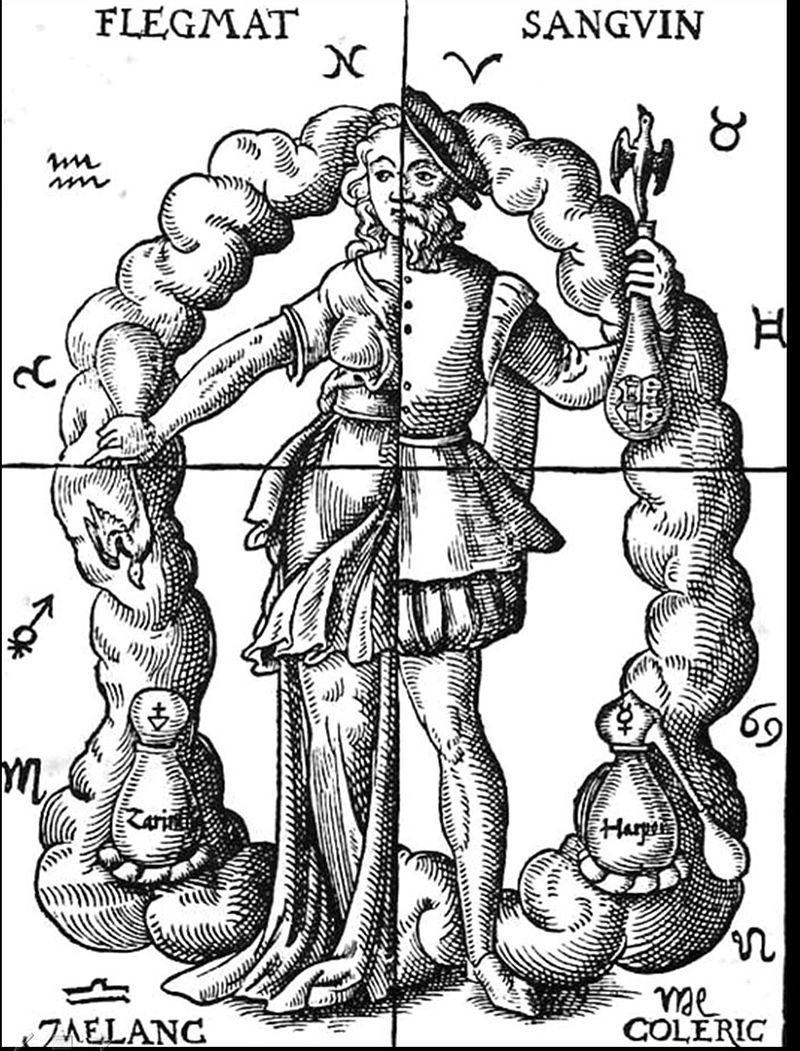
thumb|16th-century German illustration of the four humors: Flegmat (phlegm), Sanguin (blood), Coleric (yellow bile) and Melanc (black bile), divided between the male and female sexes Humorism, the humoral theory, or humoralism, was a system of medicine detailing a supposed makeup and workings of the human body, adopted by Ancient Greek and Roman physicians and philosophers.
Research
1,094 papers- A psychobiological model of temperament and character.Archives of general psychiatry · 1993
- Personality changes following heart transplantation: The role of cellular memory.Medical hypotheses · 2020
- [Temperamental endophenotypes].L'Encephale · 2012
- Temperament and personality.Current opinion in neurobiology · 1994
- Perspectives on two temperamental biases.Philosophical transactions of the Royal Society of London. Series B, Biological sciences · 2018
via PubMed
Wikidata facts
- Followed by
- four temperaments
Show 2 more facts
- topic's main category
- Category:Humorism
- Commons category
- Humorism
via Wikidata · CC0
~28 min read
Encyclopedic overview
19 sectionsContents
- Origin
- Four humors
- Blood
- Yellow bile
- Black bile
- Phlegm
- Humor production
- Relation to jaundice
- Unification with Empedocles's model
- Influence and legacy
- Islamic medicine
- Perso-Arabic and Indian medicine
- Western medicine
- Modern use
- Culture
- See also
- References
- Bibliography
- External links
thumb|16th-century German illustration of the four humors: Flegmat (phlegm), Sanguin (blood), Coleric (yellow bile) and Melanc (black bile), divided between the male and female sexes Humorism, the humoral theory, or humoralism, was a system of medicine detailing a supposed makeup and workings of the human body, adopted by Ancient Greek and Roman physicians and philosophers.
Humorism began to fall out of favor in the 17th century and it was definitively disproved with the discovery of microbes.
Excerpted from Wikipedia’s “four temperaments” article, available under the CC BY-SA 4.0 licence.