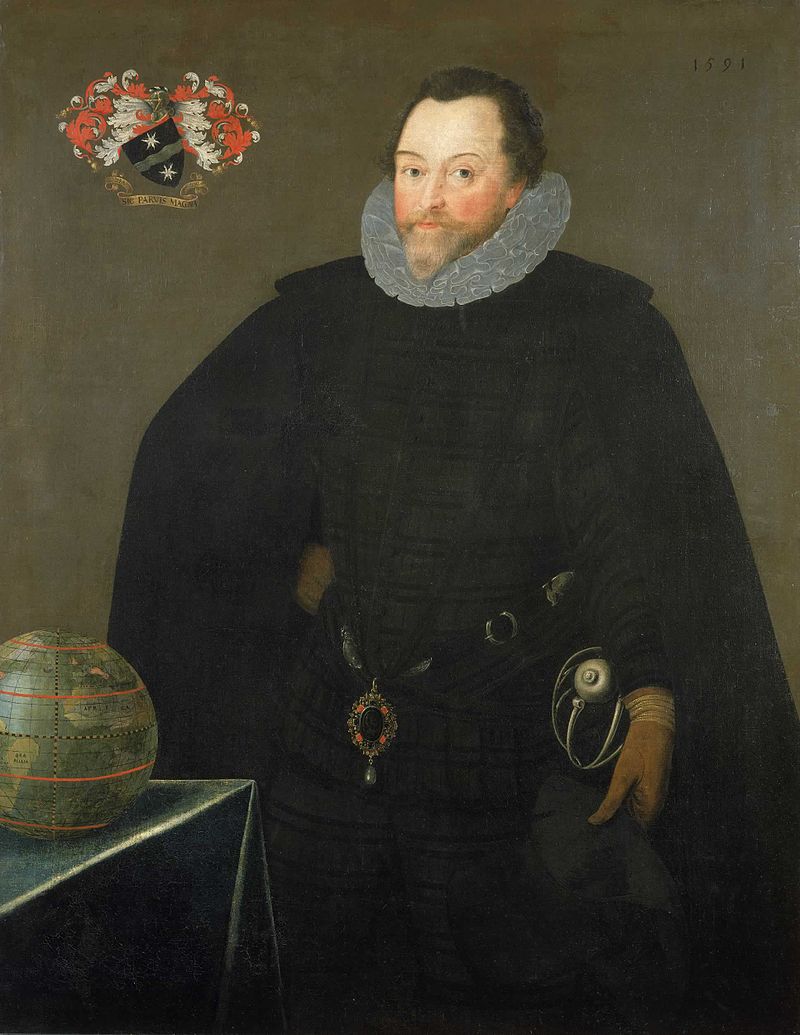
File:Gheeraerts_Francis_Drake_1591.jpg · Wikimedia Commons · See Wikimedia Commons
Francis Drake
Sign in to saveAlso known as Sir Francis Drake
English sailor and privateer (c. 1540 – 1596)
Francis Drake was an English sailor and privateer who lived from around 1540 to 1596, gaining prominence during the reign of Queen Elizabeth I. He is remembered as a significant figure in English naval history, though historical views of him vary depending on whether one emphasizes his role in English maritime expansion or his involvement in slave trading and raids on Spanish colonies.
AI-generated from the Wikipedia summary — may contain errors.
Wikidata facts
- Instance of
- human
- Given name
- Francis
- Family name
- Drake
- Gender
- male
- Citizenship
- Kingdom of England
- Place of birth
- Tavistock
- Place of death
- Portobelo
- Occupation
- privateer
- Languages spoken
- Middle English
- Award
- Knight Bachelor
- Conflict
- Anglo-Spanish War
- Military branch
- Royal Navy
- Military rank
- vice admiral
- Image
- Gheeraerts Francis Drake 1591.jpg
- Residence
- Buckland Abbey
Show 12 more facts
- Commons category
- Francis Drake
- date of birth
- 1540-00-00
- topic's main category
- Category:Francis Drake
- Commons gallery
- Francis Drake
- manner of death
- natural causes
- name in native language
- Francis Drake
- honorific prefix
- Sir
- cause of death
- dysentery
- on focus list of Wikimedia project
- Wikipedia:Vital articles/Level/4
- P12749
- La Gacilly
- date of death
- 1596-01-27
- P13311
- Horn of Africa
via Wikidata · CC0
~40 min read
Encyclopedic overview
Sir Francis Drake (c. 1540 – 28 January 1596) was an English explorer and privateer best known for making the second circumnavigation of the world in a single expedition between 1577 and 1580 (being the first English expedition to accomplish this). He is also known for participating in the early English slaving voyages of his cousin, John Hawkins, and John Lovell. Having started as a simple seaman, in 1588 he was part of the fight against the Spanish Armada as a vice admiral.
At an early age, Drake was placed into the household of a relative, William Hawkins, a prominent sea captain in Plymouth. In 1572, he set sail on his first independent mission, privateering along the Spanish Main. Drake's circumnavigation began on 13 December 1577. He crossed the Pacific Ocean, until then an area of exclusive Spanish interest, and laid claim to New Albion, plundering coastal towns and ships for treasure and supplies as he went. He arrived back in England on 26 September 1580. Elizabeth I awarded Drake a knighthood in 1581 which he received aboard his galleon the Golden Hind.
Excerpted from Wikipedia’s “Francis Drake” article, available under the CC BY-SA 4.0 licence.
Gallery (12)
Available in 111 languages
- Español
- Français
- Deutsch
- 中文
- 日本語
- Русский
- Português
- Italiano
- العربية
- हिन्दी
- Afrikaans
- Albanian
- Amharic
- Angika
- Aragonese
- Armenian
- Asturian
- Awadhi
Show 92 more
- Azerbaijani
- Bahasa Indonesia
- Bangla
- Bashkir
- Basque
- bat_smg
- be_x_old
- Belarusian
- Bosnian
- Breton
- Bulgarian
- Burmese
- Catalan
- Chuvash
- Croatian
- Czech
- Danish
- Egyptian Arabic
- Esperanto
- Estonian
- Filipino
- Finnish
- fiu_vro
- Galician
- Georgian
- Greek
- Hebrew
- Hungarian
- Icelandic
- Ido
- Interlingua
- Irish
- Javanese
- Kalmyk
- Kazakh
- kbp
- Kotava
- Kurdish
- Kyrgyz
- Ladino
- Latin
- Latvian
- Ligurian
- Lingua Franca Nova
- Lithuanian
- Luxembourgish
- Macedonian
- Maithili
- Malagasy
- Malay
- Malayalam
- Mirandese
- Nederlands
- Nepali
- Newari
- Norwegian
- Norwegian Nynorsk
- Occitan
- Ossetic
- Pampanga
- Pangasinan
- Piedmontese
- Polski
- Quechua
- Romanian
- Scots
- Scottish Gaelic
- Serbian
- Serbian (Latin)
- Sicilian
- simple
- Sinhala
- Slovak
- Slovenian
- Sundanese
- Svenska
- Tamil
- Tiếng Việt
- Türkçe
- Ukrainian
- Urdu
- Uzbek
- Waray
- Welsh
- Western Frisian
- Wu Chinese
- Zeelandic
- zh_min_nan
- zh_yue
- فارسی
- ไทย
- 한국어
via Wikidata sitelinks · CC0