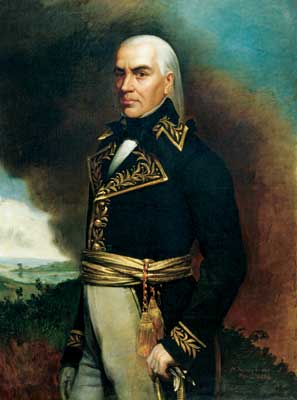
File:Francisco_de_Miranda_by_Tovar_y_Tovar.jpg · Wikimedia Commons · See Wikimedia Commons
Francisco de Miranda
Sign in to saveAlso known as Sebastián Francisco de Miranda y Rodríguez de Espinoza, Don Juan Manuel de Cagigal, Francisco Sebastián de Miranda y Rodríguez de Espinosa
Venezuelan military leader (1750–1816)
Key facts
- Preceded by
- Francisco Espejo
- Succeeded by
- Simón Bolívar , (As President of the Second Republic of Venezuela )
- Born
- Sebastián Francisco de Miranda y Rodríguez de Espinoza , ( 1750-03-28 ) 28 March 1750, Caracas , Venezuela Province , Viceroyalty of New Granada , Spanish Empire
- Died
- 14 July 1816 (1816-07-14) (aged 66), Cádiz , Spain
- Profession
- Military
- Known for
- As creator of the name of Colombia
- Nickname s
- The Precursor , The First Universal Venezuelan , The Great Universal American
- Allegiance
- Kingdom of Spain , French First Republic , First Republic of Venezuela
- Years of service
- 1773–1783, 1791–1793, 1811–1812
- Rank
- Generalissimo
- Battles wars
- Siege of Melilla (1774) American Revolutionary War Siege of Pensacola French Revolutionary War Battle of Valmy Venezuelan War of Independence Battle of San Mateo
via Wikipedia infobox
Wikidata facts
- Instance of
- human
- Given name
- Francisco
- Family name
- Miranda
- Gender
- male
- Citizenship
- Spain
- Place of birth
- Caracas
- Place of death
- Cádiz
- Occupation
- soldier
- Position held
- President of Venezuela
- Educated at
- Central University of Venezuela
- Languages spoken
- Spanish
- Native language
- Spanish
- Participant in
- Independence of Venezuela
- Conflict
- Venezuelan War of Independence
- Image
- Francisco de Miranda - Emilio Mauri.jpg
Show 8 more facts
- Commons category
- Francisco de Miranda
- date of death
- 1816-07-14
- date of birth
- 1750-03-28
- external data available at URL
- data.bnf.fr/11916255/francisco_de_miranda
- name in native language
- Apodado "El Catire"
- second family name in Spanish name
- Rodríguez
- place of burial
- Cádiz Province
- has works in the collection
- Memoria Chilena
Sources (2)
via Wikidata · CC0
Works in European collections
20 objects attributed to Francisco de Miranda, held across European museums, libraries & archives · via Europeana
Archivo del General Miranda [Texto impreso]
Por el Capitan don Franciso de Miranda, con D. Gaspar de Mendoça señor de la Villa de Hinojosa, como marido de Doña Catalina de Miranda su muger, y con Don Iuan Leonardo de Mensoza su hijo, y su curador adlite, sobre el mayorazgo que fundo Gonçalo Gil de Miranda el año pasado de mil y quatrocientos y treze de las casas de Soria, y Torre de Miranda, de Alparrache, y de la Salma, y de Reznos, y bienes dellas pertenecientes, que vaco por fin, y muerte de don Luys de Miranda, su ultimo poseedor

Diario desde New York, hacia Albany, Saratoga...

Travel from Boston to Portsmuth New Hamshaire

Proclamation of Don Francisco de Miranda, Commander-General of the Colombian Exación, to the inhabitants of the American-Colombian continent

Viajes por Rusia

Diario de Moscú y San Petersburgo

Journey to Havana-New Jersey

Travel in Italy
Correspondance du Général Miranda avéc le Général Dumourier, les Ministres de la Guerre, Pache & Beurnonville, depuis Janvier 1793 Ordres du Général Dumourier au Général Miranda, pour la bataille de Nerwinden & la retraite qui en a été la suite

Correspondance Du Général Miranda : Avec le Général Dumourier, les Ministres de la Guerre, Pache et Beurnonville, depuis Janvier 1793. Ordres du Général Dumourier au Général Miranda, pour la bataille de Nerwinden, & la retraite qui en a été la suite
Untitled
Untitled
Untitled
Untitled
Untitled
Untitled

Untitled

Untitled
Untitled
~40 min read
Encyclopedic overview
Sebastián Francisco de Miranda y Rodríguez de Espinoza (28 March 1750 – 14 July 1816), commonly known as Francisco de Miranda ( Latin American Spanish: [fɾanˈsisko ðe miˈɾanda]), was a Venezuelan military leader and revolutionary who fought in the American Revolutionary War, the French Revolution and the Spanish American wars of independence. He is regarded as a precursor of South America's liberation from the Spanish Empire, and remains known as the "First Universal Venezuelan" and the "Great Universal American".
Born in Caracas in the Viceroyalty of New Granada into a wealthy family, Miranda left to pursue an education in Madrid in 1771 and subsequently enlisted in the Spanish army. In 1780, following Spain's entry into the American Revolutionary War, he was sent to Cuba and fought the British at Pensacola. Accused of espionage and smuggling, he fled to the United States in 1783. Miranda returned to Europe in 1785 and travelled through the continent, gradually formulating his plans for Spanish American independence. From 1791 on, he took an active part in the French Revolution, serving as a general during the Battle of Valmy and the Flanders campaign. An associate of the Girondins, he became disillusioned by the Revolution and was forced to leave for Britain.
Excerpted from Wikipedia’s “Francisco de Miranda” article, available under the CC BY-SA 4.0 licence.