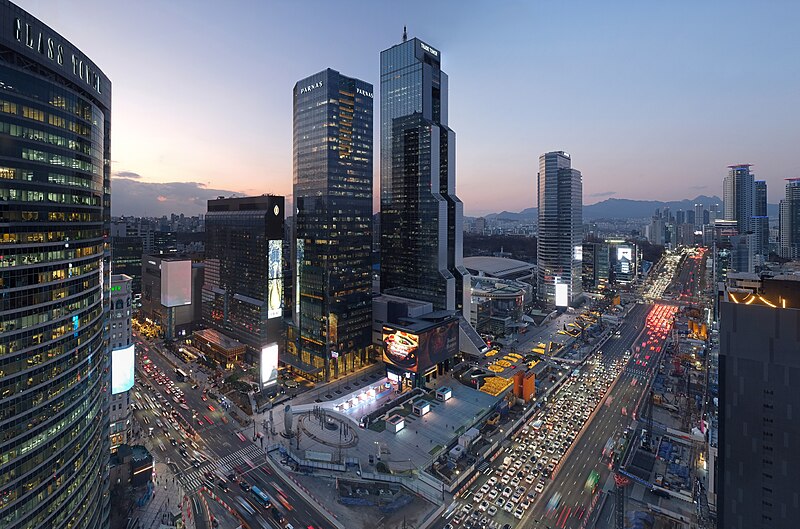
File:Teheran-ro_Yeongdong-daero_crossing_7.jpg · Wikimedia Commons · See Wikimedia Commons
Gangnam District is one of the administrative divisions of Seoul, South Korea's capital city. It gained international recognition as the subject of the 2012 song "Gangnam Style" and is known as an affluent and trendy area of the city.
AI-generated from the Wikipedia summary — may contain errors.
Key facts
- Country
- South Korea
- Region
- Sudogwon
- Special city
- Seoul
- Body
- Gangnam-gu Council
- Mayor
- Cho Seong-myeong ( People Power )
- Mnas
- List of MNAs Thae Yong-ho ( People Power ) Park Jin ( People Power ) Yu Kyung-jun ( People Power )
- Total
- 39.49 km (15.25 sq mi)
- Density
- 14,090/km (36,500/sq mi)
- Time zone
- UTC+9 ( Korea Standard Time )
- Postal code
- 06000 – 06499
- Area code s
- +82-2-2226,400,500
- Website
- gangnam.go.kr
via Wikipedia infobox
Wikidata facts
- Part of
- Seoul
- Country
- South Korea
- Located in
- Seoul
- Contains
- Yeoksam-dong
- Population
- 546291
- Area
- 39.55
- Time zone
- UTC+09:00
- Official website
- www.gangnam.go.kr
- Image
- Teheran-ro Yeongdong-daero crossing 7.jpg
- Dialing code
- 2-2226
Show 6 more facts
- twinned administrative body
- Fredericton
- Commons category
- Gangnam-gu, Seoul
- topic's main category
- Category:Gangnam District
- time of earliest written record
- 1998-00-00
- postal code
- 06000 ~ 06499
- social media followers
- 26400
Sources (9)
via Wikidata · CC0
~13 min read
Encyclopedic overview
Administrative divisions Cheongdam Intersection, the starting point of Cheongdam Fashion Street Gangnam District (Korean: 강남구; RR: Gangnam-gu; IPA: [ka̠ŋna̠m.ɡu]) is one of the 25 districts of Seoul, South Korea. The term Gangnam translates to "South of the Han River". Gangnam District is the third-largest district in Seoul, with an area of 39.5 km (15.3 sq mi). As of the 2024 census, Gangnam District had a population of 556,570. There is a high concentration of wealth in the district, with prices for an apartment as of 2024 more than double those in the rest of Seoul. Gangnam District is a part of the Gangnam region, along with the Seocho and Songpa districts. This district shares half of Gangnam-daero Gangnam station area with Seocho District, one of the most crowded places in South Korea.
It is home to Bongeunsa Temple, which dates to the Unified Silla period. It also hosts Seonjeongneung, royal tombs of the Joseon Dynasty, and the earlier gravesite of Gwangpyeong Daegun and his family's land, which are preserved as national treasures. Apgujeong, in particular, became notable from the early Joseon period as the site of the villa of Han Myeong-hoe, a high-ranking official during King Sejo's reign.
Excerpted from Wikipedia’s “Gangnam District” article, available under the CC BY-SA 4.0 licence.