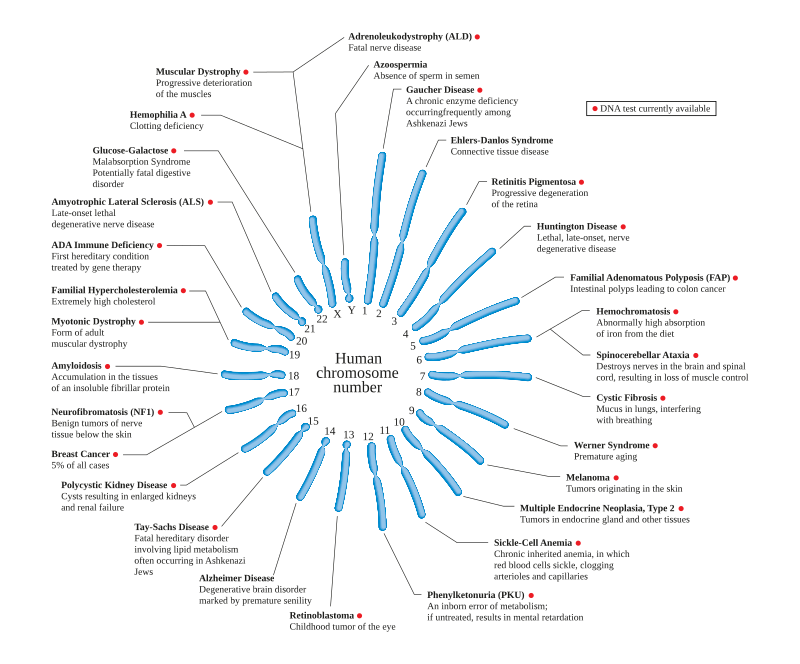
File:Human_chromosome_diseases_set_en.svg · Wikimedia Commons · See Wikimedia Commons
genetic disease
Sign in to saveAlso known as genetic disorder, inherited disease, familial disorder, inborn disorder, genetic condition, hereditary disease, molecular disease, hereditary diseases
health problem caused by one or more abnormalities in the genome
A genetic disease is a health problem caused by one or more abnormalities in a person's genome—the complete set of genetic instructions that make up their DNA. Understanding genetic diseases matters because it helps doctors diagnose conditions, predict health risks, and develop treatments tailored to a person's genetic makeup.
AI-generated from the Wikipedia summary — may contain errors.
Research
1,330,146 papers- Genetic Disease and Therapy.ReviewAnnual review of pathology · 2021Roth TL, Marson ADOI: 10.1146/annurev-pathmechdis-012419-032626
- Genetic disease.ReviewCanadian Medical Association journal · 1968
- Genetic disease since 1945.ReviewNature reviews. Genetics · 2000Lindee MSDOI: 10.1038/35042097
- Etiology of Human Genetic Disease on the Fly.ReviewTrends in genetics : TIG · 2017Chow CY, Reiter LTDOI: 10.1016/j.tig.2017.03.007
- Human Genetic Diseases.BioMed research international · 2015Deng H, Riederer P, Deng HX et al.DOI: 10.1155/2015/315216
- Genetic disease in the Arab world.BMJ (Clinical research ed.) · 2006Bayoumi RA, Yardumian ADOI: 10.1136/bmj.39002.350405.80
- Preimplantation diagnosis of genetic disease.ReviewAnnals of medicine · 1993Monk MDOI: 10.3109/07853899309147313
- A disease by any other name: musings on the concept of a genetic disease.ReviewMedicine, health care, and philosophy · 2001Smith KCDOI: 10.1023/a:1009930312079
via PubMed
Wikidata facts
- Subclass of
- disease
Show 10 more facts
- has cause
- pathology
- topic's main category
- Category:Genetic diseases and disorders
- Commons category
- Genetic diseases and disorders
- NCI Thesaurus ID
- C3101
- exact match
- purl.obolibrary.org/obo/DOID_0050325
- ICD-9-CM
- 799.89
- health specialty
- medical genetics
- on focus list of Wikimedia project
- WikiProject Medicine
- opposite of
- environmental disease
- has list
- list of genetic disorders
via Wikidata · CC0
~18 min read
Encyclopedic overview
A genetic disorder is a health problem caused by one or more abnormalities in the genome. It can be caused by a mutation in a single gene (monogenic) or multiple genes (polygenic) or by a chromosome abnormality. Although polygenic disorders are the most common, the term is mostly used when discussing disorders with a single genetic cause, either in a gene or chromosome. The mutation responsible can occur spontaneously before embryonic development (a de novo mutation), or it can be inherited from two parents who are carriers of a faulty gene (autosomal recessive inheritance) or from a parent with the disorder (autosomal dominant inheritance). When the genetic disorder is inherited from one or both parents, it is also classified as a hereditary disease. Some disorders are caused by a mutation on the X chromosome and have X-linked inheritance. Very few disorders are inherited on the Y chromosome or mitochondrial DNA (due to their size).
There are well over 6,000 known genetic disorders, and new genetic disorders are constantly being described in medical literature. More than 600 genetic disorders are treatable. Around 1 in 50 people are affected by a known single-gene disorder, while around 1 in 263 are affected by a chromosomal disorder. Around 65% of people have some kind of health problem as a result of congenital genetic mutations. Due to the significantly large number of genetic disorders, approximately 1 in 21 people are affected by a genetic disorder classified as "rare" (usually defined as affecting less than 1 in 2,000 people). Most genetic disorders are rare in themselves.
Excerpted from Wikipedia’s “genetic disease” article, available under the CC BY-SA 4.0 licence.