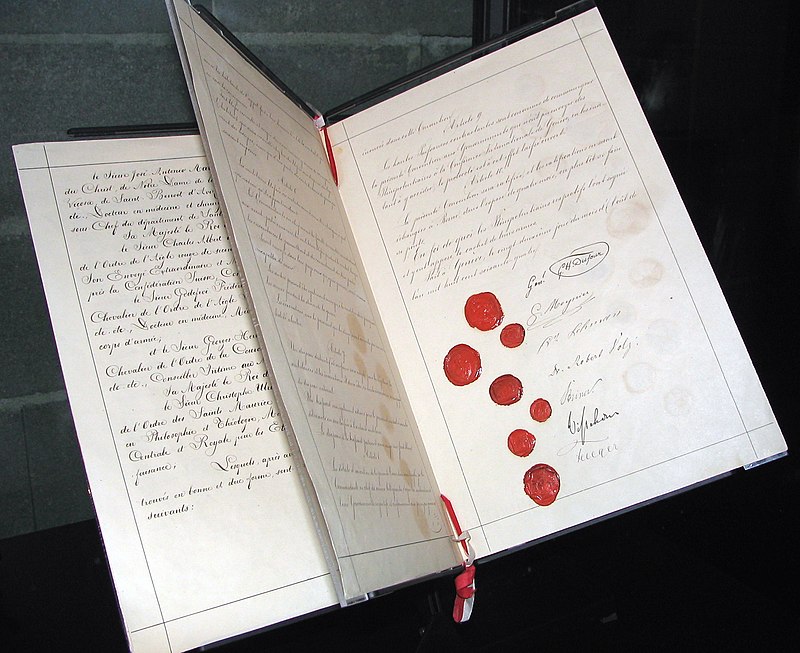
File:Original_Geneva_Conventions.jpg · Wikimedia Commons · See Wikimedia Commons
Geneva Conventions
Sign in to saveAlso known as Geneva Convention
the standards of international law for humanitarian treatment in war
Wikidata facts
- Instance of
- international humanitarian law
- Has part
- Geneva Convention of 1864
- Main subject
- law of war
- Image
- Original Geneva Conventions.jpg
Show 6 more facts
- Commons category
- Geneva Conventions Protocols
- topic's main category
- Category:Geneva Conventions
- on focus list of Wikimedia project
- Wikipedia:Vital articles/Level/4
- different from
- Convention relating to the Status of Refugees
- described by source
- Encyclopædia Britannica 11th edition
- nickname
- Geneva Suggestions
via Wikidata · CC0
~39 min read
Encyclopedic overview
A facsimile of the signature-and-seals page of the 1864 Geneva Convention, which established humane rules of war The original document in single pages, 1864
The Geneva Conventions are a series of four international treaties (1949) and their three additional protocols that form the core of international humanitarian law. They establish legal standards for humanitarian treatment of non-combatants in war and protect people who are not or are no longer actively taking part in hostilities. This category includes not only civilians and civilian populations but also former combatants, such as prisoners of war and fighters rendered hors de combat due to injury, illness, shipwreck or those who have surrendered. The four 1949 Geneva Conventions, adopted in response to the inhumanities of World War II, updated and added to previous Geneva Conventions (1864, 1906, 1929). The 1949 Geneva Conventions address the treatment of sick and wounded soldiers in the field ("Geneva Convention I"), wounded, sick and shipwrecked soldiers at sea (“Geneva Convention II”), prisoners of war (“Geneva Convention III”), and civilians in time of war (“Geneva Convention IV”). In 1977, these rules were updated by two Additional Protocols, the first concerning international armed conflicts (“Additional Protocol I”) and the second, non-international armed conflicts (“Additional Protocol II”).
Excerpted from Wikipedia’s “Geneva Conventions” article, available under the CC BY-SA 4.0 licence.
Gallery (7)
Available in 80 languages
- Español
- Français
- Deutsch
- 中文
- 日本語
- Русский
- Português
- Italiano
- العربية
- हिन्दी
- Afrikaans
- Albanian
- Armenian
- Asturian
- Azerbaijani
- Bahasa Indonesia
- Balinese
- Bangla
Show 61 more
- Basque
- be_x_old
- Belarusian
- Breton
- Bulgarian
- Catalan
- Central Kurdish
- Croatian
- Czech
- Danish
- Egyptian Arabic
- Esperanto
- Estonian
- Finnish
- fiu_vro
- Galician
- Georgian
- Greek
- Hebrew
- Hungarian
- Icelandic
- Javanese
- Kazakh
- Latin
- Latvian
- Lithuanian
- Macedonian
- Malay
- Malayalam
- Marathi
- Mirandese
- Nederlands
- Nepali
- Norwegian
- Norwegian Nynorsk
- Occitan
- Polski
- Romanian
- Serbian
- Serbian (Latin)
- simple
- Slovak
- Slovenian
- Svenska
- Tajik
- Tamil
- Tiếng Việt
- Türkçe
- Ukrainian
- Urdu
- Uzbek
- Venetian
- Waray
- Wu Chinese
- Yakut
- Zaza
- zh_min_nan
- zh_yue
- فارسی
- ไทย
- 한국어
via Wikidata sitelinks · CC0