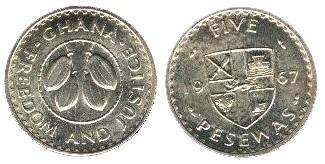
File:5_pesewas_(new_cedi).jpg · Wikimedia Commons · See Wikimedia Commons
The Ghana cedi is the official money used in Ghana for buying and selling goods and services. It matters because it's essential for everyday transactions and represents Ghana's economic independence as a nation.
AI-generated from the Wikipedia summary — may contain errors.
Wikidata facts
- Instance of
- currency
- Subclass of
- Bank of Ghana
- Country
- Ghana
- Image
- 50 Ghana Cedis.jpg
Show 11 more facts
- start time
- 1965-07-19
- central bank/issuer
- Bank of Ghana
- Commons category
- Money of Ghana
- replaces
- Ghanaian pound
- unit symbol
- ₵
- price
- 0.17689
- different from
- Chedi Kingdom
- Commons gallery
- Coins and Banknotes from Ghana
- conversion to standard unit
- 0.6381620931716656
- applies to jurisdiction
- Ghana
- inception
- 1965-07-19
Sources (3)
via Wikidata · CC0
~12 min read
Encyclopedic overview
The cedi (/ˈsiːdiː/ SEE-dee; currency sign: GH₵; currency code: GHS) is the unit of currency of Ghana. It is the fourth historical and only current legal tender in the Republic of Ghana. One Cedi is divided into one hundred Pesewas (Gp).
After independence in 1957, Ghana separated itself from the British West African pound, which was the currency of the British colonies in the region. The new republic's first independent currency was the Ghanaian pound (1958–1965). In 1965, Ghana decided to leave the British colonial monetary system and adopt the widely accepted decimal system. The African name Cedi (1965–1967) was introduced in place of the old British pound system. Ghana's first President Kwame Nkrumah introduced Cedi notes and Pesewa coins in July 1965 to replace the Ghanaian pounds, shillings and pence. The Cedi bore the portrait of the President and was equivalent to eight shillings and four pence (8s 4d), i.e. one hundred old pence, so that 1 pesewa was equal to one penny.
Excerpted from Wikipedia’s “Ghana cedi” article, available under the CC BY-SA 4.0 licence.