girdle book
Sign in to savebook with an extra covering of leather allowing the book to be hung from the girdle
Described at
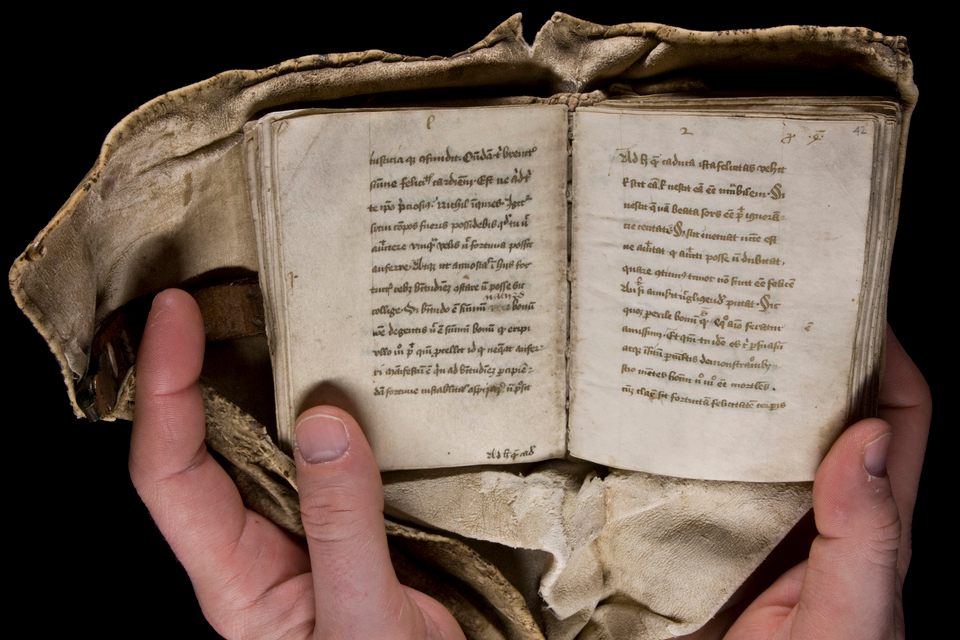
Go Medieval by Attaching a Book to Your Belt
Girdle books had to be small, and they had to be light. From the bottom edges of their bindings extended an length of leather, usually gathered into a knot...
atlasobscura.com →Used from the 14th to 17th centuries, these books were texts that their owners needed to keep close at hand: prayer books used by monks and nuns, for example, or law books used by traveling judges. Though they were valuable objects—luxuries, even—these books were meant to be consulted and read. A daily dose of hidden gems to visit, extraordinary places to eat and wondrous stories from around the world. Girdle books were once common enough that they appear more than 800 times in paintings and other art of the period. But today there are just 26 girdle books known in the world. In her book, a catalogue of what she calls “relics of an age long gone by,” Smith has measured, photographed, and investigated the history of each one. Girdle books were often very plain. This one, from Nuremberg, is the most ornate one known. Germanisches Nationalmuseum/CC BY-SA 3.0 Smith, a bookbinder and retired librarian who was the head of cataloguing and preservation at the University of San Diego’s Copley Library, first became interested in girdle books 15 years ago, and she took a class in Montefiascone, Italy, to learn how to make one. In her preparations, she found that there was little scholarly work—little information at all, really—on these once relatively common objects. Saint James wears a girdle book in 16th-century panel by Hieronymus Bosch. Hieronymous Bosch/Public domain exterior.jpg) When libraries placed these objects, hundreds of years old, in front of her, she felt a sense of awe. “Then you start looking into it, and you see all the debris from 500 years ago. There is dust and hair and fingernail parings and spots of wax from candles and erasures,” she says. “Some of the books are so fragile that you have to be very careful, especially when turning pages. But if you start measuring, once you get into that, you remember what you are there to do, and you’ve overcome the initial awe.” The books, while still treasures, became objects to be scrutinized. The part of the book cover that distinguishes a girdle book often looks like a Wee Willie Winkie hat, flopped on top of the book, or a Gandalf-esque beard, stretching down into a neat triangle. Smith discovered that some girdle books have just one extended leather cover, while other have two nested covers, with the outer one designed for carrying. But it wasn’t always easy to tell which category a girdle book fit into. One of the first things Smith learned as a bookbinder was how to tear a book down, to see how it worked. In modern books, it’s possible to tease back an endpaper and inspect a book’s secrets. In the case of the old, rare books, that wasn’t possible, so Smith had to run her fingers along the binding to feel for ridges and other hints to the book’s inner workings. Some of the books had surprises inside, as well. One belonged to a nun, Katharina Röder von Rodeck, who lived at the Frauenalb Convent near Karlsruhe, Germany. She filled the pages with her personal prayers and devotions, as well as notes about her life—when she took her vows, when German peasants rebelled in 1525. At the beginning of the book, she decorated five pages with the coats of arms of her parents’ families, a gray owl holding a red heart, a skeleton holding an hourglass, and motifs of flowers and vines that continued throughout the book. It gives, writes Smith, “a very cheerful and friendly impression.” The Codex Gigas, also known as the Devil’s Bible, is the largest medieval manuscript still in existence—with an even bigger legend behind it. Sixteenth century scholars peeled away anatomical ignorance one layer at a time. After their invention by Venetian merchants, forms of these books were kept by everyone from H.P. Lovecraft to Thomas Jefferson. In her new book, Elsa Richardson explores how the gut has been viewed across history. Sachsen: Diese Banken bieten ab sofort bis zu 4,60% p.a. auf FestgeldFinanzmarkt Deutschland A daily dose of hidden gems to visit, extraordinary places to eat and
Excerpt from a page describing this subject · 36,324 chars · not written by Vinony
Wikidata facts
- Subclass of
- book
- Image
- Girdlebook-Nuremberg-GN-Hs17231.png
Show 3 more facts
- Commons category
- Girdle books
- Commons gallery
- Girdle books
- described at URL
- www.atlasobscura.com/articles/what-is-a-girdle-book
Sources (1)
via Wikidata · CC0