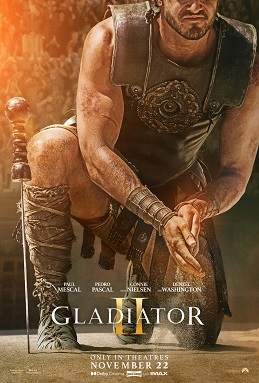
File:Gladiator_II_(2024)_poster.jpg · Wikimedia Commons · See Wikimedia Commons
OverviewAI-generated
Gladiator II is a 2024 action, drama, and adventure film directed by Ridley Scott. The screenwriter is David Scarpa, with John Mathieson serving as director of photography and Claire Simpson as film editor. The cast includes Paul Mescal, Connie Nielsen, Derek Jacobi, and Denzel Washington. Produced by Ridley Scott, Douglas Wick, Walter F. Parkes, and Laurie MacDonald, the film was distributed by Paramount Pictures and DreamWorks. It follows the original film Gladiator and is presented in English.
The movie has a runtime of 148 minutes and carries an R rating. Its production budget is listed as $310,000,000, with a capital cost of $210,000,000. The film earned $462,180,717 in revenue. Critical reception includes a Metascore of 64, a Rotten Tomatoes rating of 70%, and an IMDb rating of 6.4. The film has received 9 wins and 113 nominations, including one Oscar nomination.
Synthesized by Vinony from 47 facts across 5 sources: Wikidata, TMDb, OMDb, IMDb, Vinony graph. Generated from structured data (not the Wikipedia text) and checked against those facts — may still contain errors.
Film · TMDB
6.6Years after witnessing the death of the revered hero Maximus at the hands of his uncle, Lucius is forced to enter the Colosseum after his home is conquered by the tyrannical Emperors who now lead Rome with an iron fist. With rage in his heart and the future of the Empire at stake, Lucius must look to his past to find strength and honor to return the glory of Rome to its people.
Cast
- Paul Mescal as Lucius
- Denzel Washington as Macrinus
- Pedro Pascal as General Acacius
- Connie Nielsen as Lucilla
- Joseph Quinn as Emperor Geta
- Fred Hechinger as Emperor Caracalla
Themes
- gladiator
- roman empire
- ancient rome
- sequel
- epic battle
- family legacy
- 3rd century
- fallen hero
- political rival
- evil tyrant
This product uses the TMDB API but is not endorsed or certified by TMDB.
Ratings
IMDb
6.4/10
296,954 votes
Rotten Tomatoes
70%
Metacritic
64/100
- Year
- 2024
- Runtime
- 148 min
- Genres
- Adventure, Drama
- Rated
- R
- Awards
- Nominated for 1 Oscar. 9 wins & 113 nominations total
via OMDb · IMDb
Key facts
- Directed by
- Ridley Scott
- Screenplay by
- David Scarpa
- Story by
- Peter Craig David Scarpa
- Based on
- Characters, by David Franzoni
- Produced by
- Ridley Scott Michael Pruss Douglas Wick Lucy Fisher David Franzoni
- Starring
- Paul Mescal Pedro Pascal Joseph Quinn Fred Hechinger Connie Nielsen Denzel Washington
- Cinematography
- John Mathieson
- Edited by
- Claire Simpson Sam Restivo
- Music by
- Harry Gregson-Williams
- Production companies
- Scott Free Productions Red Wagon Entertainment
- Distributed by
- Paramount Pictures
- Release dates
- October 30, 2024 ( 2024-10-30 ) (Sydney) November 15, 2024 ( 2024-11-15 ) (United Kingdom) November 22, 2024 ( 2024-11-22 ) (United States)
- Running time
- 148 minutes
- Countries
- United Kingdom United States
- Language
- English
- Budget
- $310 million (gross) $210 million (net)
- Box office
- $462.2 million
via Wikipedia infobox
Wikidata facts
- Instance of
- film
- Genre
- adventure film
- Country of origin
- United States
- Original language
- English language
- Follows
- Gladiator
- Director
- Ridley Scott
- Screenwriter
- David Scarpa
- Composer
- Harry Gregson-Williams
- Producer
- David Franzoni
- Production company
- DreamWorks
- Cinematographer
- John Mathieson
- Duration
- 148
- FilmAffinity ID
- 784584
- Official website
- www.gladiator.movie
Show 7 more facts
- title
- Gladiator 2
- film editor
- Claire Simpson
- publication date
- 2024-11-20
- hashtag
- GladiatorII
- capital cost
- 210000000
- review score
- 70%
- Commons category
- Gladiator II
Sources (15)
via Wikidata · CC0
~39 min read
Encyclopedic overview
Gladiator II is a 2024 epic historical film directed and produced by Ridley Scott. The sequel to Gladiator (2000), it was written by David Scarpa based on a story he wrote with Peter Craig. The film was produced by Scott Free Productions and Red Wagon Entertainment and distributed by Paramount Pictures. It stars Paul Mescal, Pedro Pascal, Joseph Quinn, Fred Hechinger, Connie Nielsen, and Denzel Washington. Derek Jacobi and Nielsen reprise their roles from the first film, with Mescal replacing Spencer Treat Clark. Mescal portrays Lucius Verus Aurelius, the exiled Prince of Rome, who becomes a prisoner of war and fights as a gladiator for Macrinus, a former slave who plots to overthrow the twin emperors Caracalla and Geta.
A sequel to Gladiator was discussed as early as June 2001, with David Franzoni and John Logan set to return as screenwriters. Over the next few years, Scott offered occasional updates, including the possible involvement of the original film's lead actor, Russell Crowe, along with plot ideas about the Roman afterlife and different historical time periods. Development was halted when DreamWorks Pictures was sold to Paramount in 2006. The film was finally announced in 2018, and Mescal was cast in the lead role in January 2023, with a script by David Scarpa. Filming took place between June 2023 and January 2024, with a five-month delay due to the 2023 Hollywood labor disputes.
Excerpted from Wikipedia’s “Gladiator II” article, available under the CC BY-SA 4.0 licence.