File:Glyptothek_in_München_in_2013.jpg · Wikimedia Commons · See Wikimedia Commons
Glyptothek
Sign in to saveAlso known as Glyptothek München, Glyptothek Munich, Königsplatz 3 in München
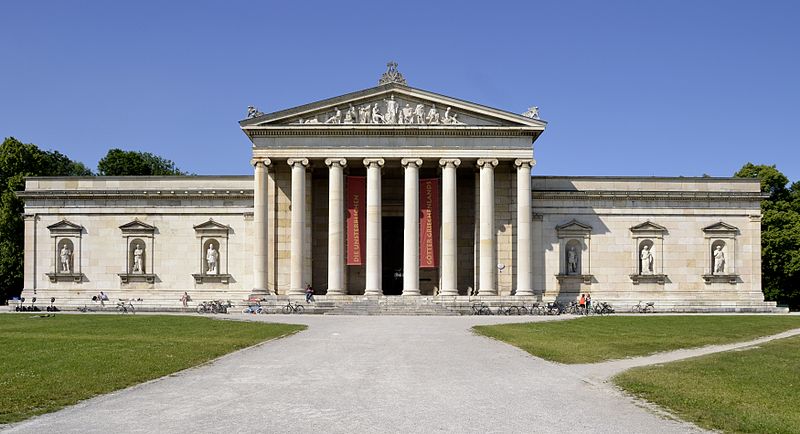
The Glyptothek () is a museum in Munich, Germany, which was commissioned by the Bavarian King Ludwig I to house his collection of Greek and Roman sculptures (hence γλυπτο- glypto- "sculpture", from the Greek verb γλύφειν glyphein "to carve" and the noun θήκη "container"). It was designed by Leo von Klenze in the neoclassical style, and built from 1816 to 1830. Today the museum is a part of the Kunstareal.
Key facts
- Museum.name
- Glyptothek
- Museum.native_name
- Glyptothek
- Museum.native_name_lang
- de
- Museum.image
- Glyptothek in München in 2013.jpg
- Museum.caption
- The Glyptothek in Munich
- Museum.former_name
- <!-- or
- Museum.former_names
- -->
- Museum.location
- Munich, Germany
- Museum.type
- Art museum
- Museum.parking
- <!-- or
- Museum.car_park
- -->
- Museum.embedded
- <!-- or
- Museum.nrhp
- -->
via Wikipedia infobox
Wikidata facts
- Instance of
- architectural heritage monument
- Country
- Germany
- Located in
- Munich
- Time zone
- UTC+02:00
- Operator
- Staatliche Antikensammlungen
- Official website
- www.antike-am-koenigsplatz.mwn.de/de/glyptothek-muenchen.html
- Image
- Glyptothek München, April 2023.jpg
Show 12 more facts
- Commons category
- Glyptothek (München)
- architect
- Leo von Klenze
- architectural style
- Greek Revival architecture
- Commons Institution page
- Glyptothek (München)
- topic's main category
- Category:Glyptothek (München)
- date of official opening
- 1816-00-00
- inception
- 1830-00-00
- located on street
- Brienner Straße
- postal code
- 80333
- street address
- Königsplatz 3
- native label
- Glyptothek
via Wikidata · CC0
~9 min read
Encyclopedic overview
11 sectionsContents
- History
- Architecture
- Collections
- Archaic period (700-490 BC)
- Classical period (490–323 BC)
- Hellenistic period (323–146 BC)
- Roman period (150 BC – 550 AD)
- Gallery
- See also
- References
- External links
The Glyptothek () is a museum in Munich, Germany, which was commissioned by the Bavarian King Ludwig I to house his collection of Greek and Roman sculptures (hence γλυπτο- glypto- "sculpture", from the Greek verb γλύφειν glyphein "to carve" and the noun θήκη "container"). It was designed by Leo von Klenze in the neoclassical style, and built from 1816 to 1830. Today the museum is a part of the Kunstareal.
==History== thumb|right|Detail of one of the Niche (architecture)|niches on the façade The Glyptothek was commissioned by the Crown Prince (later King) Ludwig I of Bavaria alongside other projects, such as the neighboring Königsplatz and the building which houses the State Collection of Greek and Roman Antiquities, as a monument to ancient Greece. He envisioned a "German Athens", in which the ancient Greek culture would be remembered; he had this built in front of the gates of Munich. The Glyptothek is Munich's oldest public museum.
Excerpted from Wikipedia’s “Glyptothek” article, available under the CC BY-SA 4.0 licence.
Gallery (24)
On the map
3 mapped locations