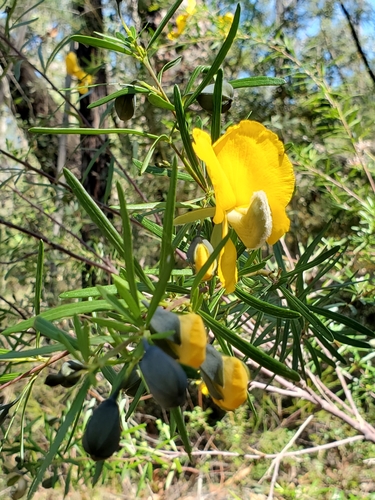
(c) BMRM Ecological Surveys, some rights reserved (CC BY-NC), uploaded by BMRM Ecological Surveys · cc-by-nc
Gompholobium
Sign in to saveGompholobium, commonly known as glory peas or wedge-peas, is a genus of plants in the pea family Fabaceae and is endemic to Australia. Most species have compound leaves composed of three leaflets and all have ten stamens which are free from each other and a distinctive arrangement of their sepals.
Species
Golden Glory Pea
GENUS
- KingdomPlantae
- PhylumTracheophyta
- ClassMagnoliopsida
- OrderFabales
- FamilyFabaceae
Gompholobium ecostatum Gompholobium là một chi thực vật có hoa trong họ Fabaceae, phân họ Faboideae. Đây là chi đặc hữu của Úc.
via GBIF · Kew POWO
Museum specimens
- Specimen records
- 86
- With media
- 72
- Family
- Fabaceae
- Collections
- MEL, RSA, JBRJ, CM, BROWN, LD
- Recorded in
- Australia, AustráLia, Nouvelle-Hollande
Wikidata facts
- Instance of
- taxon
- Parent taxon
- Mirbelieae
- Image
- Gompholobium virgatum - Morren.jpg
Show 6 more facts
- taxon name
- Gompholobium
- taxon rank
- genus
- topic's main category
- Category:Gompholobium
- endemic to
- Australia
- Commons category
- Gompholobium
Sources (1)
via Wikidata · CC0
~4 min read
Encyclopedic overview
6 sectionsContents
- Description
- Taxonomy and naming
- Distribution
- Species
- Ecology
- References
Gompholobium, commonly known as glory peas or wedge-peas, is a genus of plants in the pea family Fabaceae and is endemic to Australia. Most species have compound leaves composed of three leaflets and all have ten stamens which are free from each other and a distinctive arrangement of their sepals.
==Description== Plants in the genus Gompholobium mostly have leaves composed of three separate leaflets but some species have simple leaves and others have pinnate leaves. The leaflets are arranged alternately along the stems and are usually narrow and have smooth edges. The flowers are usually arranged in groups on the ends of the branches, sometimes singly or in pairs. The sepals form a short tube with five lobes longer than the tube. The large "standard" petal at the back of the flower is circular to kidney-shaped and is larger than the other petals. There are ten free stamens and the ovary is glabrous. The fruit is an oblong to almost spherical legume containing two to many ovules.thumb|225px|Gompholobium ecostatum|G. ecostatum growing in [[Anglesea Heath]]
Excerpted from Wikipedia’s “Gompholobium” article, available under the CC BY-SA 4.0 licence.
Gallery (5)
Available in 11 languages
via Wikidata sitelinks · CC0