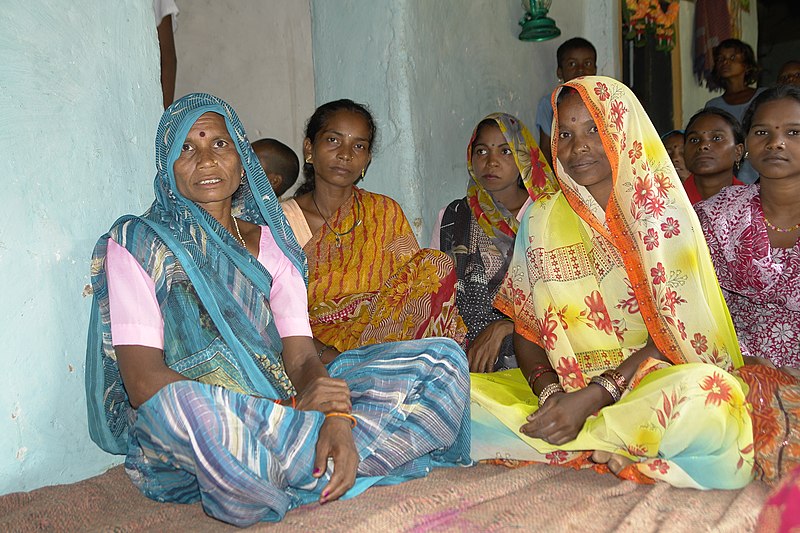
File:Women_in_adivasi_village,_Umaria_district,_India.jpg · Wikimedia Commons · See Wikimedia Commons
Gondi people
Sign in to saveAlso known as Gond people, Gondwadi (Indic people), Gaudi (Indic people), Gondi (Indic people), Ghondi (Indic people), Gondiva (Indic people), Godi (Indic people), Gond Bards (Indic people)
indigenous (Scheduled) tribe from India
Key facts
- Madhya pradesh
- 5,093,124
- Chhattisgarh
- 4,298,404
- Maharashtra
- 1,618,090
- Odisha
- 888,581
- Uttar pradesh
- 569,035
- Andhra pradesh and telangana
- 304,537
- Bihar
- 256,738
- Karnataka
- 158,243
- Jharkhand
- 53,676
- West bengal
- 13,535
- Gujarat
- 2,965
- Nepal
- 12,267
via Wikipedia infobox
Wikidata facts
- Instance of
- ethnic group
- Subclass of
- Dravidian people
- Country
- India
- Image
- Women in tribal village, Umaria district, India.jpg
Show 4 more facts
- described by source
- Nordisk familjebok
- Commons category
- Gondi people
- indigenous to
- Chhattisgarh
- language used
- Gondi
Sources (1)
via Wikidata · CC0
~32 min read
Encyclopedic overview
The Gondi (Gōṇḍī, IPA: [ɡoːɳɖiː]) or Gond people, who refer to themselves as "Kōītōr" (Kōī, Kōītōr, IPA: [koː.iː, koː.iː.t̪oːr]), are an ethnolinguistic group in India. Their native language, Gondi, belongs to the Dravidian family. They are spread over the states of Madhya Pradesh, Maharashtra, Chhattisgarh, Uttar Pradesh, Telangana, Andhra Pradesh, Bihar, and Odisha. They are classified as a Scheduled Tribe for the purpose of India's system of reservation.
The Gond have formed many kingdoms of historical significance. Gondwana was the ruling kingdom in the Gondwana region of India. This includes the eastern part of the Vidarbha of Maharashtra. The Garha Kingdom includes the parts of Madhya Pradesh immediately to the north of it and parts of western Chhattisgarh. The wider region extends beyond these, also including parts of northern Telangana, western Odisha, and southern Uttar Pradesh.
Excerpted from Wikipedia’s “Gondi people” article, available under the CC BY-SA 4.0 licence.