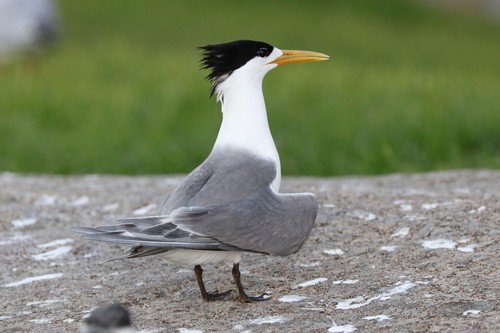
(c) Jens Sommer-Knudsen, some rights reserved (CC BY-NC), uploaded by Jens Sommer-Knudsen · cc-by-nc
Greater Crested Tern
Sign in to saveAlso known as Thalasseus bergii, Great Crested Tern
species of bird
OverviewAI-generated
The Greater Crested Tern (*Thalasseus bergii*) is a species of bird within the family Laridae and order Charadriiformes. It belongs to the class Aves and phylum Chordata, with the taxon name *Thalasseus bergii* accepted under the authority of Lichtenstein, 1823. Other common names for this species include Geelbekseeswael, Dara-laut jambul, and Charrán piquigualdo. The bird is oviparous and inhabits marine environments.
Its taxon range is Africa. The IUCN Red List assessed its conservation status as Least Concern in 2018. Physical and biological records indicate a wingspan of 115, an egg incubation period of 27, and a longest observed lifespan of 22.
Synthesized by Vinony from 31 facts across 5 sources: Wikidata, iNaturalist, WoRMS, IUCN Red List, Vinony graph. Generated from structured data (not the Wikipedia text) and checked against those facts — may still contain errors.
Species
Least Concerngreater crested tern
Species
- PhylumChordata
- ClassAves
- OrderCharadriiformes
- FamilyLaridae
via IUCN
Wikidata facts
- Instance of
- taxon
- Parent taxon
- Thalasseus
- Image
- Crested Tern Tasmania.jpg
Show 12 more facts
- taxon rank
- species
- IUCN conservation status
- Least Concern
- Commons category
- Thalasseus bergii
- taxon name
- Thalasseus bergii
- Commons gallery
- Thalasseus bergii
- wingspan
- 115
- egg incubation period
- 27
- longest observed lifespan
- 22
- taxon common name
- Varevaka
- short name
- T. bergii
- taxon range
- Africa
- has characteristic
- oviparity
via Wikidata · CC0
~17 min read
Encyclopedic overview
The greater crested tern (Thalasseus bergii), also called crested tern, swift tern, or great crested tern, is a tern in the family Laridae that nests in dense colonies on coastlines and islands in the tropical and subtropical Old World. Its four or five subspecies breed in the area from South Africa around the Indian Ocean to the central Pacific and Australia, all populations dispersing widely from the breeding range after nesting. This large tern is closely related to other species in its genus, but can be distinguished by its darker, battleship-grey upperparts, white forehead even in full breeding plumage, and greenish-tinged yellow (not orange or black) bill colour.
The greater crested tern has dark grey upperparts, white underparts, a yellow bill, and a shaggy black crest that recedes in winter. Its young have a distinctive appearance, with strongly patterned grey, brown and white plumage, and rely on their parents for food for several months after they have fledged. Like all members of the genus Thalasseus, the greater crested tern feeds by plunge diving for fish, usually in marine environments; the male offers fish to the female as part of the courtship ritual.
Excerpted from Wikipedia’s “Greater Crested Tern” article, available under the CC BY-SA 4.0 licence.