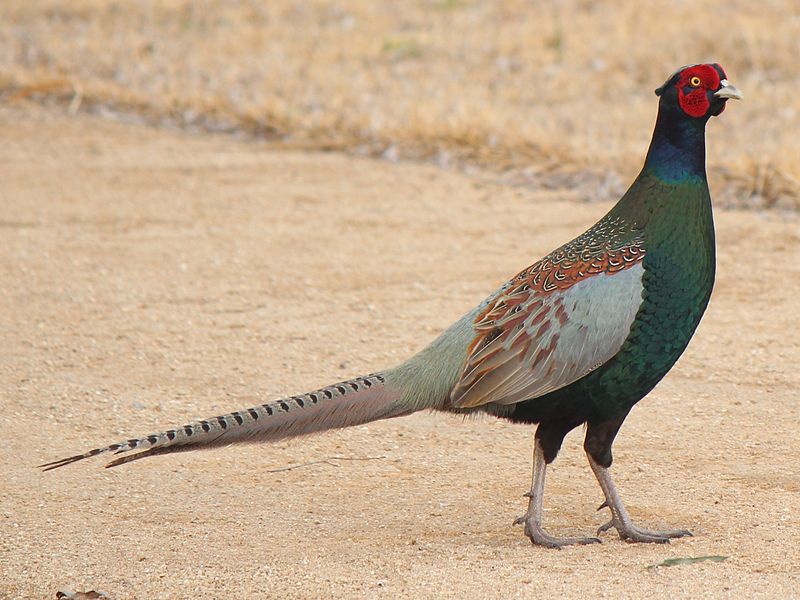
File:Phasianus_versicolor_in_Japan.JPG · Wikimedia Commons · See Wikimedia Commons
OverviewAI-generated
The Green Pheasant (*Phasianus versicolor*) is a species of bird within the genus *Phasianus*. It is classified as a taxon and belongs to the class Aves. The species is an omnivore, with a main food source consisting of insects, plants, grains, and worms. Its mass is 830, and it has a litter size of 8 with an egg incubation period of 25.
The Green Pheasant is listed as Least Concern on the IUCN Red List, a status recorded in 2025. It serves as a symbol of Japan. The species is not extinct and has been observed 2,134 times. Common names for the bird include ffesant werdd, Buntfasan, and Faisán verde.
Synthesized by Vinony from 24 facts across 4 sources: Wikidata, iNaturalist, IUCN Red List, Vinony graph. Generated from structured data (not the Wikipedia text) and checked against those facts — may still contain errors.
Species
Least ConcernGreen Pheasant
species
via IUCN
Wikidata facts
Show 12 more facts
- taxon rank
- species
- IUCN conservation status
- Least Concern
- taxon name
- Phasianus versicolor
- Commons category
- Phasianus versicolor
- Commons gallery
- Phasianus versicolor
- taxon common name
- japonski fazan
- egg incubation period
- 25
- litter size
- 8
- symbol of
- Japan
- has characteristic
- omnivore
- main food source
- grain
- short name
- P. versicolor
Sources (2)
via Wikidata · CC0
~5 min read
Encyclopedic overview
The green pheasant (Phasianus versicolor), also known as the Japanese green pheasant or Kiji, is an omnivorous bird native to the Japanese archipelago, to which it is endemic. Some taxonomic authorities consider it a subspecies of the common pheasant, Phasianus colchicus. It is the national bird of Japan.
Taxonomy and systematics
Excerpted from Wikipedia’s “Green Pheasant” article, available under the CC BY-SA 4.0 licence.