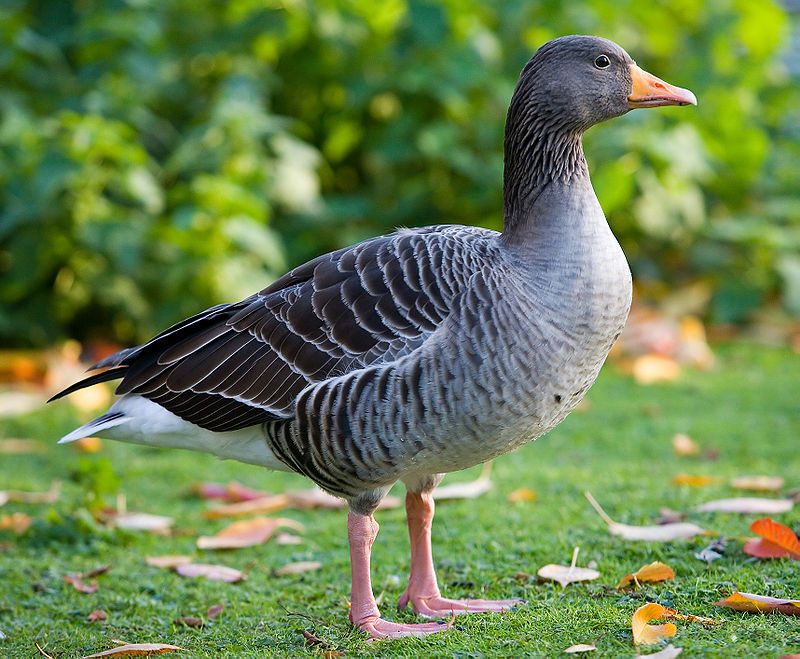
File:Greylag_Goose_-_St_James's_Park,_London_-_Nov_2006.jpg · Wikimedia Commons · See Wikimedia Commons
OverviewAI-generated
The Greylag Goose, scientifically known as Anser anser, is a species of bird classified within the family Anatidae, order Anseriformes, class Aves, and phylum Chordata. It is the nomenclatural type of the genus Anser and is recognized as an accepted species. The organism exhibits diurnality and inhabits marine, brackish, and freshwater environments.
Its range includes the Nanling Mountains, South America, and Africa. The species is listed as Least Concern by the IUCN Red List, a status recorded in 2018. Physical characteristics include a wingspan of 1.55 and a mass of 160. The average litter size is 4.9.
Synthesized by Vinony from 34 facts across 6 sources: Wikidata, IUCN Red List, iNaturalist, WoRMS, Encyclopedia of Life, Vinony graph. Generated from structured data (not the Wikipedia text) and checked against those facts — may still contain errors.
Species
Least Concerngreylag goose
Species
- PhylumChordata
- ClassAves
- OrderAnseriformes
- FamilyAnatidae
ハイイロガン(灰色雁、Anser anser)は、カモ目カモ科マガン属に分類される鳥類。マガン属の模式種。
via IUCN
Wikidata facts
Show 12 more facts
- taxon rank
- species
- IUCN conservation status
- Least Concern
- taxon name
- Anser anser
- Commons category
- Anser anser
- Commons gallery
- Anser anser
- wingspan
- 1.55
- litter size
- 4.9
- taxon common name
- Graylag Goose
- diel cycle
- diurnality
- short name
- A. anser
- taxon range
- Africa
- nomenclatural type of
- Anser
Sources (9)
via Wikidata · CC0
~17 min read
Encyclopedic overview
The greylag goose (Anser anser) is a species of large goose in the waterfowl family Anatidae and the type species of the genus Anser. It has mottled and barred grey and white plumage and an orange beak and pink legs. A large bird, it measures between 74 and 91 centimetres (29 and 36 in) in length, with an average weight of 3.3 kilograms (7 lb 4 oz). Its distribution is widespread, with birds from the north of its range in Europe and Asia often migrating southwards to spend the winter in warmer places, although many populations are resident, even in the north. It is the ancestor of most breeds of domestic goose, having been domesticated at least as early as 1360 BCE. The genus name and specific epithet are from anser, the Latin for "goose". In the USA, its name has been spelled "graylag".
Greylag geese travel to their northerly breeding grounds in spring, nesting on moorlands, in marshes, around lakes and on coastal islands. They normally mate for life and nest on the ground among vegetation. A clutch of three to five eggs is laid; the female incubates the eggs and both parents defend and rear the young. The birds stay together as a family group, migrating southwards in autumn as part of a flock, and separating the following year. During the winter they occupy semi-aquatic habitats, estuaries, marshes and flooded fields, feeding on grass and often consuming agricultural crops. Some populations, such as those in southern England and in urban areas across the species' range, are primarily resident and occupy the same area year-round.
Excerpted from Wikipedia’s “Greylag Goose” article, available under the CC BY-SA 4.0 licence.
Gallery (14)
Available in 102 languages
- Español
- Français
- Deutsch
- 中文
- 日本語
- Русский
- Português
- Italiano
- العربية
- हिन्दी
- Albanian
- Aragonese
- Armenian
- Assamese
- Asturian
- Azerbaijani
- Bahasa Indonesia
- Balinese
Show 83 more
- Bangla
- Bashkir
- Basque
- be_x_old
- Belarusian
- Bikol
- Breton
- Bulgarian
- Burmese
- Catalan
- Cebuano
- Chechen
- Chuvash
- Corsican
- Croatian
- Czech
- Danish
- Egyptian Arabic
- Esperanto
- Estonian
- Faroese
- Fijian
- Filipino
- Finnish
- Galician
- Greek
- Hebrew
- Hungarian
- Icelandic
- Interlingua
- Irish
- Javanese
- Kabardian
- Kazakh
- Latin
- Latvian
- Lithuanian
- Low German
- Macedonian
- Malayalam
- Marathi
- Minangkabau
- Mongolian
- Navajo
- Nederlands
- Nepali
- Northern Frisian
- Northern Sami
- Norwegian
- Norwegian Nynorsk
- olo
- Pashto
- Picard
- Piedmontese
- Polski
- Romanian
- Rusyn
- Scots
- Scottish Gaelic
- Serbian
- Serbian (Latin)
- simple
- Slovak
- Slovenian
- Svenska
- Talysh
- Tamil
- Tatar
- Tiếng Việt
- Türkçe
- Ukrainian
- Urdu
- Veps
- Waray
- Welsh
- Western Frisian
- Western Mari
- Western Panjabi
- Wu Chinese
- Yakut
- zh_yue
- فارسی
- 한국어
via Wikidata sitelinks · CC0