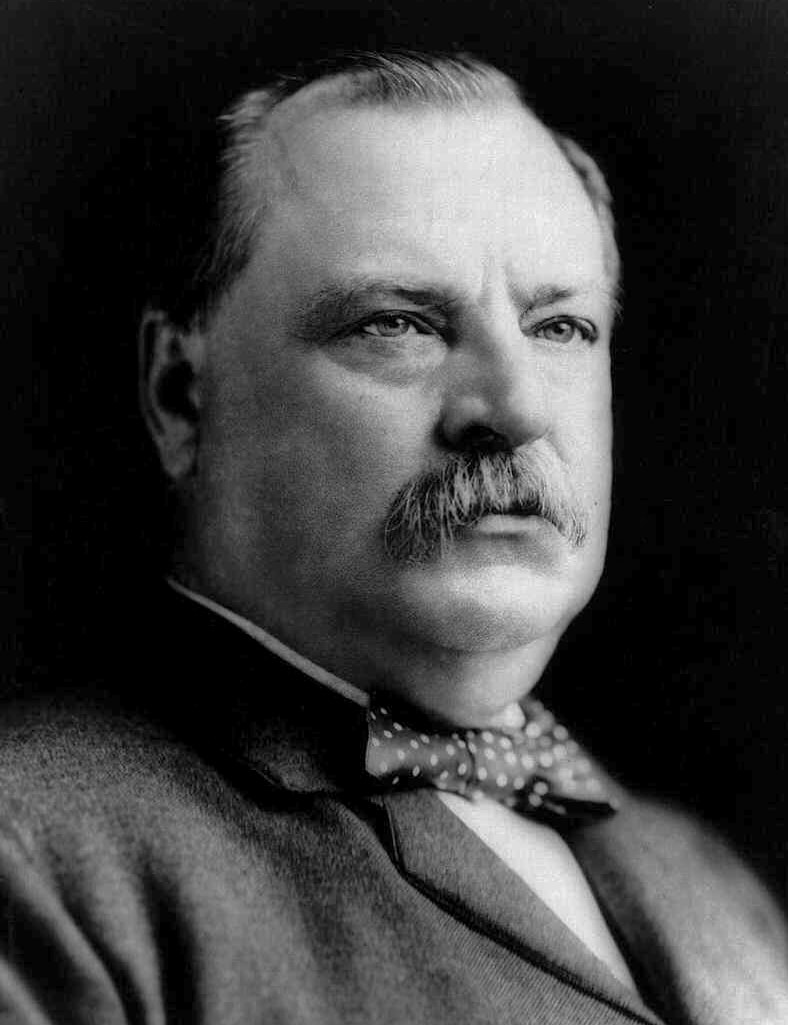
Grover Cleveland
Sign in to saveAlso known as Grover Cleveland Jr., Stephen Grover Cleveland, Stephen Grover Cleveland Jr., S. Grover Cleveland, Stephen G. Cleveland, President Cleveland
Stephen Grover Cleveland was the 22nd and 24th president of the United States, serving from 1885 to 1889 and from 1893 to 1897. He was the first U.S. president to serve nonconsecutive terms and the first Democrat elected president after the American Civil War.
OverviewAI-generated
Stephen Grover Cleveland was an American politician, lawyer, and statesperson who served as the President of the United States and the Governor of New York. A member of the Democratic Party, he was born in Caldwell in 1837 and died in Princeton in 1908 from a myocardial infarction. He was married to Frances Cleveland and had five children. His sibling was Rose Cleveland.
Cleveland’s written works include *A proclamation by the President of the United States of America*, *Addresses, state papers and letters*, *What shall we do with it?*, and *Principles and purposes of our form of government*. He is recognized in the US Presidents collection. His native language was English, and he was a Presbyterian. He is described in sources such as *Appletons' Cyclopædia of American Biography* and the *Armenian Soviet Encyclopedia*.
Synthesized by Vinony from 28 facts across 3 sources: Wikidata, Open Library, Vinony collections. Generated from structured data (not the Wikipedia text) and checked against those facts — may still contain errors.
Person · Open Library
- Born
- 1837
- Died
- 1908
- Works
- 55
Top works
- Governor Altgeld's protests against the use of federal troops in Illinois during the late strike and the President's replies
- A proclamation by the President of the United States of America
- Addresses, state papers and letters
- What shall we do with it?
- What shall we do with it? (meaning the surplus)
via Open Library + Wikidata
Wikipedia views (30d)
122,338 totalvia Wikimedia Pageviews API
Wikidata facts
- Instance of
- human
- Family name
- Cleveland
- Gender
- male
- Citizenship
- United States
- Place of birth
- Caldwell
- Place of death
- Princeton
- Spouse
- Frances Cleveland
- Sibling
- Rose Cleveland
- Occupation
- writer
- Educated at
- Princeton University
- Political party
- Democratic Party (United States)
- Languages spoken
- English language
- Native language
- English language
- Religion
- Presbyterianism
- Image
- Grover Cleveland - NARA - 518139 (cropped).jpg
- Height
- 180
- Number of children
- 5
Show 17 more facts
- Commons category
- Grover Cleveland
- cause of death
- myocardial infarction
- date of birth
- 1837-03-18
- date of death
- 1908-01-01
- topic's main category
- Category:Grover Cleveland
- name in native language
- Grover Cleveland
- manner of death
- natural causes
- birth name
- Stephen Grover Cleveland
- Commons gallery
- Grover Cleveland
- different from
- Grover
- writing language
- English language
- candidacy in election
- 1884 United States presidential election
- ethnic group
- Scotch-Irish Americans
- National Governors Association biography URL
- www.nga.org/governor/steven-grover-cleveland
- archives at
- New York Public Library Main Branch
- Commons Creator page
- Grover Cleveland
- member of
- American Philosophical Society
Sources (11)
via Wikidata · CC0
~40 min read
Encyclopedic overview
Stephen Grover Cleveland (March 18, 1837 – June 24, 1908) was the 22nd and 24th president of the United States, serving from 1885 to 1889 and from 1893 to 1897. He was the first Democrat elected president after the American Civil War and the first U.S. president to serve nonconsecutive terms.
Born in Caldwell, New Jersey, Cleveland was elected mayor of Buffalo in 1881 and governor of New York in 1882. While governor, he closely cooperated with state assembly minority leader Theodore Roosevelt to pass reform measures, winning national attention. He led the Bourbon Democrats, a pro-business movement opposed to high tariffs, free silver, inflation, imperialism, and subsidies to businesses, farmers, or veterans. His crusade for political reform and fiscal conservatism made him an icon for American conservatives of the time. Cleveland also won praise for honesty, self-reliance, integrity, and commitment to classical liberalism. His fight against political corruption, patronage, and bossism convinced many like-minded Republicans, called "Mugwumps", to cross party lines and support him in the 1884 presidential election, which he narrowly won against Republican James G. Blaine.
Excerpted from Wikipedia’s “Grover Cleveland” article, available under the CC BY-SA 4.0 licence.
Gallery (13)
Available in 129 languages
- Español
- Français
- Deutsch
- 中文
- 日本語
- Русский
- Português
- Italiano
- العربية
- हिन्दी
- Afrikaans
- Albanian
- Amharic
- ami
- Aragonese
- Armenian
- Asturian
- Aymara
Show 110 more
- azb
- Azerbaijani
- Bahasa Indonesia
- Balinese
- Bangla
- Basque
- bat_smg
- Bavarian
- be_x_old
- Belarusian
- Bikol
- Bislama
- Bosnian
- Breton
- Bulgarian
- Burmese
- Catalan
- cdo
- Cebuano
- Central Kurdish
- Chuvash
- Cornish
- Corsican
- Croatian
- Czech
- Danish
- Divehi
- Egyptian Arabic
- Esperanto
- Estonian
- Faroese
- Filipino
- Finnish
- Galician
- Georgian
- Greek
- Hakka Chinese
- Hebrew
- Hungarian
- Icelandic
- Ido
- Iloko
- Interlingua
- Irish
- Javanese
- Kazakh
- Kinyarwanda
- Kurdish
- Latin
- Latvian
- Lezghian
- Limburgish
- Lingua Franca Nova
- Lithuanian
- Lombard
- Low German
- Luxembourgish
- Malagasy
- Malay
- Malayalam
- Manx
- Marathi
- Mazanderani
- Mingrelian
- Moroccan Arabic
- Nederlands
- Norwegian
- Norwegian Nynorsk
- Occitan
- Old English
- Pampanga
- Pashto
- Piedmontese
- Polski
- Punjabi
- Romanian
- Romansh
- Scots
- Scottish Gaelic
- Serbian
- Serbian (Latin)
- Sicilian
- simple
- Sinhala
- Slovak
- Slovenian
- Svenska
- Swahili
- Tamil
- Tatar
- Telugu
- Tiếng Việt
- Tumbuka
- Türkçe
- Ukrainian
- Urdu
- Uyghur
- Waray
- Welsh
- Western Frisian
- Western Panjabi
- Wu Chinese
- Yiddish
- Yoruba
- Zaza
- zh_min_nan
- zh_yue
- فارسی
- ไทย
- 한국어
via Wikidata sitelinks · CC0