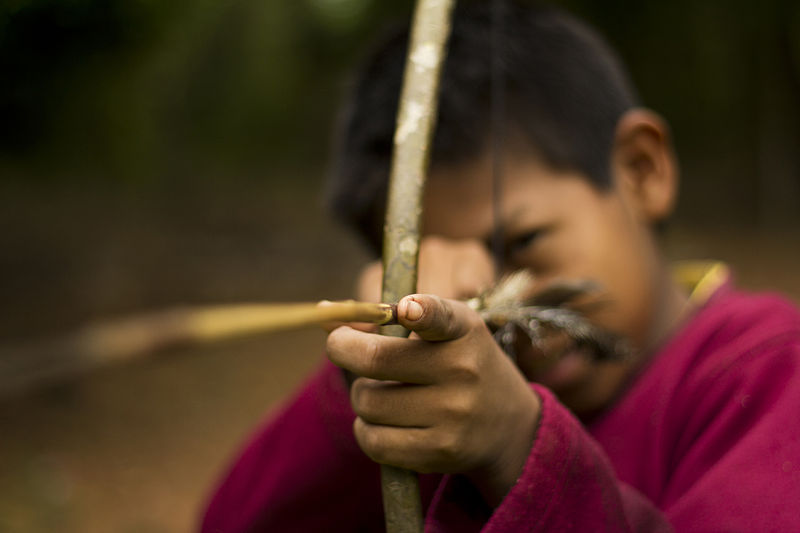
File:Guarani_kid.jpg · Wikimedia Commons · See Wikimedia Commons
Guaraní people
Sign in to saveAlso known as Guarani people, Ka'ayguá, Cainguá, Caaiguá
ethnic group of South America
Key facts
- Argentina
- 135,232 (2022)
- Bolivia
- 103,712 (2024)
- Brazil
- 85,000 (2017)
- Paraguay
- 73,607 (2024)
via Wikipedia infobox
Described at
Guarani Mbya - Indigenous Peoples in Brazil
pib.socioambiental.org →We are a single family in origin - our bodies and way of being are the same, our language and our speech are the same (...) Our ancestors went to Brazil and our kin who came from Brazil are those who were left and they are true Guarani (Part of a speech of the political leader of the village of Pastoreo, Itapua, Paraguai, in 1997). The Mbya identify their “equals”, in the past, through the remembrance of the common use of the same type of tambeao (a cotton garment that the ancestors wove), eating habits and linguistic expressions. They collectively recognize themselves as Ñandeva ekuéry (“all those who are us”). Despite the various types of pressures and interference that the Guarani have suffered over the centuries and the great dispersion of their villages, the Mbya fully recognize themselves as a differentiated group. Thus, despite the occurrence of marriages among the Guarani subgroups, the Mbya maintain a well defined religious and linguistic unity, which allows them to recognize their equals even though they live in villages separated by great geographical distances and surrounded by distinct national societies. With regard to the other Guarani subgroups who live in Brazil . “In the 16th and 17th centuries, the Spaniards, to the extent they advanced in the voyages of exploration and in their expeditions of conquest – and the missionaries in their ‘spiritual conquest’ – they found the Guarani organized into more or less extensive territorial groupings, which they called ‘provinces’, which were recognized by specific names: Cario, Tobatin, Guarambaré, Itatín, Mbaracayú, people of the Guairá, of the Paraná, of the Uruguay, those of the Tape... These provinces covered a vast territory which went from the Atlantic coast to the south of de São Vicente, in Brasil, to the right bank of the Paraguay River, and from the south of the Paranapanema River and the Gran Pantanal, the lake of the Jarayes, to the islands of the delta at Buenos Aires”(Bartomeu Melià, 1991). In the 16th and 17th centuries, the chroniclers used the term “guaranis” for groups who spoke the same language whom they met from the Atlantic Coast to the Paraguai. Small communities designated by the name of the river on the banks of which they built their villages, or by the name of their political chief, comprised the “Guarani nation”. Mulheres guarani mbya na aldeia de Bracuí, em Angra dos Reis (RJ). Foto: Milton Guran, 1988. Cabeza de Vaca (in his “Commentaries”) refers to “villages of Guarani Indians” where he stopped with his men and indigenous guides during the expedition which he undertook in 1541 from the Island of Santa Catarina to Assunção. “This nation of the Guaranis speaks a language that is understood by all the other castes of the province”. With the arrival of the conquerors, the territory occupied by the Guarani became the stage for disputes between the Portuguese and Spaniards. In their project to increase their own dominion, the Spaniards became interested in “increasing” the territory of their “Guarani” allies, at the same time as the Portuguese tried to do the same with their “Carijó” allies, thus overlapping tribal classifications and divisions according to their own interests(cf. Ladeira, 1990, 92). The terms “Guarani” and “Carijó” (or “cario”) designated peoples who over a wide extent of the land spoke the same language, several villages being characterized as warlike and rebellious, while others were peaceful and submissive; thus these terms were employed by chroniclers and historians with no regard for cultural or dialect differences. In the 18th and 19th centuries, the Guarani groups who did not submit to the Spanish encomenderos nor to the Jesuit missions, fled into the mountains and the subtropical forests of the region of the Paraguayan Guaíra and of the Sete Povos (Seven Peoples), these appear in the literature under the generic name of Cainguá, Caaiguá, Ka’ayguá or Kaiguá. Kaygua derives from the word ka’aguygua, which means “i
Excerpt from a page describing this subject · 40,000 chars · not written by Vinony
Wikidata facts
- Instance of
- indigenous peoples in Bolivia
- Subclass of
- indigenous peoples in Brazil
- Has part
- Aché people
- Languages spoken
- Tupi–Guarani
- Native language
- Tupi–Guarani
- Population
- 61701
- Country of origin
- Paraguay
- Image
- Guarani Family.JPG
Show 6 more facts
- Commons category
- Guaraní
- topic's main category
- Category:Guaraní
- different from
- Waorani people
- described at URL
- pib.socioambiental.org/pt/Quadro_Geral_dos_Povos
- native label
- Guarani
- described by source
- Encyclopædia Britannica 11th edition
via Wikidata · CC0
~28 min read
Encyclopedic overview
The Guarani are a group of culturally-related Indigenous peoples of South America. They are distinguished from the related Tupi by their use of the Guarani language. The traditional range of the Guarani people is in what is now Paraguay between the Paraná River and lower Paraguay River, the Misiones Province of Argentina, southern Brazil once as far east as Rio de Janeiro, and parts of Uruguay and Bolivia.
Although their demographic dominance of the region has been reduced by European colonisation and the commensurate rise of mestizos, there are contemporary Guarani populations in Paraguay and parts of Argentina and Bolivia. Most notably, the Guarani language, still widely spoken across traditional Guarani homelands, is one of the two official languages in Paraguay, the other one being Spanish. The Paraguayan population learns Guarani both informally from social interaction and formally in public schools. In modern Spanish, Guaraní also refers to any Paraguayan national in the same way that the French are sometimes called Gauls.
Excerpted from Wikipedia’s “Guaraní people” article, available under the CC BY-SA 4.0 licence.