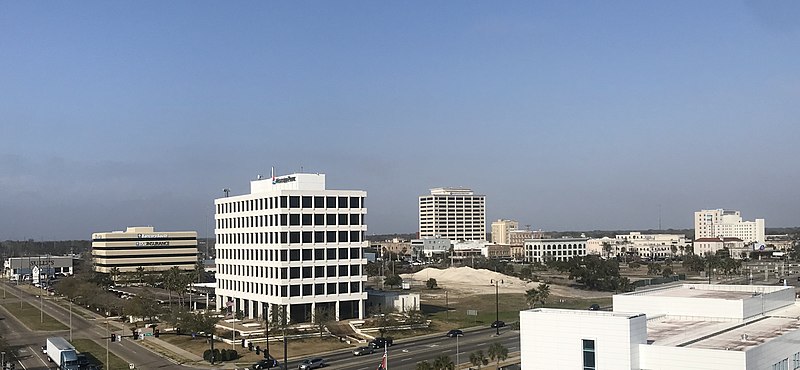
File:Gulfport,_Mississippi_Skyline_(2022).jpg · Wikimedia Commons · See Wikimedia Commons
Gulfport is a city located on the Gulf Coast of Mississippi. It serves as an important port and commercial hub for the region, handling significant maritime trade and serving as a center for tourism and industry in southern Mississippi.
AI-generated from the Wikipedia summary — may contain errors.
Wikidata facts
- Instance of
- city in the United States
- Official name
- Gulfport
- Country
- United States
- Located in
- Harrison County
- Population
- 72926
- Area
- 21.710652
- Elevation
- 6
- Time zone
- Central Time Zone
- Capital of
- Harrison County
- Official website
- www.gulfport-ms.gov
- Image
- 25thAve&13thSt.jpg
- Households
- 28193
- Dialing code
- 228
Show 8 more facts
- postal code
- 39503
- Commons category
- Gulfport, Mississippi
- topic's main category
- Category:Gulfport, Mississippi
- inception
- 1887-00-00
- category of associated people
- Category:People from Gulfport, Mississippi
- P8168
- Shozhym
- water as percent of area
- 13.1286
- per capita income
- 23907
Sources (13)
via Wikidata · CC0
~21 min read
Encyclopedic overview
Gulfport (/ˈɡʌlfˌpɔːrt/ GUHLF-port) is a port city in Harrison County, Mississippi, United States, and its co-county seat. It had a population of 72,926 at the 2020 census, making it the second-most populous city in Mississippi after Jackson. The Gulfport–Biloxi metropolitan area had a population of 416,259. Gulfport lies along the Gulf Coast of the United States in southern Mississippi, taking its name from its port on the Gulf Coast on the Mississippi Sound.
Gulfport emerged from two earlier settlements, Mississippi City and Handsboro. Founded in 1887 by William H. Hardy as a terminus for the Gulf and Ship Island Railroad, the city was further developed by Philadelphia oil tycoon Joseph T. Jones, who funded the railroad, harbor, and channel dredging. The city was officially incorporated in 1898. By the early 20th century, Gulfport had become the largest lumber export city in the United States, though this faded with the depletion of Mississippi's Piney Woods. The city transitioned into tourism through its white beaches, grand hotels, and significant casino gaming operations.
Excerpted from Wikipedia’s “Gulfport” article, available under the CC BY-SA 4.0 licence.
Gallery (12)
On the map
Available in 64 languages
- Español
- Français
- Deutsch
- 中文
- 日本語
- Русский
- Português
- Italiano
- العربية
- Aragonese
- Asturian
- azb
- Bahasa Indonesia
- Bangla
- Basque
- Breton
- Bulgarian
- Catalan
Show 45 more
- Cebuano
- Chechen
- Cornish
- Czech
- dag
- Danish
- Egyptian Arabic
- Finnish
- Gilaki
- Greek
- Haitian Creole
- Hebrew
- Hungarian
- Ido
- Interlingua
- Irish
- Kazakh
- Kyrgyz
- lld
- Malagasy
- Mazanderani
- Nederlands
- Norwegian
- Old English
- Ossetic
- Polski
- Scottish Gaelic
- Serbian
- Serbian (Latin)
- simple
- Svenska
- Swahili
- Tatar
- Tiếng Việt
- Türkçe
- Ukrainian
- Urdu
- Uzbek
- Volapük
- Waray
- Welsh
- Western Frisian
- zh_min_nan
- فارسی
- 한국어
via Wikidata sitelinks · CC0