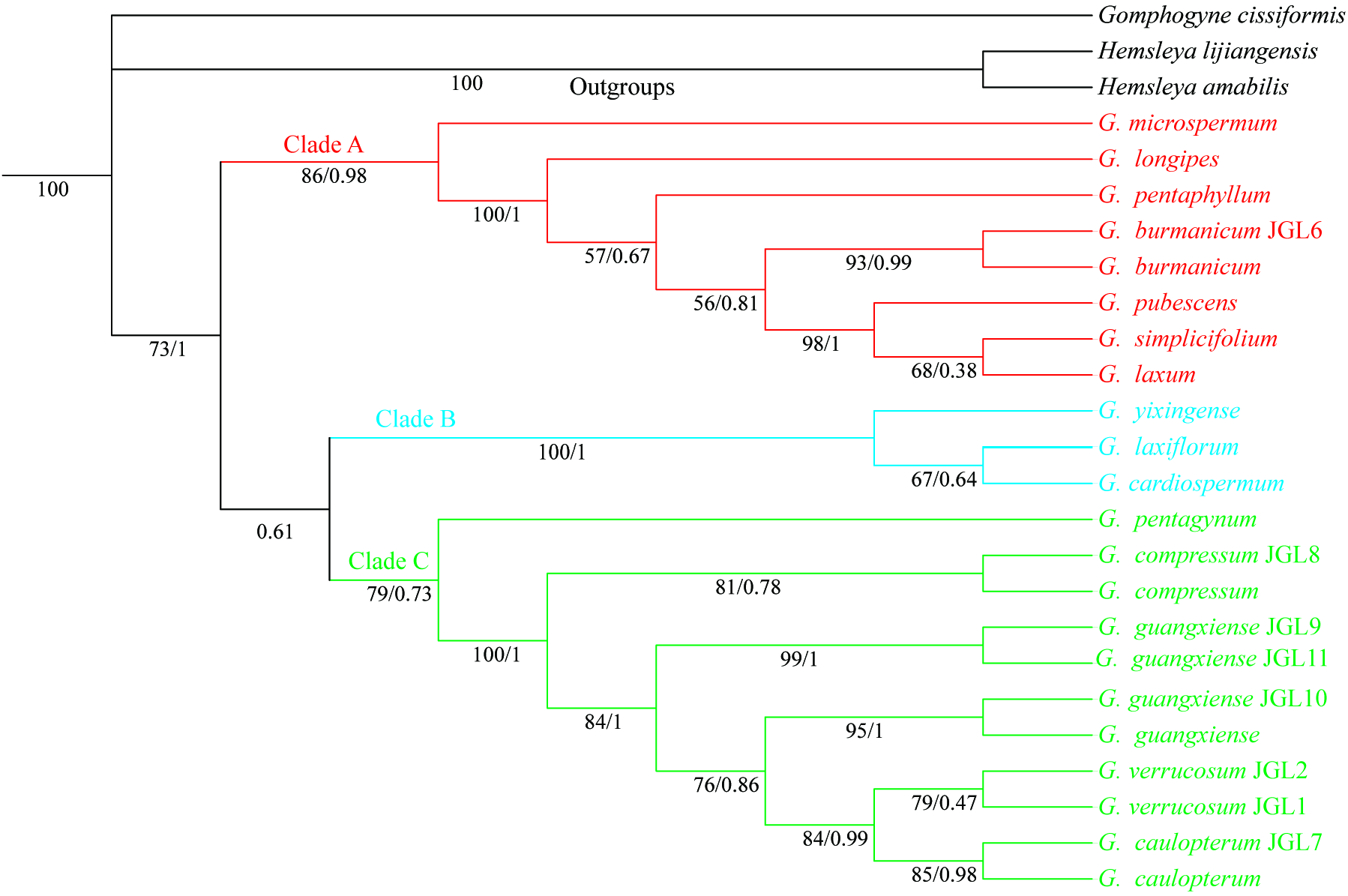
Huang, Xue-Yan;Nong, Dong-Xin;Huang, Bao-You;Yao, Li-Xiang;Yao, Ji-Jun;Yu, Li-Ying;Huang, Lu-Qi
Gynostemma
Sign in to saveGynostemma is a genus of perennial climbing vines in the cucumber, gourd, and melon family, comprising at least 19 species, all native to the tropical East or Far East, inclusive of the Himalayas: China (with 9 endemic); the islands of Japan; Malaysia; and New Guinea. The term Gynostemma is derived from Ancient Greek γυνή meaning "woman" or "female", and στέμμα meaning "wreath" or "garland". In (post-)classical Latin the form stemma is attested as Greek loanword. In Ancient Greek and Latin, stemma is of neuter gender. German-Dutch botanist Carl Ludwig Blume described Gynostemma from two specie
Species
southern ginseng
GENUS
- KingdomPlantae
- PhylumTracheophyta
- ClassMagnoliopsida
- OrderCucurbitales
- FamilyCucurbitaceae
via GBIF · Kew POWO
Museum specimens
- Specimen records
- 137
- With media
- 115
- Family
- Cucurbitaceae
- Collections
- YPM, A, MO, BRIT, VT
- Recorded in
- China, Philippines, Laos, Vietnam
Research
686 papers- Progress in the Medicinal Value, Bioactive Compounds, and Pharmacological Activities of Gynostemma pentaphyllum.Molecules (Basel, Switzerland) · 2021
- The Role of Gynostemma pentaphyllum in Regulating Hyperlipidemia.The American journal of Chinese medicine · 2023
- Triterpenoids from the genus Gynostemma: Chemistry and pharmacological activities.Journal of ethnopharmacology · 2021
- Phytochemistry, bioactivities and application of Gynostemma pentaphyllum polysaccharide: A review.International journal of biological macromolecules · 2025
- Saponins derived from Gynostemma pentaphyllum regulate triglyceride and cholesterol metabolism and the mechanisms: A review.Journal of ethnopharmacology · 2024
via PubMed
Wikidata facts
- Instance of
- taxon
- Image
- Gynostemma pentaphyllum vine.jpg
Show 8 more facts
- taxon name
- Gynostemma
- taxon rank
- genus
- Commons category
- Gynostemma
- topic's main category
- Category:Gynostemma
- taxon common name
- 绞股蓝属
- taxon author citation
- l.Q.Huang, D.X.Nong & X.Y.Huang, 2024
- location of discovery
- Guangxi
Sources (2)
via Wikidata · CC0
~2 min read
Encyclopedic overview
3 sectionsContents
- General description
- Selected species
- References
Gynostemma is a genus of perennial climbing vines in the cucumber, gourd, and melon family, comprising at least 19 species, all native to the tropical East or Far East, inclusive of the Himalayas: China (with 9 endemic); the islands of Japan; Malaysia; and New Guinea. The term Gynostemma is derived from Ancient Greek γυνή meaning "woman" or "female", and στέμμα meaning "wreath" or "garland". In (post-)classical Latin the form stemma is attested as Greek loanword. In Ancient Greek and Latin, stemma is of neuter gender. German-Dutch botanist Carl Ludwig Blume described Gynostemma from two species he named: G. pedata (later changed, to pedatum) and G. simplicifolia (also later changed, to simplicifolium). Neither species was clearly designated by him as the type; however, the former species, G. pedatum is now considered to be a synonym of G. pentaphyllum (Thunb.) Makino. The genus was published in 1825, in Carl Ludwig von Blume's Bijdragen tot de flora van Nederlandsch Indië ("Contributions to the flora of the Dutch East Indies").
==General description== All species of Gynostemma have tendrils (usually branching); most are dioecious. The leaves are usually in palmately arrayed leaflets (3–9, ovate-lanceolate in shape), arranged alternately on the stem; a few species are leaved, but without leaflets. Inflorescences are either racemose or paniculate. Fruits can be capsular or pea-like, containing two or three seeds.
Excerpted from Wikipedia’s “Gynostemma” article, available under the CC BY-SA 4.0 licence.