Encyclopedia of Life · EOL (see source)
Haloclavidae
Sign in to saveHaloclavidae is a family of sea anemones. Members of the family are found worldwide and many live largely buried in soft substrates with only their oral disc and tentacles protruding.
Species
コンボウイソギンチャク科
FAMILY
- KingdomAnimalia
- PhylumCnidaria
- ClassAnthozoa
- OrderActiniaria
- FamilyHaloclavidae
Haloclavidae is een familie uit de orde van de zeeanemonen (Actiniaria). De familie is voor het eerst wetenschappelijk beschreven door Verrill in 1899.[1] De familie omvat 6 geslachten en 25 soorten.[2] Geslachten Anemonactis Eloactis Haloclava Verrill, 1899 Harenactis Torrey, 1902 Ilyanthus Forbes, 1840 Mesacmaea Andres, 1883 Metapeachia Oractis McMurrich, 1893 Peachia Gosse, 1855 Philomedusa Siphonactinia Stephanthus Bronnen, noten en/of referenties ↑ World Register of Marine Species, Haloclavidae. Marinespecies.org. Geraadpleegd op 22-11-2011. ↑ Synopsis of described Actinaria of the World
via GBIF
Museum specimens
- Specimen records
- 8
- Family
- Haloclavidae
- Collections
- SBMNH, QM, WAM, FWRI, AM
- Recorded in
- Mexico, Australia, Antarctica, United States
Wikidata facts
- Instance of
- taxon
- Parent taxon
- Actinioidea
- Image
- Peachia quinquecapitata.jpg
Show 4 more facts
- Commons category
- Haloclavidae
- taxon name
- Haloclavidae
- topic's main category
- Category:Haloclavidae
- taxon rank
- family
Sources (1)
via Wikidata · CC0
~2 min read
Encyclopedic overview
3 sectionsContents
- Characteristics
- Genera
- References
Haloclavidae is a family of sea anemones. Members of the family are found worldwide and many live largely buried in soft substrates with only their oral disc and tentacles protruding.
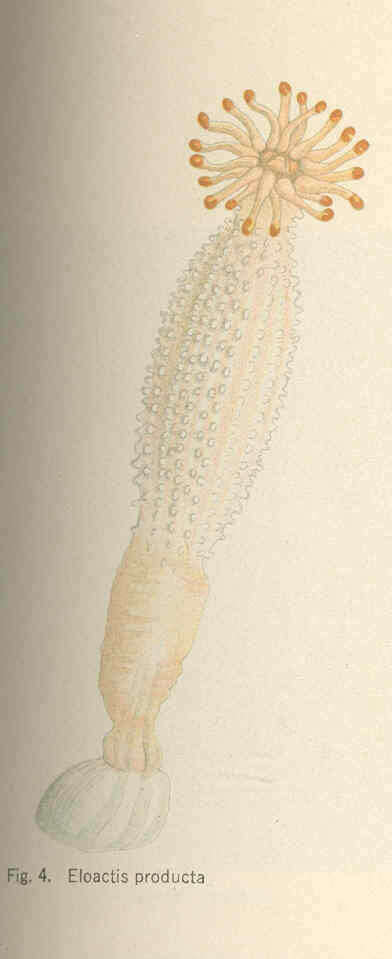
==Characteristics== Members of this family mostly have elongated columns which are often differentiated into different regions. The column is either smooth or has tubercles or suckers on its surface. The base is often rounded and used for digging but in some species it is flattened and adhesive to small objects. There is usually no sphincter but when one is present, it is endodermal. The tentacles are short and there are seldom more than 48, arranged cyclically. The mesenteries or internal tissue walls are few. There are no muscles attaching them to the basal disc but they do have strong retractor muscles. At least six pairs of the mesenteries are perfect, reaching from the base as far as the actinopharynx or throat of the anemone. There is a single, well defined siphonoglyph, a ciliated groove, which is often elongated and nearly detached from the rest of the actinopharynx.
Excerpted from Wikipedia’s “Haloclavidae” article, available under the CC BY-SA 4.0 licence.