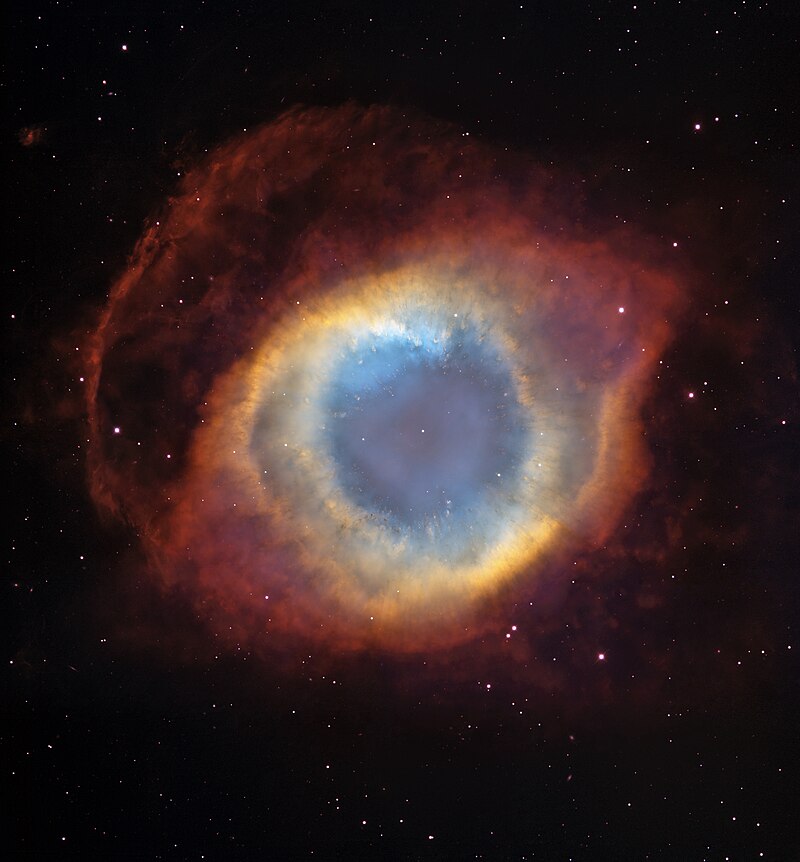
File:NGC7293_(2004).jpg · Wikimedia Commons · See Wikimedia Commons
Helix Nebula
Sign in to saveAlso known as The Helix, Caldwell 63, Eye of God, Eye of Sauron
planetary nebula
The Helix Nebula is a planetary nebula, which forms when a dying star sheds its outer layers of gas into space, creating a glowing shell of material. It's a striking example of stellar death that helps astronomers understand how stars like our Sun eventually end their lives.
AI-generated from the Wikipedia summary — may contain errors.
Astronomical data · SIMBAD
- Object type
- PN
- Spectral type
- DAO.5
- Distance
- 651 light-years
- Redshift
- z = -0.000050033362611112686
- Coordinates
- RA 337.4106° · Dec -20.8372°
via SIMBAD · CDS Strasbourg
Wikidata facts
- Constellation
- Aquarius
- Distance from Earth
- 159
- Image
- NGC 7293.jpg
Show 16 more facts
- right ascension
- 337.41060544917610
- declination
- -20.83715169252910
- catalog code
- Gaia DR2 6628874205642084224
- epoch
- J2000.0
- Commons category
- Helix Nebula
- Commons gallery
- Helix Nebula
- discoverer or inventor
- Karl Ludwig Harding
- apparent magnitude
- 14.55
- radial velocity
- -15.0
- time of discovery or invention
- 1824-00-00
- effective temperature
- 94640
- spectral class
- DAO.5
- parallax
- 1
- surface gravity
- 42000000
- right ascension component of proper motion
- 30
- declination component of proper motion
- -1
Sources (1)
via Wikidata · CC0
~6 min read
Encyclopedic overview
The Helix Nebula (also known as NGC 7293 or Caldwell 63) is a planetary nebula (PN) located in the constellation Aquarius. Discovered by Karl Ludwig Harding, most likely before 1824, this object is one of the closest of all the bright planetary nebulae to Earth. The distance, measured by the Gaia mission, is 655±13 light-years. It is similar in appearance to the Cat's Eye Nebula and the Ring Nebula, whose size, age, and physical characteristics are in turn similar to the Dumbbell Nebula, differing only in their relative proximity and the appearance from the equatorial viewing angle. The Helix Nebula has sometimes been referred to as the "Eye of God" in pop culture, as well as the "Eye of Sauron".
General information
Excerpted from Wikipedia’s “Helix Nebula” article, available under the CC BY-SA 4.0 licence.