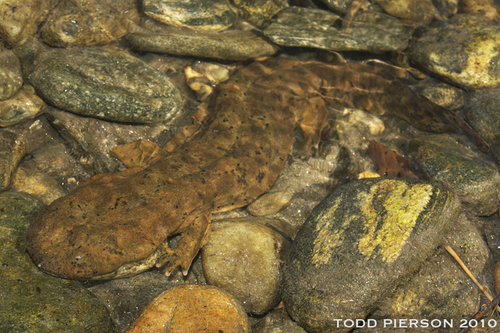
(c) Todd Pierson, some rights reserved (CC BY-NC-SA) · cc-by-nc-sa
hellbender
Sign in to saveAlso known as Cryptobranchus alleganiensis, Cryptobranchus alleghaniensis, water-dog, mud-puppy, water-puppy
The hellbender (Cryptobranchus alleganiensis), also known as the hellbender salamander, is a species of aquatic giant salamander endemic to the eastern and central United States. It is the largest salamander in North America. A member of the family Cryptobranchidae, the hellbender is the only extant member of the genus Cryptobranchus. Other closely related salamanders in the same family are in the genus Andrias, which contains the Japanese and Chinese giant salamanders. The hellbender is much larger than any other salamander in its geographic range, and employs an unusual adaption for respirat
OverviewAI-generated
The hellbender, scientifically named *Cryptobranchus alleganiensis*, is a species of amphibian belonging to the genus *Cryptobranchus*. It is endemic to the United States. The species has been present for about 850 thousand years and was described in the *Encyclopædia Britannica* 11th edition.
The IUCN Red List classifies the hellbender as Vulnerable, a status assigned in 2022. The organism is also referred to by the common name "sacavera aligátor."
Synthesized by Vinony from 19 facts across 4 sources: Wikidata, iNaturalist, IUCN Red List, Vinony graph. Generated from structured data (not the Wikipedia text) and checked against those facts — may still contain errors.
Species
VulnerableHellbender
species
美洲大鯢(Cryptobranchus alleganiensis),是一種水生兩棲動物。分佈於美國東部,棲息于水淺、流速快及含氧量高的河流、溪流中。以魚和蝦為主食,偶爾吃腐肉。視力很差,嗅覺靈敏。人工飼養的美洲大鯢壽命在30歲左右。 生殖 一般產卵時期為8月,於體外受精,卵生,受精卵的孵化期約50天。 形狀 美洲大鯢體長32釐米;重約2公斤。身體扁平,身上佈滿粘液,擁有四肢和尾巴。 ^ Bredehoeft, Keila E.; Schubert, Blaine W. A Re-Evaluation of the Pleistocene Hellbender, Cryptobranchus guildayi. Journal of Herpetology. 2015, 49: 157. doi:10.1670/12-222. ^ Geoffrey Hammerson, Christopher Phillips. Cryptobranchus alleganiensis. IUCN Red List of Threatened Species (IUCN). 2004, 2004: e.T59077A11879843 [23 February 2016]. doi:10.2305/IUCN.UK.2004.RLTS.T59077A11879843.en. 取自“https://zh.wikipedia.org/w/index.php?title=美洲大鲵&oldid=47473790” 分类:IUCN近危物種 隐藏分类:物种微格式条目
via IUCN
Wikidata facts
- Instance of
- taxon
- Parent taxon
- Cryptobranchus
- Image
- Hellbender.jpg
Show 9 more facts
- taxon rank
- species
- IUCN conservation status
- Vulnerable
- Commons category
- Cryptobranchus alleganiensis
- taxon name
- Cryptobranchus alleganiensis
- Commons gallery
- Cryptobranchus alleganiensis
- taxon common name
- sacavera aligátor
- endemic to
- United States
- start time
- 850000-00-
- described by source
- Encyclopædia Britannica 11th edition
Sources (3)
via Wikidata · CC0
~23 min read
Encyclopedic overview
16 sectionsContents
- Etymology
- Description
- Taxonomy
- Distribution
- Ecology
- Life history and behavior
- Behavior
- Diet
- Reproduction
- Adaptations
- Conservation status
- Threats
- See also
- References
- Further reading
- External links
The hellbender (Cryptobranchus alleganiensis), also known as the hellbender salamander, is a species of aquatic giant salamander endemic to the eastern and central United States. It is the largest salamander in North America. A member of the family Cryptobranchidae, the hellbender is the only extant member of the genus Cryptobranchus. Other closely related salamanders in the same family are in the genus Andrias, which contains the Japanese and Chinese giant salamanders. The hellbender is much larger than any other salamander in its geographic range, and employs an unusual adaption for respiration through cutaneous gas exchange via capillaries found in its lateral skin folds. It fills a particular niche—both as a predator and prey—in its ecosystem, which either it or its ancestors have occupied for around 65 million years. The species is listed as Vulnerable on the IUCN Red List of Threatened Species due to the impacts of disease and widespread habitat loss and degradation throughout much of its range.
==Etymology== The origin of the name "hellbender" is unclear. The Missouri Department of Conservation says: The name 'hellbender' probably comes from the animal's odd look. One theory claims the hellbender was named by settlers who thought "it was a creature from hell where it's bent on returning." Another rendition says the undulating skin of a hellbender reminded observers of "horrible tortures of the infernal regions." In reality, it's a harmless aquatic salamander.In 1802, while traveling through the Holston Valley in present-day North Carolina and Virginia, French explorer François Michaux encountered a giant salamander and recorded that enslaved African American men in the area referred to it as a “hellbender,” indicating the name was already in common use.
Excerpted from Wikipedia’s “hellbender” article, available under the CC BY-SA 4.0 licence.