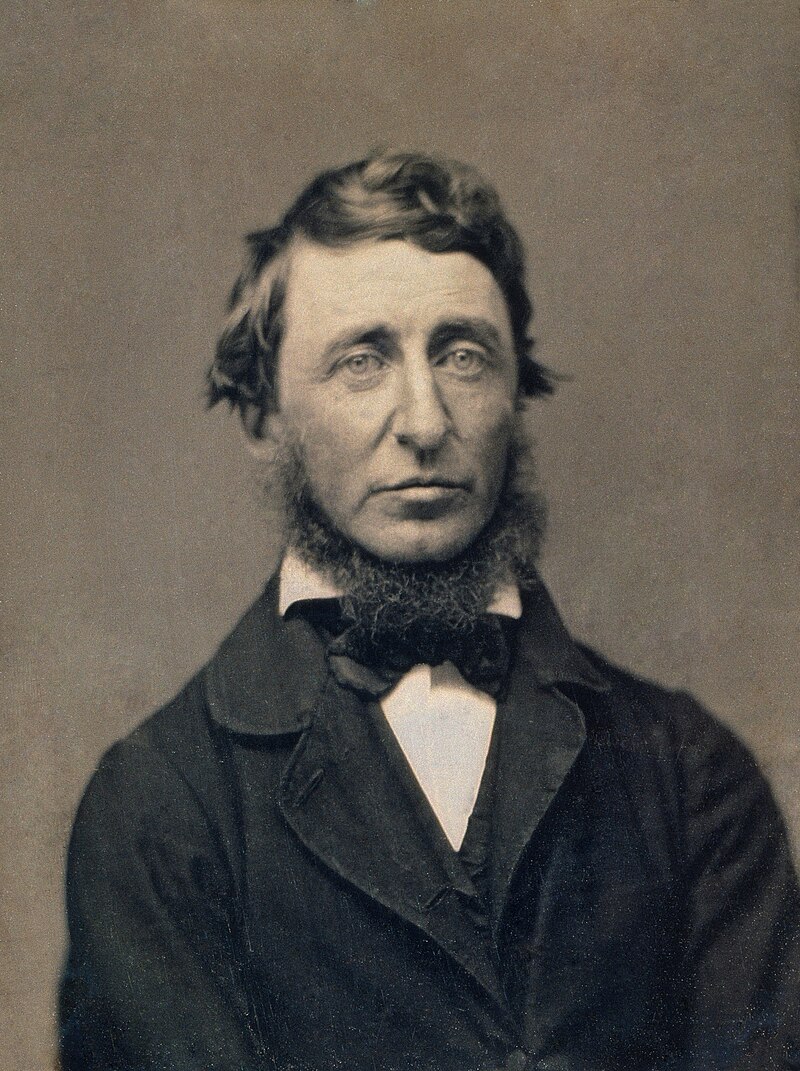
File:Benjamin_D._Maxham_-_Henry_David_Thoreau_-_Restored.jpg · Wikimedia Commons · See Wikimedia Commons
Henry David Thoreau
Sign in to saveAlso known as Thoreau, Henry D. Thoreau, Henry Thoreau
American essayist, poet, and philosopher (1817–1862)
Henry David Thoreau was an American writer and thinker who lived from 1817 to 1862 and is known for his essays, poetry, and philosophical ideas. His work continues to influence how people think about nature, society, and how to live a meaningful life.
AI-generated from the Wikipedia summary — may contain errors.
Wikidata facts
- Instance of
- human
- Given name
- David
- Gender
- male
- Citizenship
- United States
- Place of birth
- Concord
- Place of death
- Concord
- Occupation
- environmentalist
- Educated at
- Harvard University
- Languages spoken
- English language
- Native language
- English language
- Religion
- Unitarianism
- Notable work
- Civil Disobedience
- Field of work
- history
- Genre
- transcendentalism
- Movement
- Western philosophy
- Image
- Henry David Thoreau 2.jpg
Show 23 more facts
- place of burial
- Sleepy Hollow Cemetery
- Commons category
- Henry David Thoreau
- cause of death
- tuberculosis
- date of birth
- 1817-07-12
- date of death
- 1862-05-06
- topic's main category
- Category:Henry David Thoreau
- Commons gallery
- Henry David Thoreau
- medical condition
- tuberculosis
- lifestyle
- vegetarianism
- influenced by
- Alexander von Humboldt
- P6944
- Henry David Thoreau
- birth name
- David Henry Thoreau
- manner of death
- natural causes
- Commons Creator page
- Henry David Thoreau
- archives at
- Beinecke Rare Book & Manuscript Library
- name in native language
- Henry David Thoreau
- has works in the collection
- J. Paul Getty Museum
- writing language
- English language
- time period
- 19th-century philosophy
- facial hair
- chin curtain
- on focus list of Wikimedia project
- Wikipedia:Vital articles/Level/4
- P12674
- 15727 Ianmorison
- P12749
- Nannestad
Sources (11)
via Wikidata · CC0
Works in European collections
1 object attributed to Henry David Thoreau, held across European museums, libraries & archives · via Europeana

~40 min read
Encyclopedic overview
Henry David Thoreau (born David Henry Thoreau; July 12, 1817 – May 6, 1862) was an American naturalist, essayist, poet, and philosopher. A leading transcendentalist, he is best known for his book Walden, a reflection upon simple living in natural surroundings, and his essay "Civil Disobedience" (originally published as "Resistance to Civil Government"), an argument in favor of citizen disobedience against an unjust state.
Thoreau's books, journals, and poetry amount to more than 20 volumes. Among his lasting contributions are his writings on natural history and philosophy, in which he anticipated the methods and findings of ecology and environmental history, two sources of modern-day environmentalism. His literary style interweaves close observation of nature, personal experience, pointed rhetoric, symbolic meanings, and historical lore, while displaying a poetic sensibility, philosophical austerity, and attention to practical detail. He was also deeply interested in the idea of survival in the face of hostile elements, historical change, and natural decay; at the same time he advocated abandoning waste and illusion to discover life's true essential needs.
Excerpted from Wikipedia’s “Henry David Thoreau” article, available under the CC BY-SA 4.0 licence.
Gallery (12)
Available in 88 languages
- Español
- Français
- Deutsch
- 中文
- 日本語
- Русский
- Português
- Italiano
- العربية
- हिन्दी
- Afrikaans
- Armenian
- Asturian
- Azerbaijani
- Bahasa Indonesia
- Bangla
- Basque
- Belarusian
Show 69 more
- Breton
- Bulgarian
- Catalan
- Central Kurdish
- Croatian
- Czech
- Danish
- Egyptian Arabic
- Esperanto
- Estonian
- Faroese
- Filipino
- Finnish
- Galician
- Georgian
- Greek
- Hebrew
- Hungarian
- Ido
- Irish
- Kazakh
- Kotava
- Kurdish
- Kyrgyz
- Latin
- Latvian
- Lithuanian
- Malagasy
- Malayalam
- Marathi
- Mingrelian
- Nederlands
- Nepali
- Newari
- Norwegian
- Norwegian Nynorsk
- Occitan
- Pashto
- Polski
- Punjabi
- Romanian
- Sardinian
- Scots
- Scottish Gaelic
- Serbian
- Serbian (Latin)
- simple
- Sindhi
- Slovak
- Slovenian
- Svenska
- Tajik
- Tamil
- Tiếng Việt
- Türkçe
- Ukrainian
- Urdu
- Venetian
- Waray
- Welsh
- Western Frisian
- Western Panjabi
- Wu Chinese
- Yoruba
- Zaza
- zh_yue
- فارسی
- ไทย
- 한국어
via Wikidata sitelinks · CC0