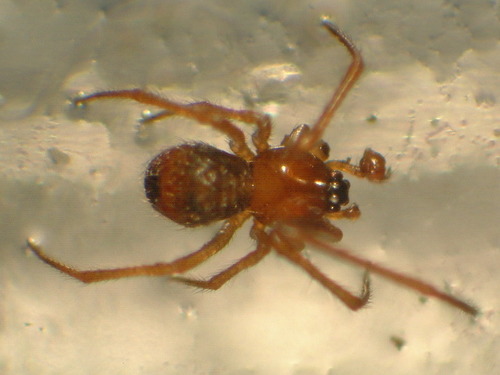
(c) cheins1, all rights reserved, uploaded by cheins1
Hentziectypus
Sign in to saveHentziectypus is a genus of comb-footed spiders that was first described by Allan Frost Archer in 1946. Originally placed with Theridion, it was moved to Achaearanea in 1955, and to its own genus in 2008. These spiders most resemble members of Cryptachaea, but are distinguished by a median apophysis that is broadly attached to the tegulum. Spiders of Parasteatoda have a median apophysis attached to the embolus, while those of Achaearanea have a hooked paracymbium on the pedipalps of males.
Species
Fingered Cobweaver
GENUS
- KingdomAnimalia
- PhylumArthropoda
- ClassArachnida
- OrderAraneae
- FamilyTheridiidae
via GBIF
Museum specimens
- Specimen records
- 2
- Family
- Theridiidae
- Collections
- FMNH
- Recorded in
- MéXico, Honduras
Wikidata facts
- Instance of
- taxon
- Parent taxon
- Theridiidae
- Image
- Hentziectypus globosus 1.jpg
Show 3 more facts
- taxon name
- Hentziectypus
- taxon rank
- genus
- Commons category
- Hentziectypus
Sources (1)
via Wikidata · CC0
~2 min read
Encyclopedic overview
2 sectionsContents
- Species
- References
Hentziectypus is a genus of comb-footed spiders that was first described by Allan Frost Archer in 1946. Originally placed with Theridion, it was moved to Achaearanea in 1955, and to its own genus in 2008. These spiders most resemble members of Cryptachaea, but are distinguished by a median apophysis that is broadly attached to the tegulum. Spiders of Parasteatoda have a median apophysis attached to the embolus, while those of Achaearanea have a hooked paracymbium on the pedipalps of males.
==Species== it contains twelve species, found in the Americas and in the Caribbean, including Cuba, Jamaica, Panama, and Bermuda: Hentziectypus annus (Levi, 1959) – Jamaica, Bermuda Hentziectypus apex (Levi, 1959) – Panama Hentziectypus conjunctus (Gertsch & Mulaik, 1936) – USA, Canada Hentziectypus florendidus (Levi, 1959) – USA to Venezuela Hentziectypus florens (O. Pickard-Cambridge, 1896) – USA to Panama, Cuba Hentziectypus globosus (Hentz, 1850) (type) – North America Hentziectypus hermosillo (Levi, 1959) – Mexico Hentziectypus rafaeli (Buckup & Marques, 1991) – Bolivia, Brazil Hentziectypus schullei (Gertsch & Mulaik, 1936) – USA, Mexico Hentziectypus serax (Levi, 1959) – Mexico Hentziectypus tayrona Buckup, Marques & Rodrigues, 2012 – Colombia Hentziectypus turquino (Levi, 1959) – Cuba
Excerpted from Wikipedia’s “Hentziectypus” article, available under the CC BY-SA 4.0 licence.
Available in 7 languages
via Wikidata sitelinks · CC0