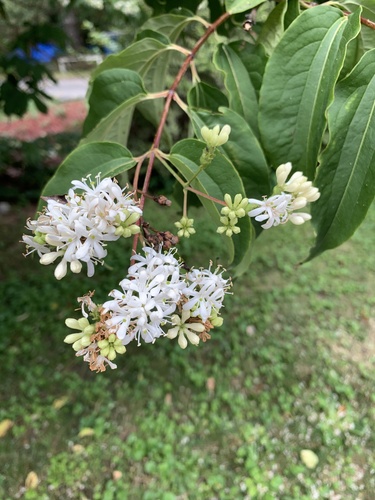
(c) annpoznanski, some rights reserved (CC BY-NC) · cc-by-nc
Heptacodium
Sign in to saveHeptacodium miconioides, the seven-son flower, is a species of flowering plant. It is the sole species in the monotypic genus Heptacodium, of the honeysuckle family Caprifoliaceae. The common name "seven-son flower" is a direct translation of the Standard Chinese name 七子花 qī zi huā.
Species
Seven Sons Tree
GENUS
- KingdomPlantae
- PhylumTracheophyta
- ClassMagnoliopsida
- OrderDipsacales
- FamilyCaprifoliaceae
via GBIF · Kew POWO
Museum specimens
- Specimen records
- 13
- With media
- 13
- Family
- Caprifoliaceae
- Collections
- MO, KNK, NO, YALE PEABODY MUSEUM OF NATURAL HISTORY
- Recorded in
- China, United States
Wikidata facts
- Instance of
- taxon
- Subclass of
- tree
- Parent taxon
- Caprifoliaceae
- Image
- Heptacodium miconioides - in Mount Auburn Cemetery.JPG
Show 6 more facts
- Commons category
- Heptacodium
- topic's main category
- Category:Heptacodium
- taxon name
- Heptacodium
- taxon rank
- genus
- taxon common name
- 七子花属
Sources (2)
via Wikidata · CC0
~7 min read
Encyclopedic overview
9 sectionsContents
- Description
- Six flowers, not seven
- Cultivation
- Varieties
- Notable trees
- Etymology
- Medicinal potential
- Gallery
- References
Heptacodium miconioides, the seven-son flower, is a species of flowering plant. It is the sole species in the monotypic genus Heptacodium, of the honeysuckle family Caprifoliaceae. The common name "seven-son flower" is a direct translation of the Standard Chinese name 七子花 qī zi huā.
Endemic to China, this species was discovered for Western horticulture in 1907 by the British plant hunter Ernest Wilson on behalf of the Arnold Arboretum. It was growing on mountain cliffs at 'Hsing-Shan Hsien' in present-day Xingshan County in the west of Hubei Province in central China. Considered rare even at that time, only nine populations are known to remain in the wild (e.g. one on Tiantai Mountain), all of them in Anhui and Zhejiang provinces and threatened by habitat loss. The species is now under second-class national protection in China. The Sino-American Botanical Expedition of 1980 collected viable seeds and sent them to the Arnold Arboretum where it was found to be readily cultivated. The plant is now grown as an ornamental around the world and is considered an important source of food for insects due to its late flowering period.
Excerpted from Wikipedia’s “Heptacodium” article, available under the CC BY-SA 4.0 licence.
Gallery (3)
Available in 11 languages
via Wikidata sitelinks · CC0