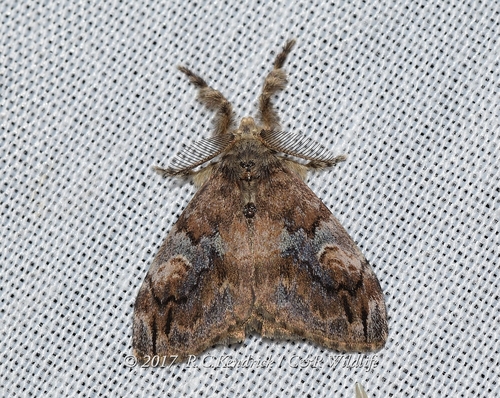
(c) Roger C. Kendrick, all rights reserved, uploaded by Roger C. Kendrick
Hevea
Sign in to saveHevea is a genus of flowering plants in the spurge family, Euphorbiaceae, with about ten members. It is also one of many names used commercially for the wood of the most economically important rubber tree, H. brasiliensis. The genus is native to tropical South America but is widely cultivated in other tropical countries and naturalized in several of them. It was first described in 1775.
Species
Cocoa Tussock Moth
GENUS
- KingdomPlantae
- PhylumTracheophyta
- ClassMagnoliopsida
- OrderMalpighiales
- FamilyEuphorbiaceae
Common Name: India rubber
via GBIF · Kew POWO
Museum specimens
- Specimen records
- 565
- With media
- 369
- Family
- Euphorbiaceae
- Collections
- US, GH, F, IPA, A, MICH
- Recorded in
- Guyana, Bolivia, Brazil, Peru, Brasil, Venezuela
Research
1,610 papers- Genomic technologies for Hevea breeding.Advances in genetics · 2019
- Hevea brasiliensis latex proteomics: a review of analytical methods and the way forward.Journal of plant research · 2021
- Preface.Advances in genetics · 2019
- [Hevea brasiliensis como fuente alergénica: revisión bibliográfica].Revista alergia Mexico (Tecamachalco, Puebla, Mexico : 1993) · 2023
- Hevea brasiliensis latex allergens: current panel and clinical relevance.International archives of allergy and immunology · 2005
via PubMed
Wikidata facts
- Instance of
- taxon
- Parent taxon
- Euphorbiaceae
- Image
- Rubber tree leaves.JPG
Show 6 more facts
- Commons category
- Hevea
- taxon name
- Hevea
- taxon rank
- genus
- topic's main category
- Category:Hevea
- taxon common name
- 橡胶树属
via Wikidata · CC0
~6 min read
Encyclopedic overview
11 sectionsContents
- Characteristics
- Distribution
- Habitat
- Rubber History
- Historical Uses
- European Discovery
- Pneumatic tires
- Botanical Piracy
- Species
- References
- External links
Hevea is a genus of flowering plants in the spurge family, Euphorbiaceae, with about ten members. It is also one of many names used commercially for the wood of the most economically important rubber tree, H. brasiliensis. The genus is native to tropical South America but is widely cultivated in other tropical countries and naturalized in several of them. It was first described in 1775.
==Characteristics== French botanist and explorer Jean Baptiste Christophore Fusée Aublet first described Hevea as a genus in 1775. H. brasiliensis and H. guianensis are large trees, often reaching more than in height. Most of the other members of the genus are small to medium trees, and H. camporum is a shrub of around . Trees in this genus are either deciduous or evergreen. Certain species, namely H. benthamiana, H. brasiliensis and H. microphylla, bear "winter shoots", stubby side shoots with short internodes, scale leaves on the stem and larger leaves near the tip; on these, the leaves are shed leaving the tree bare before new shoots develop. The remaining species bear more vigorous side shoots which develop before the old foliage is shed and thus the tree remains green. The leaves consist of three, usually elliptical, leaflets which are held horizontally or slightly drooping in most species. The inflorescences have separate male and female flowers, with the females being at the end of the panicles. The fruits are capsules, usually with three seeds, which in all except two species (H. spruceana and H. microphylla) split explosively when ripe to eject the large seeds.
Excerpted from Wikipedia’s “Hevea” article, available under the CC BY-SA 4.0 licence.