High Resolution Stereo Camera
Sign in to saveAlso known as HRSC
camera system on the Mars Express spacecraft
Described at
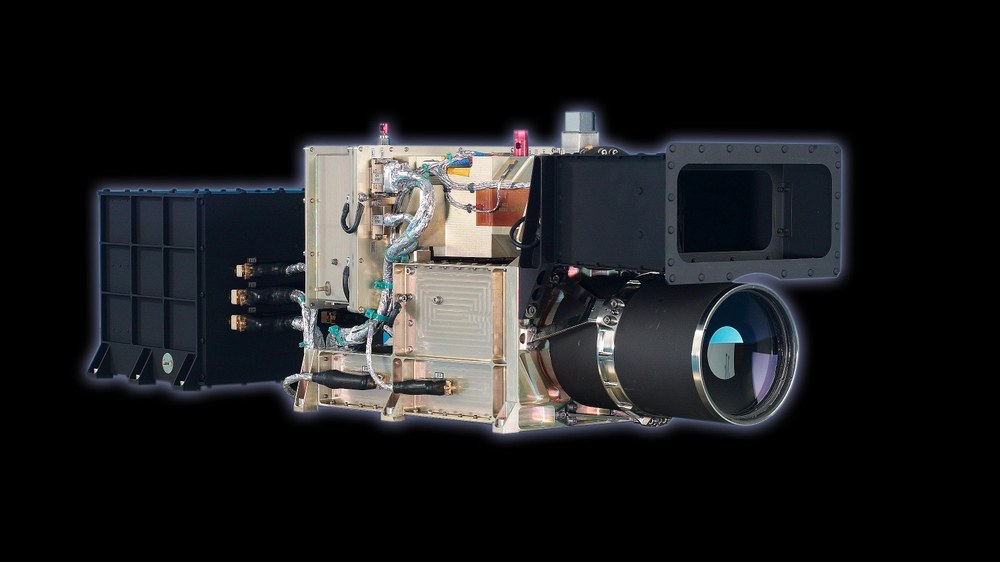
HRSC – High Resolution Stereo Camera
The High Resolution Stereo Camera (HRSC) is Germany's most important contribution to the European Space Agency (ESA) Mars Express mission.
dlr.de →The HRSC camera system, which only weighs 20 kilograms, has two camera heads: the High Resolution Stereo head, which consists of nine CCD line sensors mounted in parallel behind a lens, and the SRC head, which is composed of a mirror telephoto lens and a CCD array sensor. The High Resolution Stereo head works on pushbroom mode: sensors image a line on the planet surface perpendicular to the ground track of the spacecraft and rely on the orbital motion of the spacecraft to reposition them as they record a sequence of images known as an image swath. In this case, each sensor records the same object on the surface at a different angle. Three-dimensional images are generated by five of the image strips. The remaining four of the nine line sensors are equipped with special colour filters for recording multi-spectral data. The shortest distance from the spacecraft to Mars is 270 kilometres. At this altitude, the resolution of the 9 image strips is 12 metres for each of the 5184 seven-micron square pixels. The image swath is 52 kilometres and the minimum strip length 300 kilometres. The latter depends on the spacecraft's data storage and transmission capacity. The Super Resolution Channel (SRC) is used as a magnifying glass. At the pericentre, it provides pictures 2.3 kilometres by 2.3 kilometres wide in the centre of the image strips; the surface details are imaged with a resolution of 2.3 metres per pixel. The SRC recordings provide a geological context of the area, which is supplied by the high-resolution images acquired with the stereo head. Since 1997, two versions of the HRSC been modified for aircraft use. These have already demonstrated the robustness of the HRSC design and the scientific value of HRSC technology in various flight campaigns. The investigation of surface structures using remote sensing is dependent on three-dimensional information for many quantitative measurements – for example, cross sections of valleys and volumes of mountains. The topography or relief of the surface provides important information for the geomorphological and geological interpretation of planetary images. This technique is referred to as lidar – light detection and ranging. Since the distance between the spacecraft and the centre of the planet is known, it is possible to determine the distance from there to the surface, that is, the elevation of the surface. An example of a successful lidar instrument is the MOLA (Mars Orbiter Laser Altimeter) instrument on the Mars Global Surveyor spacecraft, which has collected over 600 million individual elevation measurements from the surface of the Red Planet. These measurements were used to create a global digital elevation model with an absolute vertical accuracy of approximately 10 metres. The horizontal resolution is poorer, however, varying from 300 metres close to the poles to several kilometres near the equator. This is due to the polar orbit of Mars Global Surveyor. Its orbits intersect at the poles, where a very large number of measurement points are located in a small area. In contrast, the ground tracks across the equator are widely spaced, so it is here that the stereo information obtained by the HRSC is particularly valuable. Humans and animals with both eyes facing forward have the capability to perceive their environments in a spatial sense, meaning in three dimensions. This requires interaction between the eyes and the brain. The human eyes are located approximately seven centimetres apart, so the two optical systems (the left and right eye) see each object from a different viewing angle. The brain uses stereoscopic vision to process the images obtained from both eyes and to create an impression of spatial depth – the stereo principle. However, the information acquired about distances is based on experience and does not represent absolute, exactly defined measurement values. A stereoscopic camera operates in the same way. It takes images of an object from different viewing angles
Excerpt from a page describing this subject · 12,323 chars · not written by Vinony