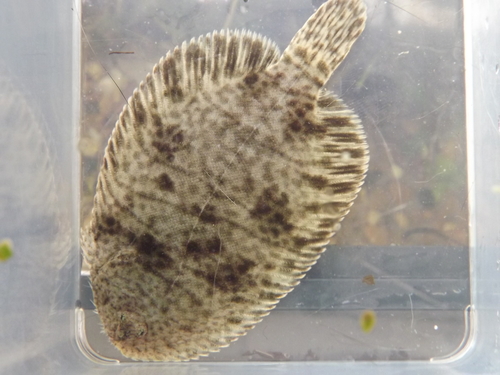
(c) Kari McWest, all rights reserved, uploaded by Kari McWest
Hogchoker
Sign in to saveAlso known as Trinectes maculatus
The hogchoker (Trinectes maculatus) is a small species of flatfish found along the Atlantic and Gulf coasts of North and South America, ranging from Massachusetts to Venezuela. They prefer brackish water, and the nominate subspecies is abundant in many bays and estuaries north of the Carolinas (the southern subspecies T. m. fasciatus replaces it south of the Carolinas). It is a member of the American sole family Achiridae. They are usually brown to dark brown in color, and lighter on their "blind side" (side lacking an eye). The overall body color is often broken by a series of spots and thin
Species
hogchoker
Species
- PhylumChordata
- ClassTeleostei
- OrderPleuronectiformes
- FamilyAchiridae
via
Wikidata facts
Show 7 more facts
- Commons category
- Trinectes maculatus
- taxon rank
- species
- taxon name
- Trinectes maculatus
- IUCN conservation status
- Least Concern
- Commons gallery
- Trinectes maculatus
- taxon common name
- Hogchoker
- short name
- T. maculatus
Sources (1)
via Wikidata · CC0
~3 min read
Encyclopedic overview
3 sectionsContents
- In the aquarium
- References
- External links
The hogchoker (Trinectes maculatus) is a small species of flatfish found along the Atlantic and Gulf coasts of North and South America, ranging from Massachusetts to Venezuela. They prefer brackish water, and the nominate subspecies is abundant in many bays and estuaries north of the Carolinas (the southern subspecies T. m. fasciatus replaces it south of the Carolinas). It is a member of the American sole family Achiridae. They are usually brown to dark brown in color, and lighter on their "blind side" (side lacking an eye). The overall body color is often broken by a series of spots and thin stripes, which can be lighter or darker than the main body color. The fins and tail have fringed edges helping hide the fish from its prey. They mainly feed on small aquatic insects and invertebrates. They get their common name because East Coast fishermen would feed these so-called "trash" fish to their hogs, after which the fish would bow its body into a suction cup and stick to the soft palate of the hog, rather like peanut butter in a dog's mouth.
Distinguished from other species by an interbrachial septum lacking a foramen, T. maculatus often has no rays, or rarely one ray, in its pectoral fin.
Excerpted from Wikipedia’s “Hogchoker” article, available under the CC BY-SA 4.0 licence.
Gallery (2)
Available in 11 languages
via Wikidata sitelinks · CC0