(c) International Institute of Tropical Agriculture, some rights reserved (CC BY-NC) · cc-by-nc
Hoslundia
Sign in to saveHoslundia is a genus of flowering plant in the family Lamiaceae, first described in 1804. It contains only one known species, Hoslundia opposita. It is widespread across much of sub-Saharan Africa.
In the Vinony graph
Within Vinony's link graph, Hoslundia is referenced by 7 other articles, and connects out to Nepetoideae, South Africa and Somalia.
It is catalogued under topics including Lamiaceae, Monotypic Lamiaceae genera and Taxa named by Martin Vahl.
Its subject is documented across 9 Wikipedia language editions.
Species
butterberry
GENUS
- KingdomPlantae
- PhylumTracheophyta
- ClassMagnoliopsida
- OrderLamiales
- FamilyLamiaceae
via GBIF · Kew POWO
Museum specimens
- Specimen records
- 21
- With media
- 10
- Family
- Lamiaceae
- Collections
- MO, MNHN, MIN, LD, VT
- Recorded in
- Tanzania, Ivory Coast, Uganda, Congo (Kinshasa), Cameroon, Mozambique, Zimbabwe, South Africa
Wikidata facts
Show 4 more facts
- taxon name
- Hoslundia
- taxon rank
- genus
- Commons category
- Hoslundia
Sources (1)
via Wikidata · CC0
~1 min read
Encyclopedic overview
4 sectionsContents
- Description
- Distribution
- References
- External links
Hoslundia is a genus of flowering plant in the family Lamiaceae, first described in 1804. It contains only one known species, Hoslundia opposita. It is widespread across much of sub-Saharan Africa.
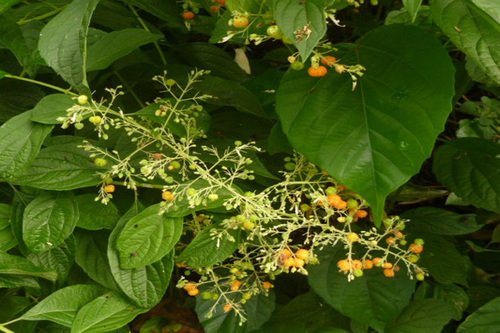
==Description== Spreading, erect or subscandent shrub-like perennial herb up to 3–4 m tall, often regenerating and flowering after fire. Stems and branches sharply 4-angled; branches opposite. Leaves with strong and rather unpleasant smell; petiolate, opposite or sometimes ternate, blade grey-green, ovate-lanceolate to ovate-elliptic, 35-70 x 18-25 mm; apex acute, base cuneate; velvety; margin serrate; petiole short. Flowers in terminal, rather lax panicles or racemes. Calyx 5-toothed, 4 mm long at flowering; teeth narrow, about 1 mm long; tube cylindric, becoming globose and fleshy in fruit. Corolla bilabiate, white or cream, 6–7 mm long; tube straight, subcylindric; upper lip short, erect, 1 mm long, 3-lobed; lower lip patent, a little longer. Fruit fleshy, ovoid, ribbed, bright orange when ripe; edible and are relished by birds.
Excerpted from Wikipedia’s “Hoslundia” article, available under the CC BY-SA 4.0 licence.