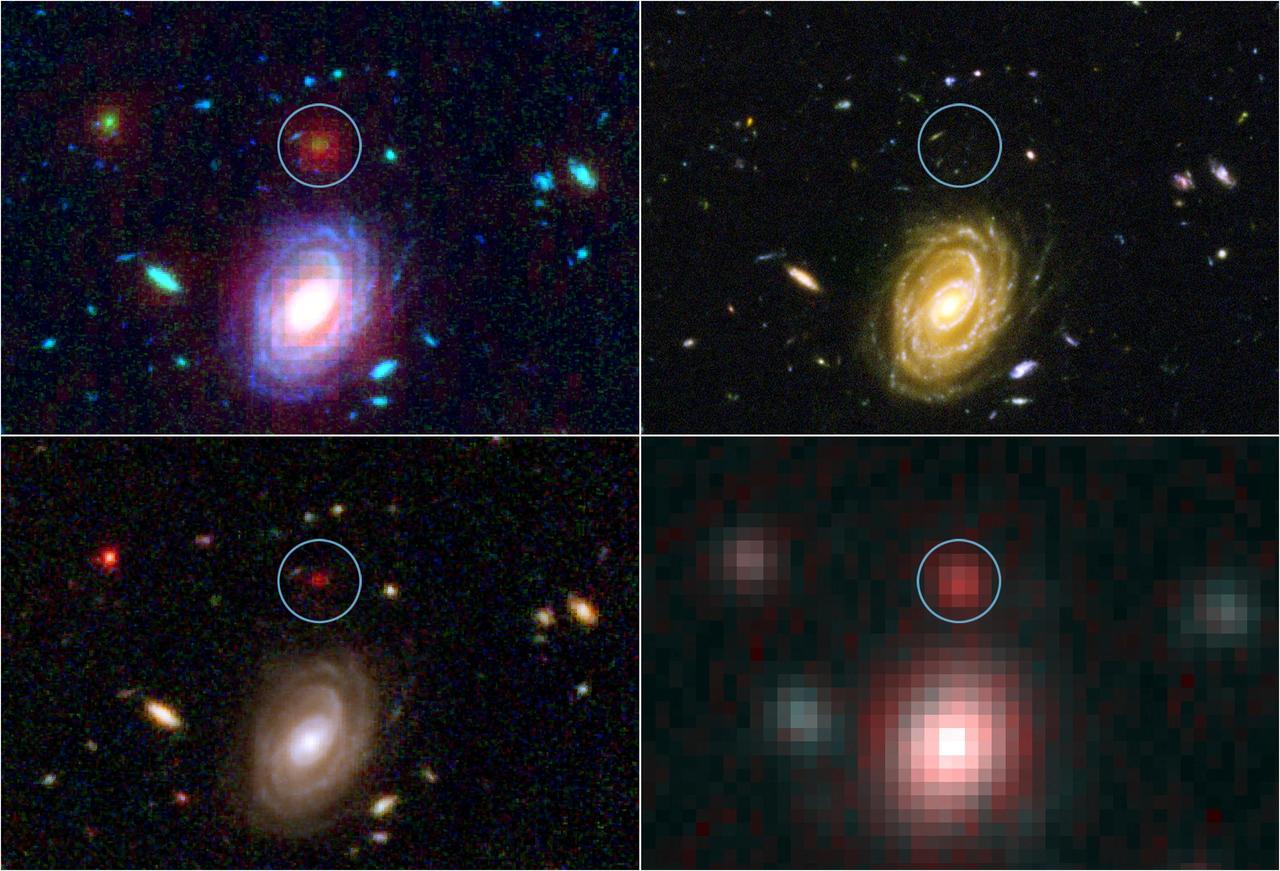
Big Galaxy in Baby Universe · NASA · NASA — public domain
HUDF-JD2
Sign in to saveHUDF-JD2 (UDF 033238.7 -274839.8 or BBG 3179) is a distant, massive, post-starburst galaxy that was discovered with the Hubble Ultra Deep Field (HUDF) image. It was the most distant galaxy identified in the HUDF, in 2005. It is located at in the constellation of Fornax.
Wikidata facts
Show 7 more facts
- redshift
- 6.5
- right ascension
- 53.161361690
- declination
- -27.811079030
- apparent magnitude
- 23.95
- epoch
- J2000.0
- galaxy morphological type
- E/S0
- radial velocity
- 289319
Sources (2)
via Wikidata · CC0
~2 min read
Encyclopedic overview
3 sectionsContents
- See also
- References
- External links
HUDF-JD2 (UDF 033238.7 -274839.8 or BBG 3179) is a distant, massive, post-starburst galaxy that was discovered with the Hubble Ultra Deep Field (HUDF) image. It was the most distant galaxy identified in the HUDF, in 2005. It is located at in the constellation of Fornax.
In a 2005 search for very red galaxies in the HUDF that were not detected at wavelengths shorter than the near-infrared J band, two objects were detected. The second, initially designated UDF033238.7-274839.8, displayed a high redshift and showed characteristics of a post-starburst galaxy. The derived photometric redshift yielded z approximately equal to 6.5, which indicates it is most likely being viewed from a time when the Universe was only 830 million years old. The estimated bolometric luminosity of this galaxy is a trillion times the solar luminosity (the luminosity of the Sun) and it has a mass of approximately 600 billion solar masses.
Excerpted from Wikipedia’s “HUDF-JD2” article, available under the CC BY-SA 4.0 licence.