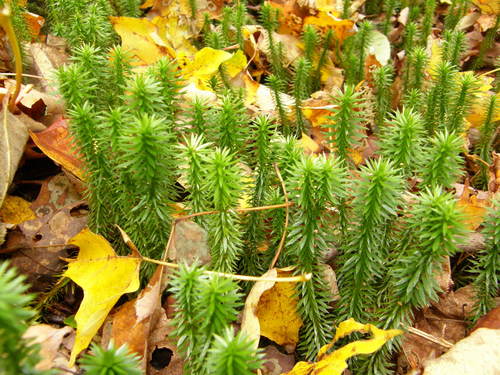
(c) copepodo, some rights reserved (CC BY-NC-ND) · cc-by-nc-nd
Huperzia
Sign in to saveHuperzia is a genus of lycophyte plants, sometimes known as the firmosses or fir clubmosses; the Flora of North America calls them gemma fir-mosses. This genus was originally included in the related genus Lycopodium, from which it differs in having undifferentiated sporangial leaves, and the sporangia not formed into apical cones. The common name firmoss, used for some of the north temperate species, refers to their superficial resemblance to branches of fir (Abies), a conifer. , two very different circumscriptions of the genus were in use. In the Pteridophyte Phylogeny Group classification of
Species
shining firmoss
GENUS
- KingdomPlantae
- PhylumTracheophyta
- ClassLycopodiopsida
- OrderLycopodiales
- FamilyLycopodiaceae
У этого термина существуют и другие значения, см. Баранец. Царство: Растения Подцарство: Зелёные растения Отдел: Плауновидные Класс: Плауновые Порядок: Плауновые (Lycopodiales DC. ex Bercht. & J.Presl, 1820) Семейство: Плауновые Род: Баранец Международное научное название Huperzia Bernh., 1801 Типовой вид Huperzia selago (L.) Bernh. ex Schrank & Mart. — Баранец обыкновенный Систематикана ВикивидахИзображенияна Викискладе ITIS 202451NCBI 37428EOL 59329GRIN g:13091IPNI 166517-3 Баране́ц (лат. Hupérzia) — род вечнозелёных многолетних растений семейства Плауновые (Lycopodiaceae) (согласно другой классификации, принадлежит семейству Баранцовые (Huperziaceae)[1], распространённых преимущественно в лесных зонах Северного полушария. Название рода Huperzia дано в честь немецкого ботаника Иоганна Хуперца (швед. Johann Peter Huperz; 1771—1816)[2]. Содержание 1 Ботаническое описание 2 Распространение и среда обитания 3 Хозяйственное значение 4 Виды 5 Примечания 6 Литература 7 Ссылки Ботаническое описание Huperzia sp. на горе Рораима, Венесуэла Побеги однотипные, ортотропные, но полегающие. У некоторых форм время от времени на побеге образуются карликовые дочерние веточки, служащие веге
via GBIF · Kew POWO
Museum specimens
- Specimen records
- 1,690
- With media
- 1,314
- Family
- Lycopodiaceae
- Collections
- IIB-UV, UNICACH, UNIVERSITY OF NEW HAMPSHIRE, GMUF, ETSU, DUKE
- Recorded in
- Mexico, United States, China, Philippines, Peru, Colombia
Research
330 papers- The use of Huperzia species for the treatment of Alzheimer's disease.Journal of basic and clinical physiology and pharmacology · 2019
- Lycopodium Alkaloids from Huperzia goebelii.Chemistry & biodiversity · 2024
- Secondary metabolites of endophytic fungi isolated from Huperzia serrata.Fitoterapia · 2021
- Lycopodium alkaloids from Huperzia serrata.Fitoterapia · 2019
- Huperzine A and Its Neuroprotective Molecular Signaling in Alzheimer's Disease.Molecules (Basel, Switzerland) · 2021
via PubMed
Wikidata facts
- Instance of
- taxon
- Parent taxon
- Huperzioideae
- Named after
- Vegetable Lamb of Tartary
- Image
- Huperzia selago 240906.jpg
Show 6 more facts
- Commons category
- Huperzia
- taxon name
- Huperzia
- taxon rank
- genus
- topic's main category
- Category:Huperzia
- taxon common name
- 石杉属
Sources (3)
via Wikidata · CC0
~7 min read
Encyclopedic overview
6 sectionsContents
- Morphology
- Taxonomy
- Species
- Distribution and habitat
- References
- External links
Huperzia is a genus of lycophyte plants, sometimes known as the firmosses or fir clubmosses; the Flora of North America calls them gemma fir-mosses. This genus was originally included in the related genus Lycopodium, from which it differs in having undifferentiated sporangial leaves, and the sporangia not formed into apical cones. The common name firmoss, used for some of the north temperate species, refers to their superficial resemblance to branches of fir (Abies), a conifer. , two very different circumscriptions of the genus were in use. In the Pteridophyte Phylogeny Group classification of 2016 (PPG I), Huperzia is one of three genera in the subfamily Huperzioideae of the family Lycopodiaceae. Most species in the subfamily are placed in the genus Phlegmariurus. Huperzia is left with about 25 species, although not all have been formally transferred to other genera. Other sources recognize only Huperzia, which then has about 340 species.
==Morphology== The sporophytes of this genus have unbranched shoots that are generally upright and round in cross section. Horizontal stems are absent. The leaves are not borne in distinct ranks, and are usually somewhat lanceolate in shape. In some species, they vary in size according to the season in which they grow. Branchlets bearing gemmae – bud-like structures by which the plant reproduces asexually – occur among the leaves. The gemmae are triangular, with eight leaves in a constant pattern: four flattened into a plane and two large lateral leaves. The sporangia are kidney-shaped (reniform), occurring at the base of a leaf that is either unmodified or reduced. The roots are produced near the apex of shoots, and migrate downwards inside the cortex of the stem to emerge at soil level. The unbranched gametophytes are not photosynthetic, but rather subterranean and mycorrhizal.
Excerpted from Wikipedia’s “Huperzia” article, available under the CC BY-SA 4.0 licence.