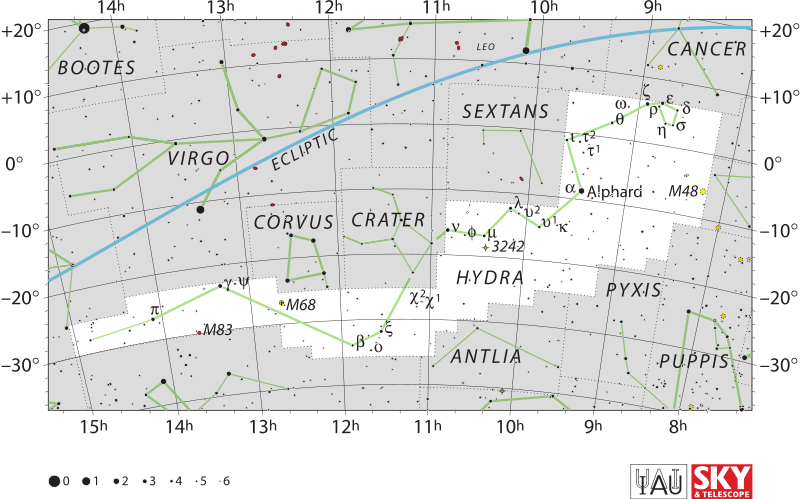
File:Hydra_IAU.svg · Wikimedia Commons · See Wikimedia Commons
Hydra is the largest constellation in the night sky, stretching across a vast area near the celestial equator where the sky is divided into northern and southern hemispheres. It matters to astronomers and stargazers because its size and position make it an important reference point for mapping and studying the heavens.
AI-generated from the Wikipedia summary — may contain errors.
Wikidata facts
- Instance of
- constellation
- Named after
- Hydra
- Official name
- Hydra
- Area
- 1303
- Shares border with
- Virgo
- Image
- HydraCC.jpg
Show 7 more facts
- Commons category
- Hydra (constellation)
- topic's main category
- Category:Hydra (constellation)
- Commons gallery
- Hydra (constellation)
- described by source
- Encyclopædia Britannica 11th edition
- short name
- Hya
- on focus list of Wikimedia project
- Wikipedia:Vital articles/Level/4
- different from
- Hydra
Sources (3)
via Wikidata · CC0
~10 min read
Encyclopedic overview
Hydra is the largest of the 88 modern constellations, measuring 1303 square degrees, and also the longest at over 100 degrees. Its southern end borders Libra and Centaurus and its northern end borders Cancer. It was included among the 48 constellations listed by the 2nd century astronomer Ptolemy. Commonly represented as a water snake, it straddles the celestial equator.
History and mythology
Excerpted from Wikipedia’s “Hydra” article, available under the CC BY-SA 4.0 licence.
Gallery (6)
Available in 86 languages
- Español
- Français
- Deutsch
- 中文
- 日本語
- Русский
- Português
- Italiano
- العربية
- हिन्दी
- Afrikaans
- Armenian
- Asturian
- Azerbaijani
- Bahasa Indonesia
- Bangla
- Bashkir
- Basque
Show 67 more
- be_x_old
- Belarusian
- Bosnian
- Breton
- Bulgarian
- Burmese
- Catalan
- cdo
- Cornish
- Corsican
- Croatian
- Czech
- Danish
- Egyptian Arabic
- Esperanto
- Estonian
- Finnish
- Galician
- Georgian
- Greek
- Hakka Chinese
- Hebrew
- Hungarian
- Icelandic
- Irish
- Javanese
- Latin
- Latvian
- Lithuanian
- Luxembourgish
- Macedonian
- Malay
- Malayalam
- Manx
- Marathi
- Mingrelian
- Nederlands
- Northern Frisian
- Norwegian
- Norwegian Nynorsk
- Occitan
- Ossetic
- Polski
- Romanian
- Serbian
- Serbian (Latin)
- simple
- Slovak
- Slovenian
- Svenska
- Swahili
- Tibetan
- Tiếng Việt
- Türkçe
- Ukrainian
- Urdu
- Uzbek
- Waray
- Welsh
- Wu Chinese
- Yakut
- Zaza
- zh_min_nan
- zh_yue
- فارسی
- ไทย
- 한국어
via Wikidata sitelinks · CC0