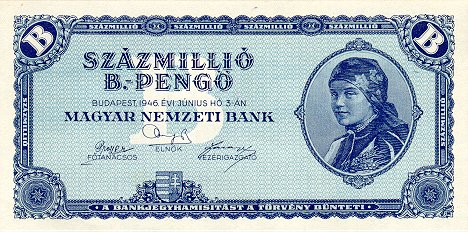
File:HUP_100MB_1946_obverse.jpg · Wikimedia Commons · See Wikimedia Commons
Hyperinflation is an extreme situation where the value of money drops so rapidly that prices skyrocket and currency becomes nearly worthless, as illustrated by Hungary's 1946 pengő notes and Venezuela's recent currency collapse. It matters because hyperinflation can devastate an economy, making everyday purchases unaffordable and wiping out people's savings and financial security.
AI-generated from the Wikipedia summary — may contain errors.
Wikidata facts
- Subclass of
- social issue
- Image
- 1923 gdansk 500mln.JPG
Show 4 more facts
- facet of
- economy
- Commons category
- Hyperinflation
- topic's main category
- Category:Hyperinflation
- Commons gallery
- Hyperinflation
via Wikidata · CC0
Article · 中文
在經濟學上,惡性通貨膨脹(英语:Hyperinflation),簡稱惡性通膨,是一種失控的通貨膨脹,在物价飞速上涨的情况下,货币也失去了价值。惡性通貨膨脹沒有一個普遍公認的標準界定。一般界定為每月通貨膨脹50%或更多,但很多時在寬鬆上使用的比率會更低。多數的經濟學家認為的定義為「一個沒有任何平衡趨勢的通貨膨脹循環」。當越來越多的通膨現象隨著週期反覆發生便會產生惡性循環。有關惡性通膨的肇因雖有很多爭議,可是當貨幣供給有異常的增加或錢幣大幅的貶值,且常與戰爭(或戰後)、經濟蕭條、及政治或社會動盪联系在一起時,惡性通膨便日益明顯。
Abstract from DBpedia / Wikipedia · CC BY-SA
Gallery (46)
Available in 63 languages
- Español
- Français
- Deutsch
- 中文
- 日本語
- Русский
- Português
- Italiano
- العربية
- हिन्दी
- Albanian
- Armenian
- Azerbaijani
- Bahasa Indonesia
- Bangla
- Basque
- be_x_old
- Belarusian
Show 44 more
- Breton
- Bulgarian
- Catalan
- Croatian
- Czech
- Danish
- Esperanto
- Estonian
- Finnish
- Georgian
- Greek
- Hebrew
- Hungarian
- Icelandic
- Javanese
- Kazakh
- Kyrgyz
- Latvian
- Lithuanian
- Macedonian
- Nederlands
- Norwegian
- Norwegian Nynorsk
- Pashto
- Polski
- Romanian
- Scots
- Serbian
- Serbian (Latin)
- simple
- Sinhala
- Slovak
- Slovenian
- Svenska
- Tamil
- Tiếng Việt
- Türkçe
- Ukrainian
- Uzbek
- Venetian
- zh_yue
- فارسی
- ไทย
- 한국어
via Wikidata sitelinks · CC0