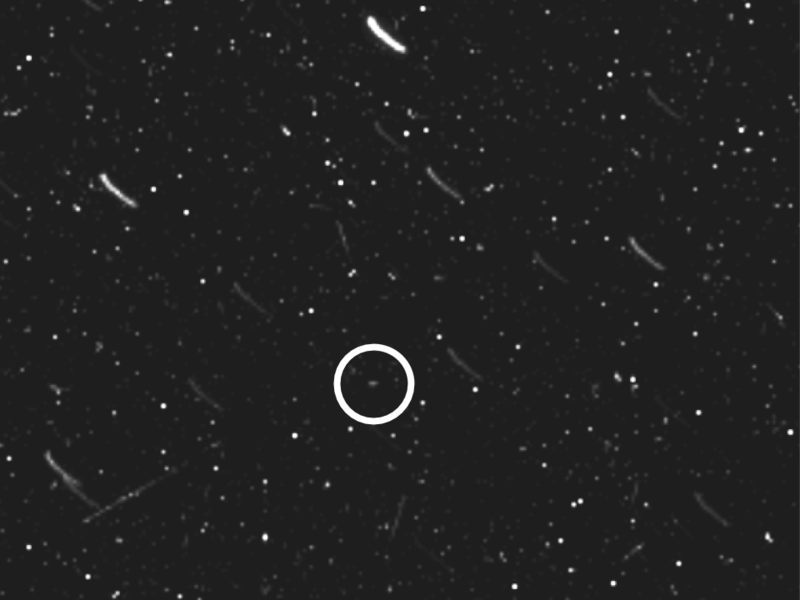
File:Hyrrokkin-cassini.png · Wikimedia Commons · See Wikimedia Commons
Key facts
- Discovered by
- Scott S. Sheppard , David C. Jewitt , Jan T. Kleyna , Brian G. Marsden
- Discovery date
- December 2004
- Designation
- Saturn XLIV
- Pronunciation
- / h ɪ ˈ r ɒ k ən /
- Named after
- Hyrrokkin
- Alternative names
- S/2004 S 19
- Semi major axis
- 18 437 000 km
- Orbital period sidereal
- −931.8 days
- Inclination
- 151°
- Satellite of
- Saturn
- Group
- Norse group
- Mean diameter
- 8 +50%, −30% km
- Synodic rotation period
- 12.76 ± 0.03 h
- Albedo
- 0.06 (assumed)
- Spectral type
- g – r = 0.50 ± 0.08, r – i = 0.34 ± 0.09
via Wikipedia infobox
Wikidata facts
- Instance of
- irregular moon
- Named after
- Hyrrokkin
- Parent body
- Saturn
- Diameter
- 8
- Orbital period
- -931.8
- Image
- Hyrrokkin-cassini.png
Show 9 more facts
- time of discovery or invention
- 2004-12-12
- provisional designation
- S/2004 S 19
- Commons category
- Hyrrokkin (moon)
- semi-major axis of an orbit
- 18217125
- orbital eccentricity
- 0.333
- orbital inclination
- 151.4
- apparent magnitude
- 23.5
- name
- Saturn XLIV
- discoverer or inventor
- Brian G. Marsden
Sources (2)
via Wikidata · CC0
~2 min read
Encyclopedic overview
Hyrrokkin or Saturn XLIV is a natural satellite of Saturn. Its discovery was announced by Scott S. Sheppard, David C. Jewitt, Jan Kleyna, and Brian G. Marsden on June 26, 2006, from observations taken between December 12, 2004, and April 30, 2006.
Hyrrokkin is about 8 kilometres in diameter, and orbits Saturn at an average distance of 18,168 Mm in 914 days, at an inclination of 153° to the ecliptic (154° to Saturn's equator), in a retrograde direction and with an eccentricity of 0.3582. During four observations in March 2013, the synodic rotational period was measured by the Cassini spacecraft to approximately 12 hours and 45 minutes. The rotation period was later refined to 12.76±0.03 hours. Its light curve shows three minima as seen in Ymir and Siarnaq, but has one minimum much shallower than the others. The rotation period and orbit are similar to Greip's, with only the inclination being appreciably different, but it is not known whether the moons are closely related to each other.
Excerpted from Wikipedia’s “Hyrrokkin” article, available under the CC BY-SA 4.0 licence.