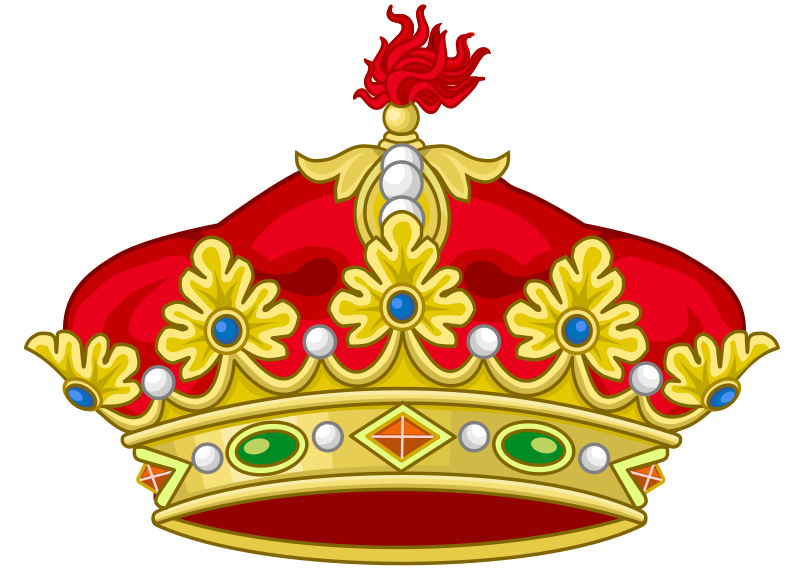
File:Heraldic_Crown_of_Spanish_Infantes.svg · Wikimedia Commons · See Wikimedia Commons
infante
Sign in to saveAlso known as infant
' (, ; f. infanta'''), also anglicised as "infant" or translated as "prince", is the title and rank given in the Iberian kingdoms of Spain (including the predecessor kingdoms of Aragon, Castile, Navarre, and León) and Portugal to the sons and daughters (infantas) of the king, regardless of age, sometimes with the exception of the heir apparent or heir presumptive to the throne who usually bears a unique princely or ducal title. A woman married to a male infante was accorded the title of infanta'' if the marriage was dynastically approved (e.g., Princess Alicia of Bourbon-Parma), although since
In Spain and Portugal, an "infante" is a royal title given to the sons and daughters of the king, regardless of their age, though the heir to the throne typically holds a different title instead. This rank mattered historically because it clearly defined which royal family members held formal status and rights within the Iberian kingdoms' hierarchy.
AI-generated from the Wikipedia summary — may contain errors.
Wikidata facts
- Instance of
- noble title
- Has part
- Infante of Spain
Show 5 more facts
- described by source
- Encyclopædia Britannica 11th edition
- female form of label
- infantinja
- male form of label
- infant
- P8168
- Mirabilis
- Commons category
- Signatures of Spanish Infantes and Infantas
Sources (1)
via Wikidata · CC0
~6 min read
Encyclopedic overview
7 sectionsContents
- History
- Spanish infantes
- Current infantes of Spain
- Portuguese infantes
- Current infantes of Portugal
- See also
- Footnotes
' (, ; f. infanta'''), also anglicised as "infant" or translated as "prince", is the title and rank given in the Iberian kingdoms of Spain (including the predecessor kingdoms of Aragon, Castile, Navarre, and León) and Portugal to the sons and daughters (infantas) of the king, regardless of age, sometimes with the exception of the heir apparent or heir presumptive to the throne who usually bears a unique princely or ducal title. A woman married to a male infante was accorded the title of infanta'' if the marriage was dynastically approved (e.g., Princess Alicia of Bourbon-Parma), although since 1987 this is no longer automatically the case in Spain (e.g., Princess Anne d'Orléans). Husbands of born infantas did not obtain the title of infante through marriage (unlike most hereditary titles of Spanish nobility), although they were occasionally elevated to the title de gracia ("by grace") at the sovereign's command.
While the title belonged by right to all sons and daughters of a monarch (even when they ceased to be children of the reigning sovereign), it was also often accorded to sons-in-law and male-line grandchildren of the sovereign (e.g., Prince Ferdinand of Bavaria, Infante Pedro Carlos of Spain and Portugal), sometimes to other agnates of the ruling dynasty (e.g., Infante Enrique, Duke of Seville), and to female-line relatives of the monarch (e.g. Infante Sebastian of Portugal and Spain, Infante Alfonso de Orléans-Borbón).
Excerpted from Wikipedia’s “infante” article, available under the CC BY-SA 4.0 licence.