Person · Open Library
- Works
- 9
via Open Library + Wikidata
Described at
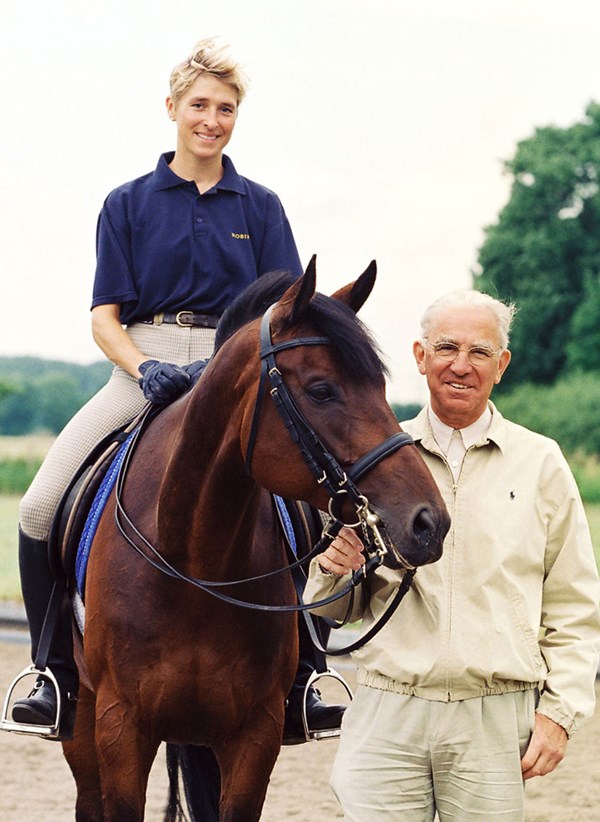
The Klimke Approach to Dressage
Germany’s Olympic eventing gold medalist and Grand Prix dressage rider, Ingrid Klimke carries on her legendary father’s classical approach to dressage., Germany’s Olympic eventing gold medalist and Grand Prix dressage rider, Ingrid Klimke carries on her legendary father’s classical approach to dressage.
dressagetoday.com →Germany’s Olympic eventing gold medalist and Grand Prix dressage rider, Ingrid Klimke carries on her legendary father’s classical approach to dressage. Often one hears riders in whatever discipline say that their aim is to bring the horse to a certain level or to place highly at certain shows. These goals are absolutely legitimate, but we must not forget that they are only a byproduct of what should be our highest of aims: To make our horses more beautiful and keep them healthy through their training. Ingrid Klimke poses with her father, the late Dr. Reiner Klimke, in 1999. (Credit: PhelpsPhotos.com) Klimke rides Dresden Mann and works with trainer Morten Thomsen. (Credit: Silke Rottermann) To keep horses healthy, it was of uppermost importance to my father to offer a training program that developed the musculature and kept them happy and motivated in their work. Having been an internationally successful event rider, my father knew about the positive effects of cavalletti work for developing strength and keeping horses entertained. All his dressage horses did it and so do my horses today. (Click here to read more from Ingrid Klimke about cavalletti or scroll to the bottom of this article.) I don’t shy away from asking my dressage horses to jump at least small poles at home. It is another way of putting variety into the training program, and most horses enjoy it tremendously once the ice is broken. This was demonstrated when my upcoming Grand Prix horse, Dresden Mann (Westfalian by Dresemann owned by Clodagh Wallace), showed his joy of jumping at the recent 2012 Global Dressage Forum. A swish in the bush made him sweat, and I could not ride him forward and downward. Then I started jumping him, first at home and then cross-country, to strengthen his self-confidence. Still, it took me a year until he gave me the feeling that he trusted me and would focus on me. I continued with the varying training, and after another several months, he had complete faith in me. That year, we qualified for the World Cup Final, where we placed eighth. During my baby break, Nector just did a relaxing program, and when I was back on board, he gave me the feeling that he really had come into his own, nearly two years after I got him. Sometimes riders just forget that when a horse learns new things, he might easily be able to cope with the demands physically, but he also needs appropriate time to take them in mentally. So after teaching my horses a new exercise and, after they do it well, I always allow them to rest and do something different for the next few days. This gives them time to think about it and understand. With very young horses, we turn them out in a field for a longer time after they have mastered an important step in their training. With older, more-advanced horses, some quieter days may be enough before we come back to the recently learned things. By taking small steps and allowing the horse to understand each of them, we respect his personality. A horse that is never asked too much at once and is given time to really learn and understand is a horse that feels loved by his rider and this subsequently increases his self-confidence. Taking small steps should be the main principle of any horse’s training, but it is even more indispensable when you have a highly talented horse that offers everything every day. Such a horse was the Westfalian stallion Damon Hill (by Donnerhall owned by Christian Becks). I got him as a 3-year-old. This horse was an incredibly quick learner, highly talented and extremely cooperative. Each day he came out of his stall asking, What are we doing today? I had to slow him down and distract him by varying his training a lot. She includes riding in a half seat at canter. (Credit: Silke Rottermann) Damon Hill could have reached Grand Prix a year earlier, but his health might not have kept up with that. So one winter, we just kept him happy and motivated by hacking, jumping and riding in the field. That way
Excerpt from a page describing this subject · 22,479 chars · not written by Vinony
Wikidata facts
- Instance of
- human
- Given name
- Ingrid
- Gender
- female
- Citizenship
- Germany
- Place of birth
- Münster
- Father
- Reiner Klimke
- Occupation
- non-fiction writer
- Languages spoken
- German
- Participant in
- equestrian at the 2016 Summer Olympics
- Sport
- equestrian sport
- Mass
- 59
- Official website
- www.ingrid-klimke.de
- Image
- Ingrid Klimke (GER) 2018.jpg
- Height
- 172
- Number of children
- 2
Show 3 more facts
- Commons category
- Ingrid Klimke
- date of birth
- 1968-04-01
Sources (6)
via Wikidata · CC0