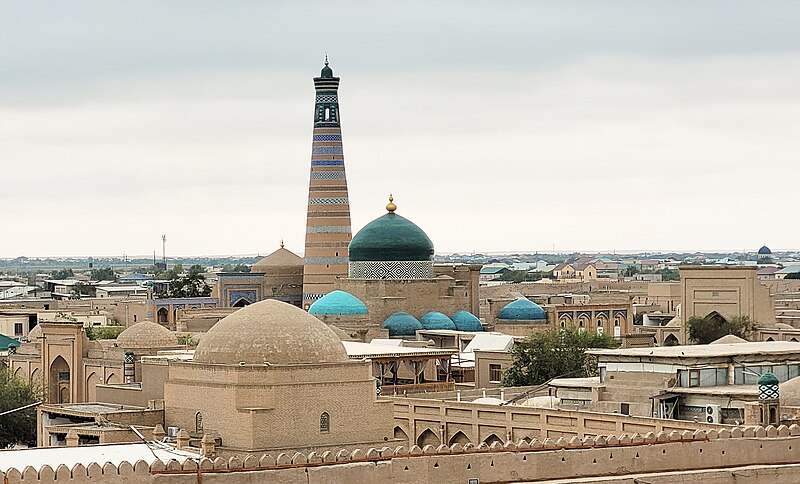
File:Islam_Khodja_Madrasa_01.jpg · Wikimedia Commons · See Wikimedia Commons
Weather now
cached 15h ago7-day forecast
via Open-Meteo
Place details
- Locality
- Xiva
- Region
- Xorazm Viloyati
- Country
- Oʻzbekiston
- Population
- 115,000
via OpenStreetMap · GeoNames
Key facts
- Location
- Khiva , Uzbekistan
- Criteria
- Cultural: (iii), (iv), (v)
- Inscription
- 1990 (14th Session )
- Area
- 37.5 ha (93 acres)
via Wikipedia infobox
Described at
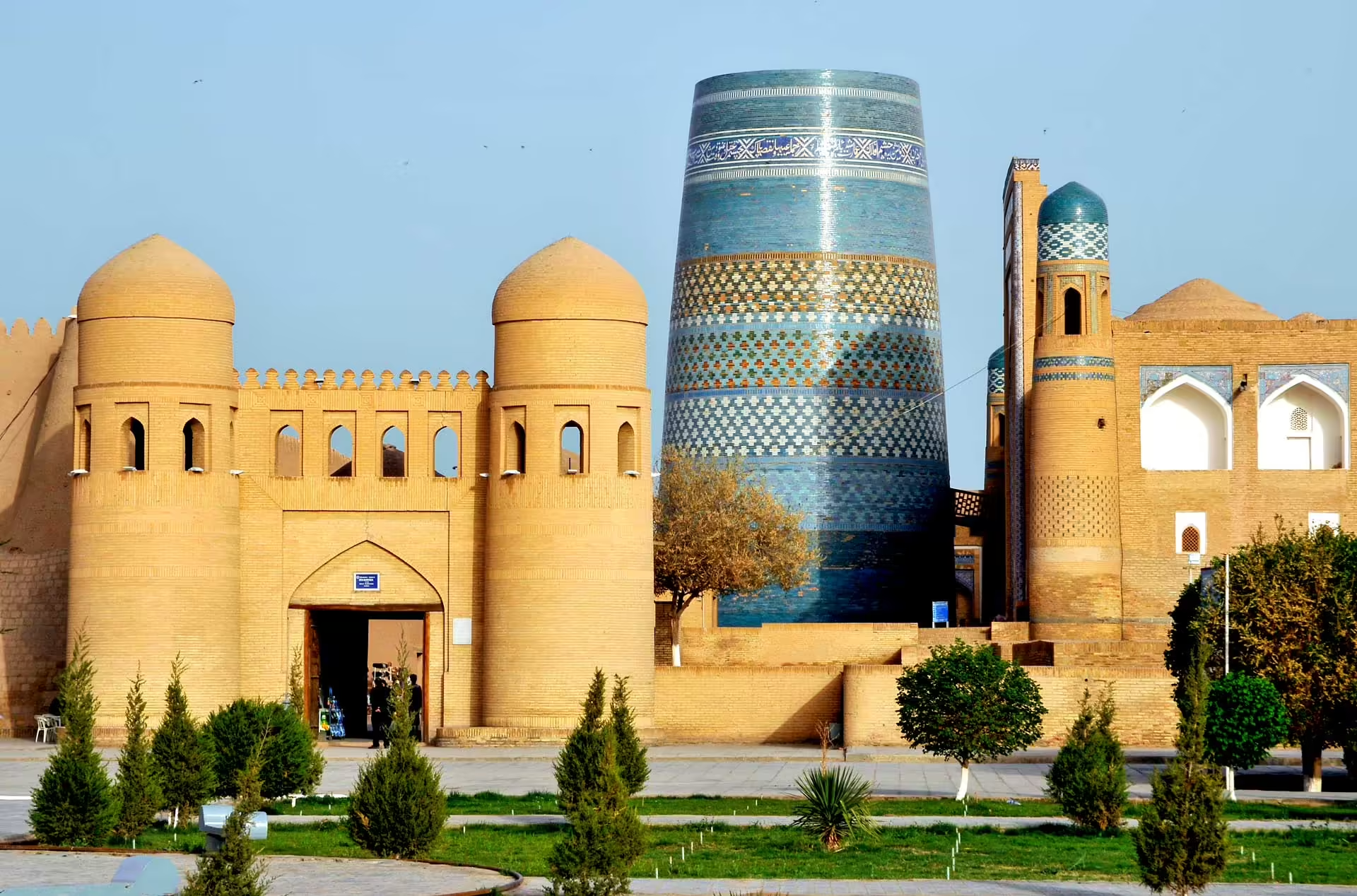
Hradby Itchan Kala - Uzbekistan - PlaceMania
Kedysi dôležitú zastávku na Hodvábnej ceste obkolesujú starobylé hradby.
placemania.sk →Itchan Kala ( píše sa aj Ichan Qa’la) sa nachádza v meste Chiva a bola dôležitým míľnikom na Hodvábnej ceste. Pre karavány prichádzajúce zo západu to bolo posledné miesto, kde si mohli doplniť zásoby pred cestou do púšte. Podobne ako väčšina miest v regióne sa pôvodná osada skladala z vnútornej a vonkajšej časti. Itchan Kala bola vnútorná, opevnená časť tohto mesta. Pri takomto neustálom príleve návštevníkov nie je prekvapujúce, že opevnené múry boli postavené tak, aby sa tiahli do výšky viac ako 30 stôp. Najstaršia časť bariéry, ktorá bola postavená z hlinených tehál, pochádza z piateho storočia. Kedysi sa na hradbách nachádzali štyri brány, ktoré smerovali na štyri svetové strany. Hradby sú prerušované polkruhovými vežami a spolu vytvárajú fascinujúce vlnovky, ktoré v priebehu rokov zaujali predstavivosť umelcov. Nádherné hradby nie sú jediným pokladom opevneného mesta. Ako svedectvo geopolitického významu, ktorý kedysi malo, je Itchan Kala pôsobivým miestom na pohľad. Jeho história siaha tisícročia do minulosti, ale budovy, ktoré zostali stáť, pochádzajú prevažne zo začiatku 19. storočia. Celkovo sa v jeho hradbách nachádza 51 pamiatok a 250 budov. Medzi najvýznamnejšie pamiatky patria mešita Džuma (zároveň najstaršia stavba v Itchan Kale), mešita Oq, medresa Alla-Kulli-Khan, mauzóleum Pahlavol Mahmúda a rôzne karavanseráje a bazáre, ktoré sú nádhernými príkladmi starobylej stredoázijskej islamskej architektúry. Ako pohraničné mesto dosiahla starobylá Chiva úctyhodný stupeň slávy, keď sem po celý rok prichádzali a odchádzali nájazdníci a obchodníci s otrokmi. Keď začiatkom 20. storočia začala sláva Chivy slabnúť, príchod sovietskeho režimu znamenal prelom. Vojenský dozor zabezpečil, aby sa nevykonávali žiadne nezákonné činnosti. Mesto sa dostalo do takej situácie, že sa naň takmer zabudlo, rovnako ako na Itchan Kalu. Dnes sa obyvatelia Chivy pozerajú na Itchan Kalu ako na maják z grandióznej minulosti, z ktorej všetci pochádzajú. Zakladateľ projektu PlaceMania.sk a zodpovedá za jeho obsah, technické fungovanie a dlhodobý rozvoj. Cestovné zápisky na webe vychádzajú z vlastnej skúsenosti z ciest; faktografické záznamy o miestach vznikajú kombináciou verejných zdrojov, automatizovaného spracovania dát a redakčného overovania. Zameriava sa na netradičné lokality, ich historický a geografický kontext a menej známe súvislosti. Things to do near Hradby Itchan Kala, Itchan Kala, Ichan qalʼa, Ichan-Qal’a, Iczan Kala, Ičan Kala, Ichon-Qal’a, Múzeum histórie, Historické miesto, Múzeum, Historická pamiatka, Turistická atrakcia, history museum, Xiva, Xiva tumani, Xorazm Viloyati. Find tours, guided tours, local activities, attractions, tickets, excursions, sightseeing, day trips and travel experiences nearby. Coordinates: 41.3780695, 60.35933. Ruiny Ayoz Qala v Karakalpakstane patria k systému opevnených miest starovekého Chorezmu. Kitabská geologická rezervácia zachováva súvislý záznam hornín starých približne 407 miliónov rokov. Komplex Barak-khan združuje medresu a mauzóleá z 15.–16. storočia, vrátane tzv. Kok Gumbaz so zničenou kupolou po zemetrasení v roku… Pozrite si ďalšie zaujímave miesta vo svete, ktoré stoja za naplánovanie ďalšej cesty. Opustená mongolská pevnosť, kde piesok lezie po hradbách a rieka, ktorá ju kedysi živila, dnes skôr pripomína mýtus než istotu.… Citadela Naryn-Kala v Derbente, založená v 6. storočí ako súčasť perzského obranného systému. Druhý najdlhší súvislý múr na svete chráni skryté tajomstvo v indických púšťach. Berlínsky múr sa stal symbolom studenej vojny a hmatateľným prejavom rozdelenia sveta na dva odlišné ideologické bloky. Chcete vidieť ďalšie úchvatné miesta ako Hradby Itchan Kala? Nájdeš ich u nás na mape. Objav s nami ďalšie úžasné miesta na zemi.
Excerpt from a page describing this subject · 18,091 chars · not written by Vinony
Wikidata facts
- Instance of
- urban area
- Country
- Uzbekistan
- Located in
- Khiva
- Area
- 37.5
- Time zone
- UTC+05:00
- Image
- KhivaWalls.jpg
Show 3 more facts
- Commons category
- Itchan Kala
- heritage designation
- World Heritage Site
- described at URL
- www.placemania.sk/svetova-zaujimavost/hradby-itchan-kala
Sources (2)
via Wikidata · CC0
Travel guide
Understand
Famous for its long and brutal history as a slave trading post sandwiched in between the vast Kyzylkum and Karakum deserts, Khiva is now a quiet, sleepy oasis that awaits busloads of tourists instead of caravans of captives. It's difficult to imagine what exactly ancient Khiva was like, considering the historical areas were restored to a scrubbed and squeaky-clean look by the Soviets in the 1970s. However, the clustered array of mosques, madrassahs and tiled minarets within an area of less than 3 km give you a sense of how crowded and bustling this town must have been throughout its history.
Khiva is 35 km from the regional capital of Urgench and 5 km from the border of Turkmenistan.
Khiva is divided into two distinct sections; one being the older, museum-like Ichon-Qala or Itchan Kala (literally: within the wall) where striking examples of Islamic architecture were built over the span of 600 years; and the modern Dichon-Qala (literally: outside the wall) where both the majority of the population live and where all of the modern buildings exist, but glimpses of Khiva's greatness as a center of Islamic power still linger.
Get in
Khiva is about 1390 km from Andizhan, 470 km from Bukhara, 1370 km from Fergana, 630 km from Karshi, 740 km from Samarkand, 1270 km from Kokand, 200 km from Nukus, 750 km from Shakhrisabz, 1020 km from Tashkent and 850 km from Termez.
When travelling via the regional capital of Urgench, whether it's by air, bus, or shared taxi, then with the exception of flying where the rates are fixed (most of the time) you might be subject to ticket agents at the bus and share taxi stations charging you a bit higher for a fare because you look like a tourist. Ask a guide or local for correct information, as Uzbeks are usually willing to assist you in getting the correct price. You will, however, be expected to haggle for the price of your cab everywhere, with the unusual exception of the taxi from the Urgench bazaar to Khiva (see "by car").
Get around
There are no taxis in the Ichon Qala, however it is so compact it's easy to take a leisurely stroll.
Outside the walls, Khiva is still a very walkable city. You can access the main bazaar, either through the Caravanserai through the Ichon-Qala east gate or you can walk around the Ichon-Qala walls on the north side until you see the produce sellers sitting near the western wall. A few of the better authentic Uzbek restaurants lie within a half-kilometre of the Ichon-Qala walls as well as some great beer stands. If you want to explore the residential northern and western ends of town, flag down an informal "taxi" and negotiate a fare, which should run between 1,500 and 3,000 som per hour.
Toprak-Kala Koj-Krylgan-Kala Ayaz-Kala
Do
Take a walk in Ichon-Qala - it's compact and full of old beautiful buildings. The walk gives you a good overview and is probably your best bet if you're short in time. You don't need a ticket to just walk around - tell the guards you'll just walk around and not enter museums. Walk the narrow streets and see how locals live there. Make a visit to the silk workshop (don't confuse it with the silk museum). Jump into some wood workshop to have a chat with locals. Take a meal in the evening on one of rooftop restaurants. For a different perspective, you may want to walk the city walls (entrance 40,000 som, 2025).
If you like Ichon-Qala you may also like Arda Khiva tourist complex. As locals say, it's like Ichon-Qala, but all-new.
Buy
There are many souvenir vendors in Khiva and they all will want to sell something to you, trying to attract your attention with some knowledge of English. Souvenirs might be more expensive than in Samarkand and Bukhara, but you can bargain quite a lot and get some very good deals.
A good place to buy is the UNESCO-sponsored silk workshop in Qqozi Kalon Medressa. It sells unique silk handcrafts. Although they might be more expensive than in other places, you support the workers there directly:
Drink
Tap water is generally not potable. Carefully check bottom of the bottles of water for any deposits otherwise you can buy counterfeit bottled water.
Sleep
Most of the hotels lie within the Ichon-Qala, with a few exceptions. Homestays are a good idea if you happen to be on a budget and it's a great way to meet locals and experience the almost overwhelming hospitality that is unique to Uzbekistan and Central Asia. If you're coming with a tour group, you're guaranteed a spot in one of the more "upscale" tourist hotels.
Stay safe
Because of Khiva's importance as a tourist town, most of the staff and locals will go out of their way to keep you safe. In and around the Ichon-Qala the biggest risk is being asked by local children for gifts like pens, in which they will probably be shooed away by a stern adult. Take the usual precautions of watching your valuables and you'll be fine.
In the Dichon-Qala, especially in the late evening or at night, you may run the risk of being harassed by local drunk men. However, these incidents are rare and the perpetrators are easily scared away with a few stern words (in any language). Aside from the main road, Khiva gets very dark at night, so carry a torch if exploring the town in the evening or having dinner outside the city walls.
Take the usual precautions when drinking from local water sources, but make sure to stay hydrated, especially in the summer. The heat bouncing off the mud walls can make Khiva feel like a broiler sometimes, and you can easily run the risk of heat exhaustion.
Connect
Khiva and the highway from Urgench have 4G from all Uzbek carriers. As of Sep 2024, 5G has not reached town.
Go next
Bukhara - Once the historic rival of Khiva, Bukhara boasts an impressive old city with lots of interesting alleyways, buildings, and shopping. Check out the Jewish Quarter, one of the last bastions of the Judaism in Central Asia, and the towering Kalon Minaret, where the Khan of Bukhara executed prisoners by tossing them out of the top window. Going to Bukhara is best by train, there are some connections daily, both in the morning and afternoon. Be sure to check times and buy tickets in advance (i.e. if you leave in the afternoon buy tickets in the morning). The journey takes 7.5 hr and costs about 160,000 som (plackart, 2025). Nukus - The capital of the nominally autonomous Republic of Karakalpakstan on the remote frontier of Uzbekistan. Nukus looks like a planned Soviet city (it was host the Red Army's Chemical Ressearch Institute) but is also home to the Nukus Museum of Art, commonly referred to as the Savitsky Museum, which houses the second largest collection of Russian avant-garde artwork in the world, second only to the Russian Museum in Saint Petersburg. A rare gem of a museum in the middle of practically nowhere and a must-see. To go to Nukus via Urgench by minivans and shared taxis (100,000-150,000 som, 2025), and return the same day, start early from Khiva. The Aral Sea and Moynaq - If ecological disasters interest you, then checking out the Aral Sea should be high on your list. Once the 4th largest saline body of water in the world, the Aral Sea has steadily dimin…
Travel guide from Wikivoyage (CC BY-SA 4.0)
~5 min read
Encyclopedic overview
Itchan Kala (Uzbek: Ichan-Qаl’а) is the walled inner town of the city of Khiva, Uzbekistan. Since 1990, it has been protected as a World Heritage Site.
The old town retains more than 50 historic monuments and 250 old houses, dating primarily from the eighteenth or nineteenth centuries. Juma Mosque, for instance, was established in the tenth century and rebuilt from 1788 to 1789, although its celebrated hypostyle hall still retains 112 columns taken from ancient structures. Notable buildings in Itchan Kala are Konya Ark, Juma Mosque, Ak Mosque, Hasanmurod Qushbegi mosque, madrasahs of Alla-Kulli-Khan, Muhammad Aminkhon, Muhammad Rakhimkhon, Mausoleums of Pahlavon Mahmoud, Sayid Allavuddin, Shergozikhon as well as caravanserais and markets.
Excerpted from Wikipedia’s “Itchan Kala” article, available under the CC BY-SA 4.0 licence.
Gallery (5)
On the map
Available in 50 languages
- Español
- Français
- Deutsch
- 中文
- 日本語
- Русский
- Português
- Italiano
- العربية
- Azerbaijani
- Bahasa Indonesia
- Bashkir
- Basque
- Belarusian
- Bulgarian
- Croatian
- Czech
- Egyptian Arabic
Show 31 more
via Wikidata sitelinks · CC0