(c) Jacqui Geux, some rights reserved (CC BY), uploaded by Jacqui Geux · cc-by
Ixerba
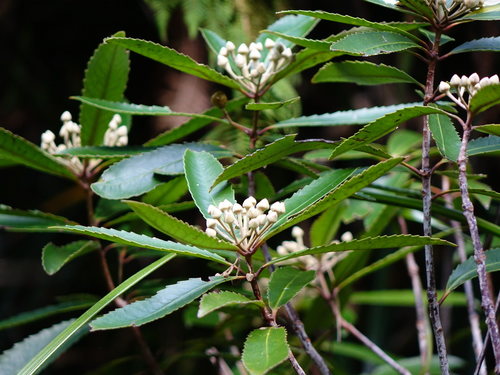
Sign in to saveIxerba brexioides, the sole species in the genus Ixerba, is a bushy tree with thick, narrow, serrated, dark green leaves and panicles of white flowers with a green heart. The fruit is a green capsule that splits open to reveal the black seeds partly covered with a fleshy scarlet aril against the white inside of the fruit. Ixerba is endemic to the northern half of the North Island of New Zealand. Common names used in New Zealand are tawari (or tāwari) for the tree and whakou when in flower. It is assigned to the family Strasburgeriaceae.
Species
Tāwari
GENUS
- KingdomPlantae
- PhylumTracheophyta
- ClassMagnoliopsida
- OrderCrossosomatales
- FamilyIxerbaceae
via GBIF
Museum specimens
- Specimen records
- 9
- With media
- 5
- Family
- Strasburgeriaceae
- Collections
- RSA, BRIT, BPBM
- Recorded in
- New Zealand
Wikidata facts
- Instance of
- taxon
- Parent taxon
- Strasburgeriaceae
- Image
- Ixerba brexioides.jpg
Show 5 more facts
- taxon name
- Ixerba
- taxon rank
- genus
- Commons category
- Ixerba
- topic's main category
- Category:Ixerba
Sources (1)
via Wikidata · CC0
~8 min read
Encyclopedic overview
13 sectionsContents
- Description
- Stem and leaves
- Flowers
- Fruit and seed
- Taxonomy
- Phylogeny
- Etymology
- Distribution
- Ecology
- Use
- Cultivation
- External sources
- References
Ixerba brexioides, the sole species in the genus Ixerba, is a bushy tree with thick, narrow, serrated, dark green leaves and panicles of white flowers with a green heart. The fruit is a green capsule that splits open to reveal the black seeds partly covered with a fleshy scarlet aril against the white inside of the fruit. Ixerba is endemic to the northern half of the North Island of New Zealand. Common names used in New Zealand are tawari (or tāwari) for the tree and whakou when in flower. It is assigned to the family Strasburgeriaceae.
== Description == === Stem and leaves === Tawari is a small tree of up to 10 m high with a spreading crown. The trunk is usually between 2–4 dm in diameter, and covered by a thick grayish brown bark that acts as a buffer. Young branches have few flat-lying pale unicellular T-hairs, while the peduncles, pedicels, sepals and petals are thickly covered in such hairs, giving them a felty look. The leaves are alternately positioned along the stem and often almost create a whorl at the end of a growth period, with the bud at the end covered in stout triangular scales. These scales have entire margins fringed with simple single celled hairs. The first leaves to appear when growth recommences are an intermediate series between schales and full leaves. Stipules at the base of the leaf stem are absent. The leaf stalk is stout, fleshy and about 2 cm long. The somewhat fleshy and distinctly leathery simple leaf blades are yellowish to dark green on top and pale green beneath and measure 6-16 × 1–4 cm, are lanceolate to elliptic in shape, while the widest point may be at or beyond midlength, with a pointy tip, and the edges are coarsely serrated. A small gland is present at the tip of each tooth. Young leaves are often reddish and have rolled-in margins. Leaves on young shoots may be relatively narrower. Old leaves discolor to orange or red.
Excerpted from Wikipedia’s “Ixerba” article, available under the CC BY-SA 4.0 licence.